The impact of exercise and dietary interventions on circulating leptin and adiponectin in individuals who are overweight and those with obesity: A systematic review and meta-analysis
Systematic review and meta-analysisMixed results
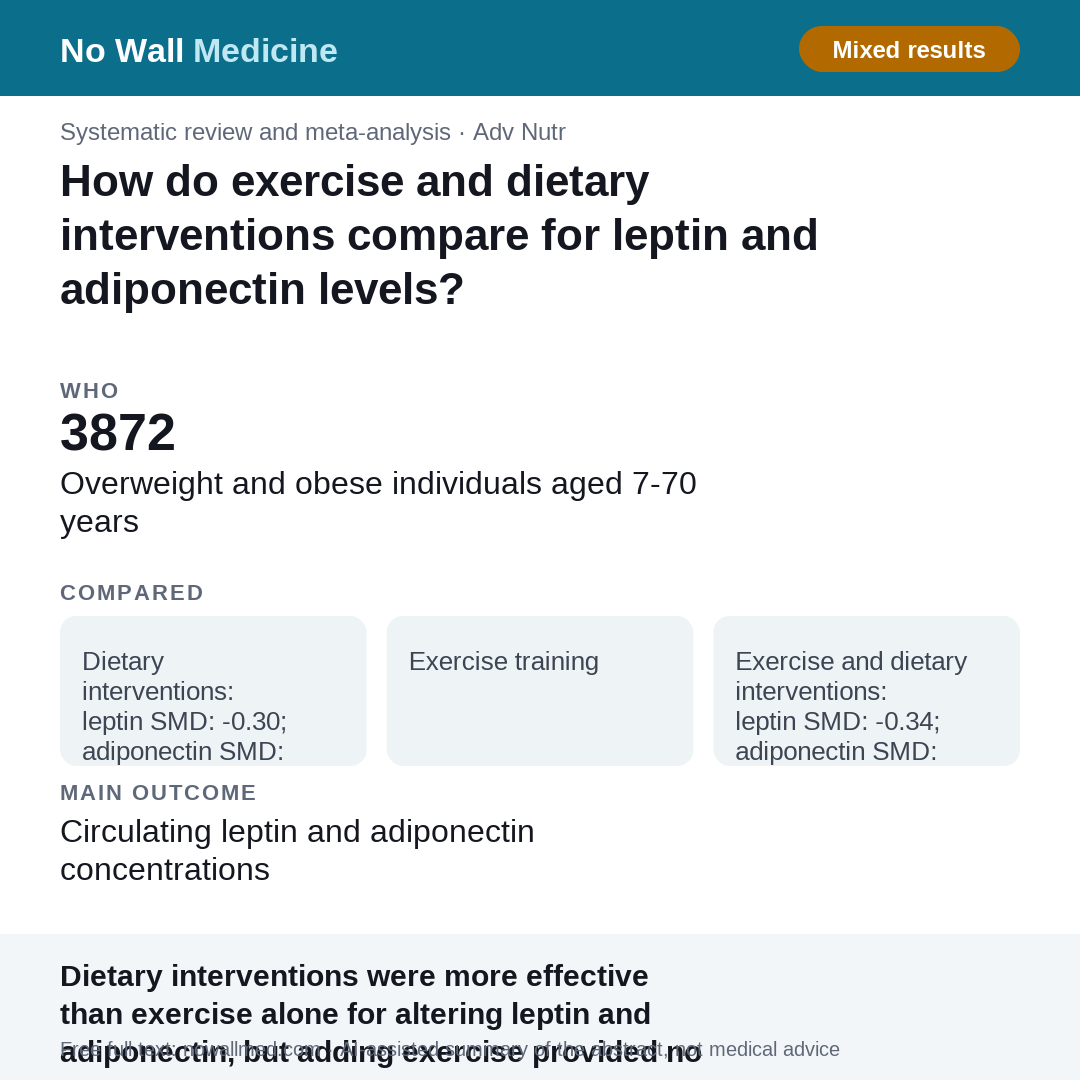
How do exercise and dietary interventions compare for leptin and adiponectin levels?
Who
3872
Overweight and obese individuals aged 7-70 years
Compared
Dietary interventions: leptin SMD: -0.30; adiponectin SMD: 0.23
Exercise training
Exercise and dietary interventions: leptin SMD: -0.34; adiponectin SMD: 0.37
Main outcome
Circulating leptin and adiponectin concentrations
Bottom line: Dietary interventions were more effective than exercise alone for altering leptin and adiponectin, but adding exercise provided no extra benefit.
Limitation: Age, BMI, duration, supervision, study quality, and energy restriction were sources of heterogeneity.
Adv Nutr · 2022-12-15Download image
Clinical question: How do exercise and dietary interventions compare for leptin and adiponectin levels?
Abstract
The effects of exercise training (Ex), dietary interventions (DIs), and a combination of Ex and DI (Ex + DI) on leptin and adiponectin have been established. However, less is known regarding the comparisons of Ex with DI and of Ex + DI with either Ex or DI alone. The aim of the present meta-analysis is to compare the effects of Ex with those of DI and those of Ex + DI with those of either Ex or DI alone on circulating leptin and adiponectin in individuals who are overweight and those with obesity. PubMed, Web of Science, and MEDLINE were searched to identify original articles, published through June 2022, that compared the effects of Ex with those of DI and/or the effects of Ex + DI with those of Ex and/or DI on leptin and adiponectin in individuals with BMIs (in kg/m2) of ≥25 and aged 7-70 y. Standardized mean differences (SMDs), weighted mean differences, and 95% CIs were calculated using random-effect models for outcomes. Forty-seven studies, comprising 3872 participants who were overweight and those with obesity, were included in the current meta-analysis. DI reduced the concentration of leptin (SMD: -0.30; P = 0.001) and increased the concentration of adiponectin (SMD: 0.23; P = 0.001) compared with Ex, as did Ex + DI (leptin: SMD: -0.34; P = 0.001; adiponectin: SMD: 0.37; P = 0.004) compared with Ex alone. However, Ex + DI did not affect the concentration of adiponectin (SMD: 0.10; P = 0.11) and led to inconsistent and nonsignificant changes in the concentration of leptin (SMD: -0.13; P = 0.06) compared with DI alone. Subgroup analyses showed that age, BMI, duration of intervention, type of supervision, quality of the study, and magnitude of energy restriction are sources of heterogeneity. Our results suggest that Ex alone was not as effective as DI or Ex + DI for decreasing leptin and increasing adiponectin in individuals with overweight and obesity. However, Ex + DI was not more effective than DI alone, suggesting that diet plays a critical role in beneficially altering the concentrations of leptin and adiponectin. This review was registered at PROSPERO as CRD42021283532.
Subject terms
Cite this article
Khalafi M, Hossein Sakhaei M, Kheradmand S, Symonds ME, Rosenkranz SK. The impact of exercise and dietary interventions on circulating leptin and adiponectin in individuals who are overweight and those with obesity: A systematic review and meta-analysis. Adv Nutr. 2022. doi:10.1016/j.advnut.2022.10.001
Spotted a mistake? Suggest a correction
Top studies every Monday
The week’s key trials and guidelines in your specialties, plus any topics you follow. By email, free.
Get the weekly digest