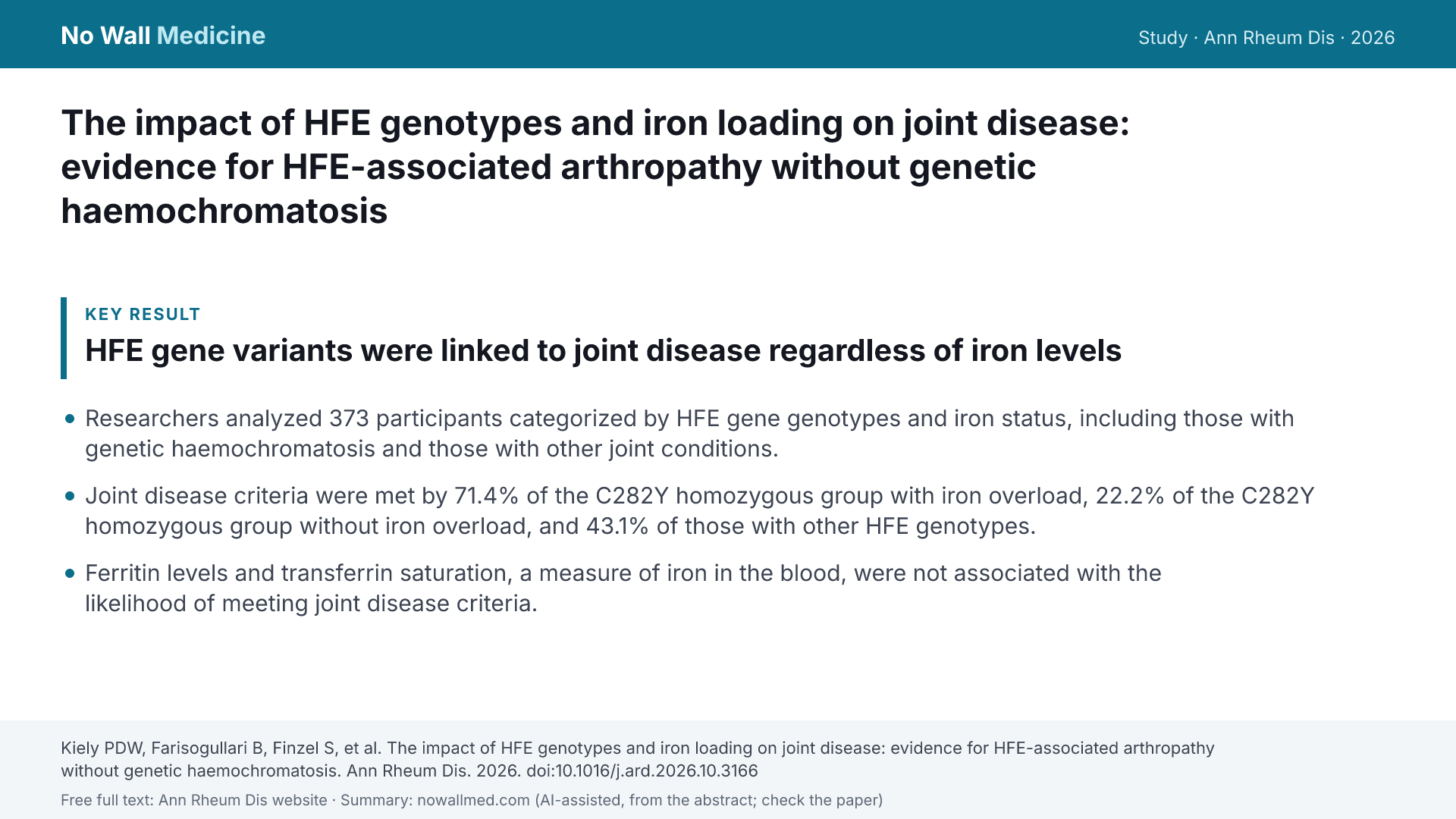
HFE gene variants were linked to joint disease regardless of iron levels
The impact of HFE genotypes and iron loading on joint disease: evidence for HFE-associated arthropathy without genetic haemochromatosis
Key points
- Researchers analyzed 373 participants categorized by HFE gene genotypes and iron status, including those with genetic haemochromatosis and those with other joint conditions.
- Joint disease criteria were met by 71.4% of the C282Y homozygous group with iron overload, 22.2% of the C282Y homozygous group without iron overload, and 43.1% of those with other HFE genotypes.
- Ferritin levels and transferrin saturation, a measure of iron in the blood, were not associated with the likelihood of meeting joint disease criteria.
Study type: Observational study: it can show a link, but not prove that one thing causes another.
Headline and key points written with AI from the paper’s abstract, with every number checked against it. Read the paper before relying on them.
Was this summary helpful?
Headline, design, result, key points, caveat and citation as plain text.
Cite this article
Kiely PDW, Farisogullari B, Finzel S, et al. The impact of HFE genotypes and iron loading on joint disease: evidence for HFE-associated arthropathy without genetic haemochromatosis. Ann Rheum Dis. 2026. doi:10.1016/j.ard.2026.10.3166
Spotted a mistake? Suggest a correction