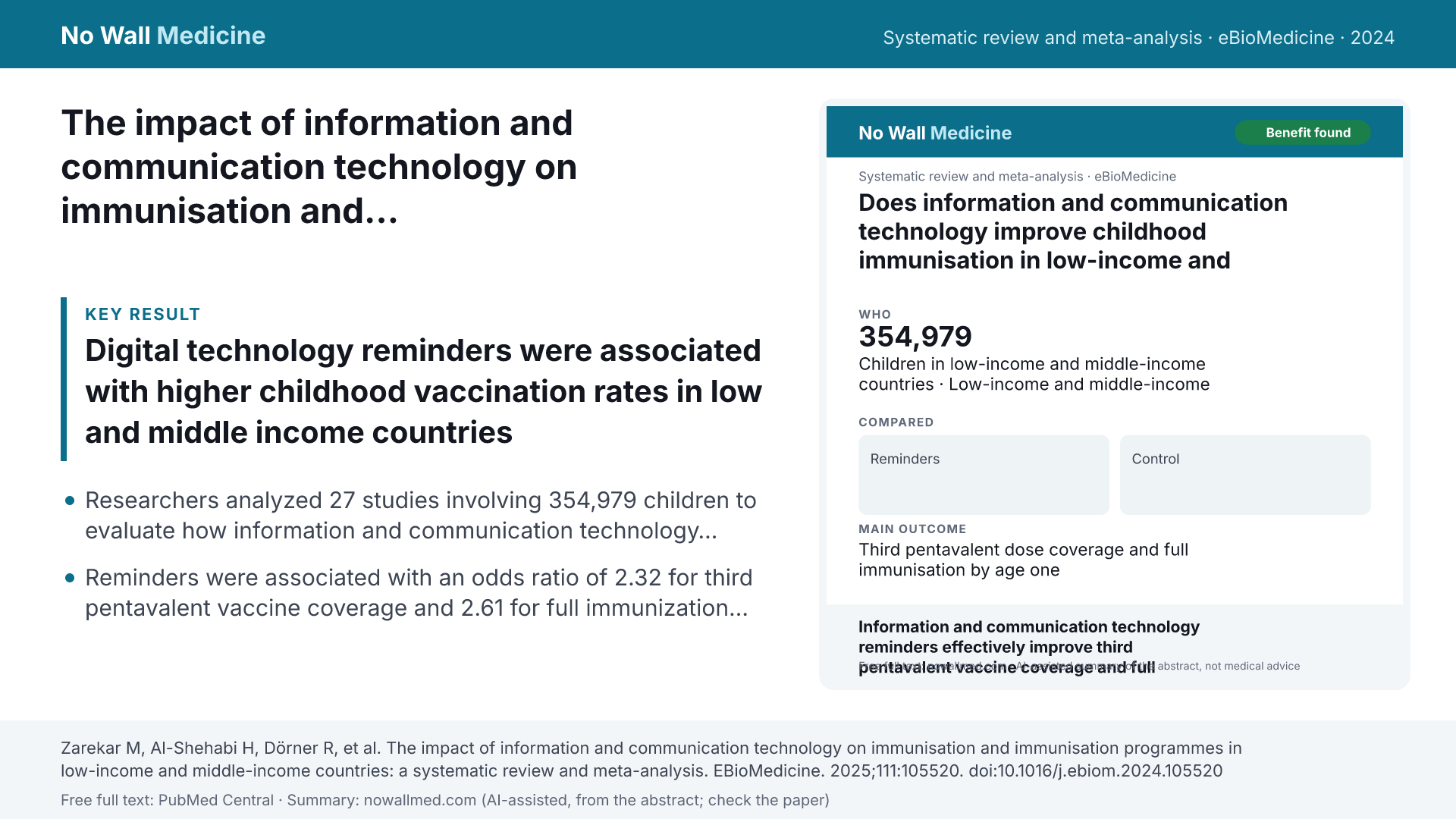
The impact of information and communication technology on immunisation and immunisation programmes in low-income and middle-income countries: a systematic review and meta-analysis
Key result: Digital technology reminders were associated with higher childhood vaccination rates in low and middle income countries
Key points
- Researchers analyzed 27 studies involving 354,979 children to evaluate how information and communication technology affects vaccine delivery.
- Reminders were associated with an odds ratio of 2.32 for third pentavalent vaccine coverage and 2.61 for full immunization by age one.
- Most studies showed technology was linked to better record accuracy, more adverse event reporting, and fewer vaccine stockouts.
Limitation the authors note: Main concerns for bias in randomized controlled trials included unblinded outcome assessors and intervention providers.
Discussion prompts
- Would these patients look like yours? Who was left out?
- Is the main outcome one that matters to patients?
- Is the difference large enough to change what you do?
Cite: Zarekar M, Al-Shehabi H, Dörner R, et al. The impact of information and communication technology on immunisation and immunisation programmes in low-income and middle-income countries: a systematic review and meta-analysis. EBioMedicine. 2025;111:105520. doi:10.1016/j.ebiom.2024.105520
Free full text: PubMed Central · Summary and visual abstract: nowallmed.com/a/the-impact-of-information-and-communication-technology-on-g33xzc/ (AI-assisted from the abstract; check the paper before relying on it).