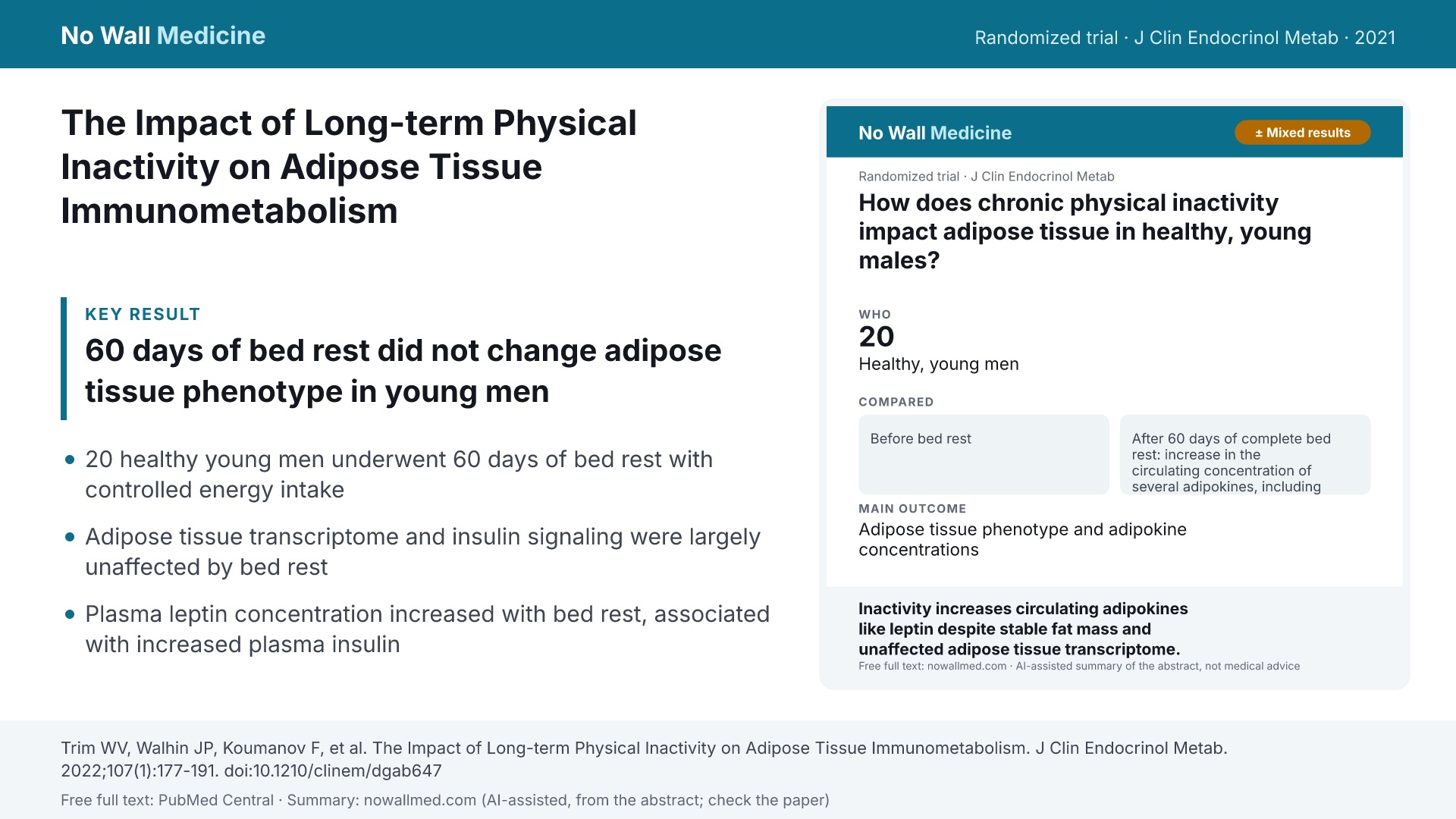
60 days of bed rest did not change adipose tissue phenotype in young men
The Impact of Long-term Physical Inactivity on Adipose Tissue Immunometabolism
Randomized trialMixed results
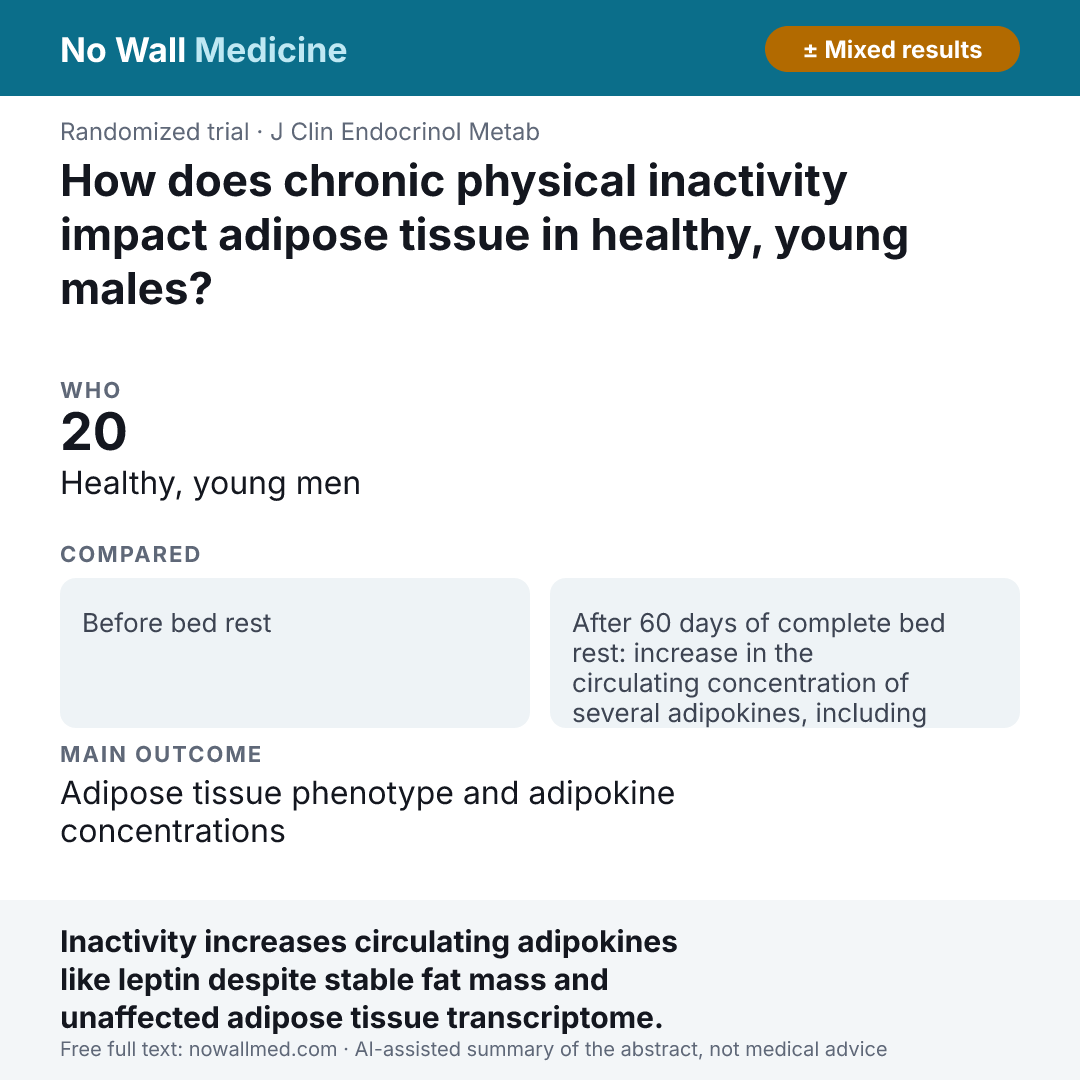
How does chronic physical inactivity impact adipose tissue in healthy, young males?
Who
20
Healthy, young men
Compared
Before bed rest
After 60 days of complete bed rest: increase in the circulating concentration of several adipokines, including plasma leptin
Main outcome
Adipose tissue phenotype and adipokine concentrations
Bottom line: Inactivity increases circulating adipokines like leptin despite stable fat mass and unaffected adipose tissue transcriptome.
Limitation: Energy intake was reduced to maintain energy balance and fat mass.
J Clin Endocrinol Metab · 2021-09-05 · Save PNG
Clinical question: How does chronic physical inactivity impact adipose tissue in healthy, young males?
Key points
- 20 healthy young men underwent 60 days of bed rest with controlled energy intake.
- Adipose tissue transcriptome and insulin signaling were largely unaffected by bed rest.
- Plasma leptin concentration increased with bed rest, associated with increased plasma insulin.
Headline and key points written with AI from the paper’s abstract, with every number checked against it. Read the paper before relying on them.
Was this summary helpful?
Subject terms
Headline, design, result, key points, caveat and citation as plain text.
Cite this article
Trim WV, Walhin JP, Koumanov F, et al. The Impact of Long-term Physical Inactivity on Adipose Tissue Immunometabolism. J Clin Endocrinol Metab. 2022;107(1):177-191. doi:10.1210/clinem/dgab647
Spotted a mistake? Suggest a correction