Choice of reference standard changes accuracy results for carpal tunnel syndrome diagnostic tests
The Impact of Reference Standard on Diagnostic Testing Characteristics for Carpal Tunnel Syndrome: A Systematic Review
Systematic reviewMixed results
How does the reference standard impact diagnostic accuracy for carpal tunnel syndrome?
Who
113
Studies evaluating carpal tunnel syndrome diagnostic modalities
Compared
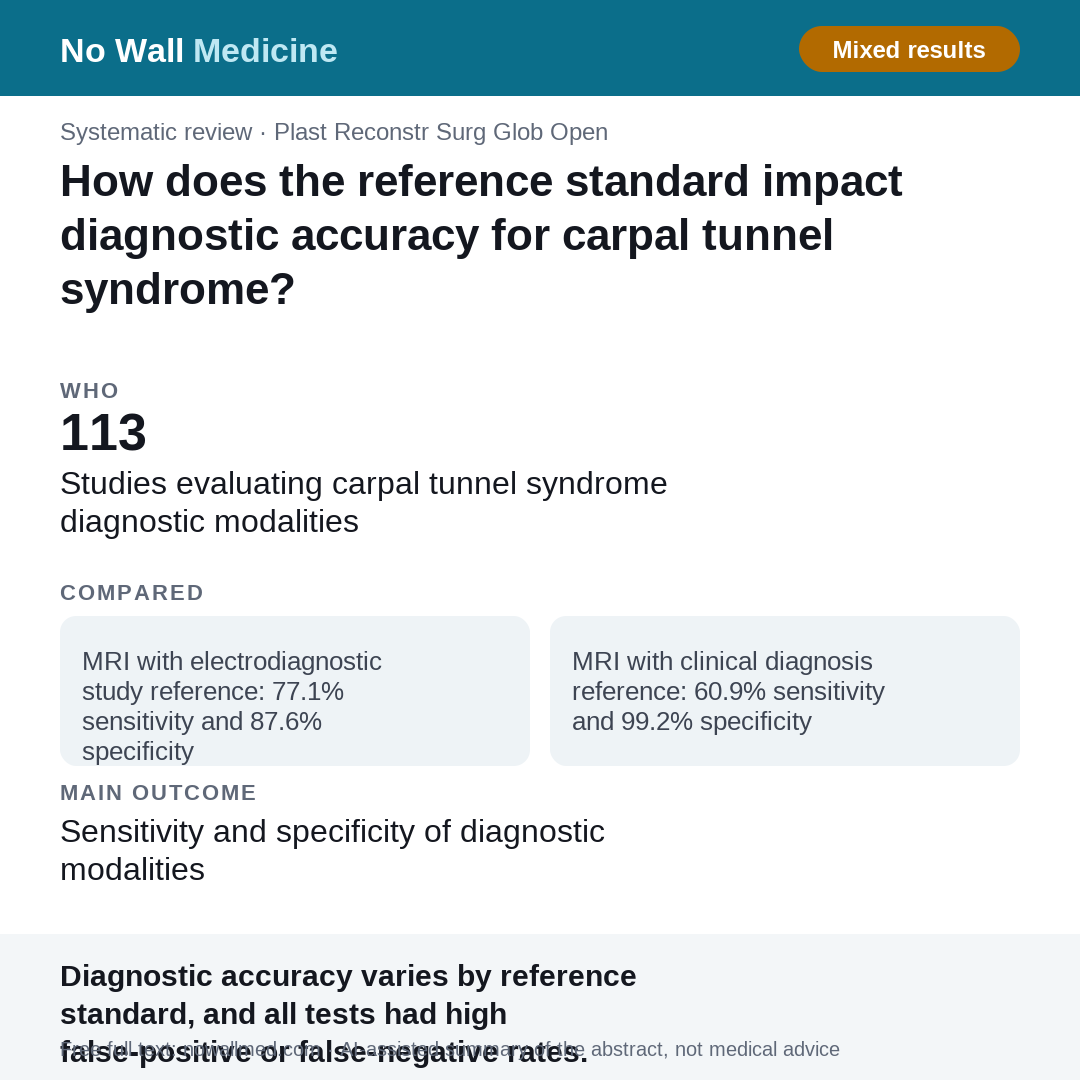
MRI with electrodiagnostic study reference: 77.1% sensitivity and 87.6% specificity
MRI with clinical diagnosis reference: 60.9% sensitivity and 99.2% specificity
Main outcome
Sensitivity and specificity of diagnostic modalities
Bottom line: Diagnostic accuracy varies by reference standard, and all tests had high false-positive or false-negative rates.
Plast Reconstr Surg Glob Open · 2023-07-03Download image
Clinical question: How does the reference standard impact diagnostic accuracy for carpal tunnel syndrome?
Why it matters: The accuracy of diagnostic tests for carpal tunnel syndrome may be impacted by the lack of a single reliable reference standard.
Key points
- Researchers reviewed 113 studies to compare how different reference standards affect the accuracy of carpal tunnel syndrome diagnostic tools.
- When using electrodiagnostic studies as the reference standard, magnetic resonance imaging (MRI) sensitivity was 77.1% compared to 60.9% for clinical diagnosis.
- All tests, including ultrasound and electrodiagnostic studies, had false-positive or false-negative rates of at least 10% regardless of the reference standard.
Headline and key points written with AI from the paper’s abstract, with every number checked against it. Read the paper before relying on them.
Was this summary helpful?
Cite this article
Bennett OM, Sears ED. The Impact of Reference Standard on Diagnostic Testing Characteristics for Carpal Tunnel Syndrome: A Systematic Review. Plast Reconstr Surg Glob Open. 2023. doi:10.1097/GOX.0000000000005067
Spotted a mistake? Suggest a correction
Top studies every Monday
The week’s key trials and guidelines in your specialties, plus any topics you follow. By email, free.
Get the weekly digest