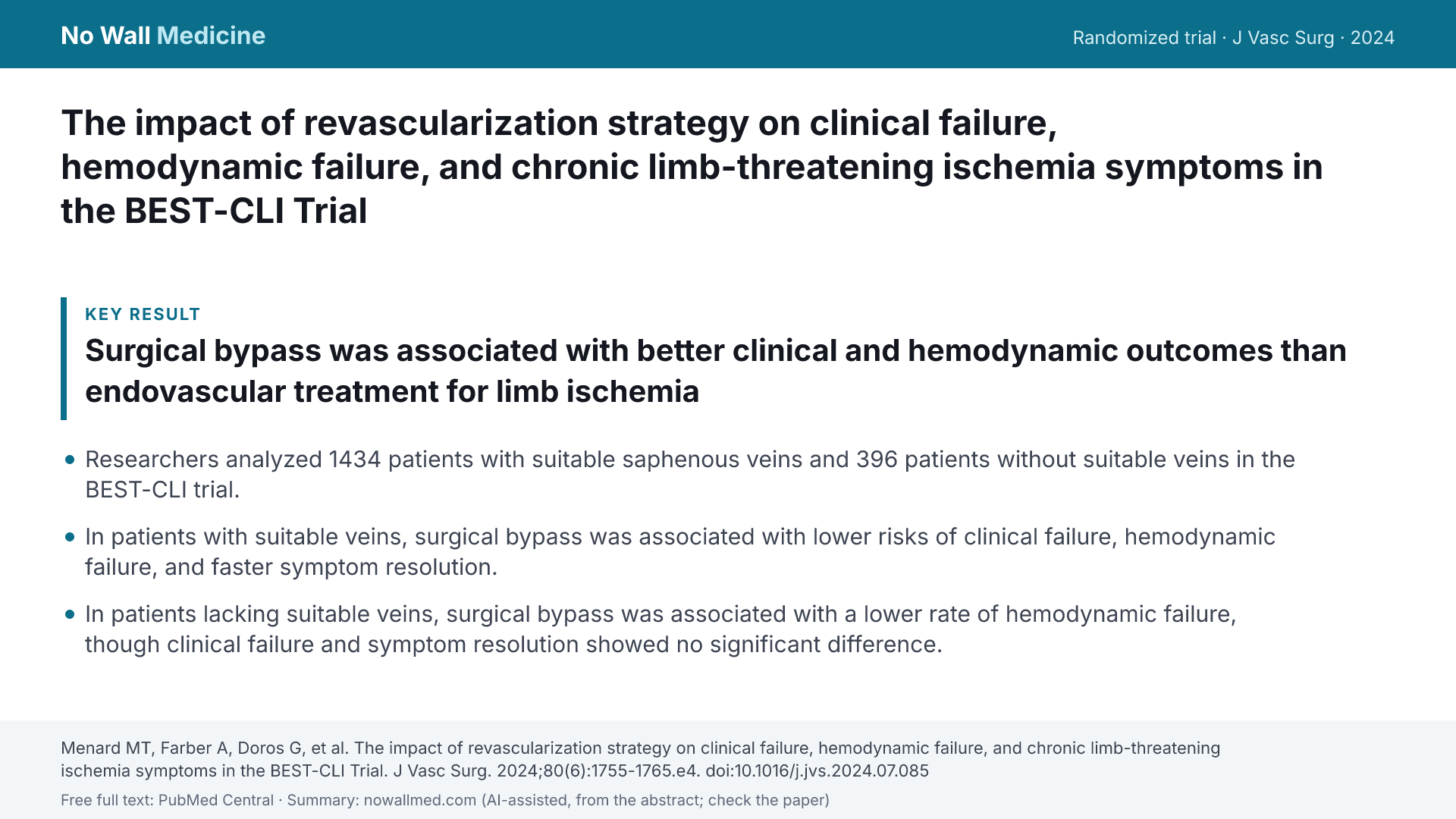
The impact of revascularization strategy on clinical failure, hemodynamic failure, and chronic limb-threatening ischemia symptoms in the BEST-CLI Trial
Key result: Surgical bypass was associated with better clinical and hemodynamic outcomes than endovascular treatment for limb ischemia
Key points
- Researchers analyzed 1434 patients with suitable saphenous veins and 396 patients without suitable veins in the BEST-CLI trial.
- In patients with suitable veins, surgical bypass was associated with lower risks of clinical failure, hemodynamic failure, and faster symptom resolution.
- In patients lacking suitable veins, surgical bypass was associated with a lower rate of hemodynamic failure, though clinical failure and symptom resolution showed no significant difference.
Discussion prompts
- Would these patients look like yours? Who was left out?
- Is the main outcome one that matters to patients?
- Is the difference large enough to change what you do?
Cite: Menard MT, Farber A, Doros G, et al. The impact of revascularization strategy on clinical failure, hemodynamic failure, and chronic limb-threatening ischemia symptoms in the BEST-CLI Trial. J Vasc Surg. 2024;80(6):1755-1765.e4. doi:10.1016/j.jvs.2024.07.085
Free full text: PubMed Central · Summary and visual abstract: nowallmed.com/a/the-impact-of-revascularization-strategy-on-clinical-failure-5eo9ve/ (AI-assisted from the abstract; check the paper before relying on it).