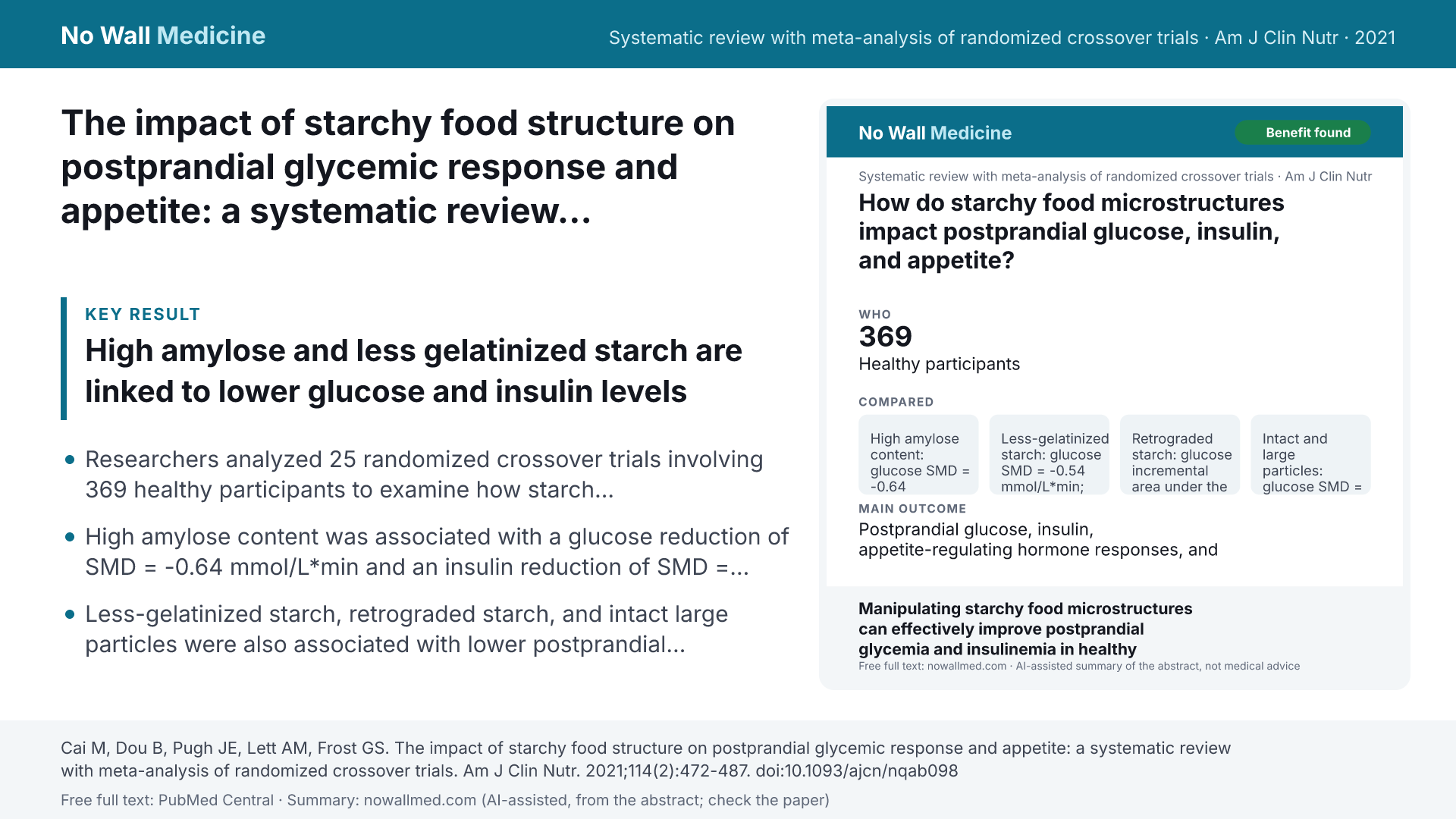
High amylose and less gelatinized starch are linked to lower glucose and insulin levels
The impact of starchy food structure on postprandial glycemic response and appetite: a systematic review with meta-analysis of randomized crossover trials
Systematic review with meta-analysis of randomized crossover trialsBenefit found
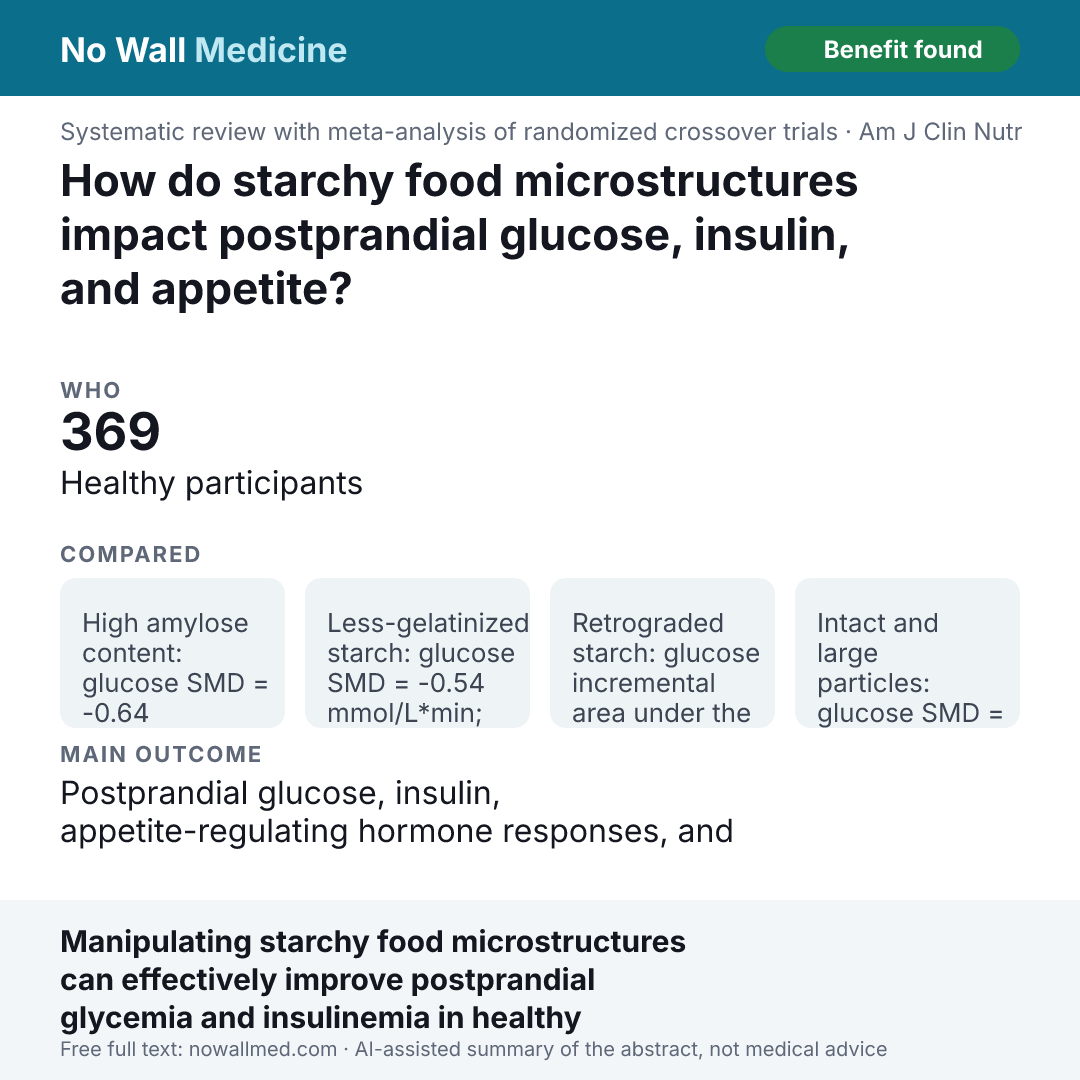
How do starchy food microstructures impact postprandial glucose, insulin, and appetite?
Who
369
Healthy participants
Compared
High amylose content: glucose SMD = -0.64 mmol/L*min; insulin SMD = -0.81 pmol/L*min
Less-gelatinized starch: glucose SMD = -0.54 mmol/L*min; insulin SMD = -0.48 pmol/L*min
Retrograded starch: glucose incremental area under the curve SMD = -0.46 pmol/L*min
Intact and large particles: glucose SMD = -0.43 mmol/L*min; insulin SMD = -0.63 pmol/L*min
Main outcome
Postprandial glucose, insulin, appetite-regulating hormone responses, and subjective satiety
Bottom line: Manipulating starchy food microstructures can effectively improve postprandial glycemia and insulinemia in healthy individuals.
Am J Clin Nutr · 2021-05-29 · PROSPERO CRD42020190873
Headline and visual abstract written with AI from the paper’s abstract, with every number checked against it. Read the paper before relying on them.
Was this summary helpful?
Subject terms
Cite this article
Cai M, Dou B, Pugh JE, Lett AM, Frost GS. The impact of starchy food structure on postprandial glycemic response and appetite: a systematic review with meta-analysis of randomized crossover trials. Am J Clin Nutr. 2021;114(2):472-487. doi:10.1093/ajcn/nqab098
Spotted a mistake? Suggest a correction