Interactive education increased knowledge and attitudes toward advance care planning in psychiatric patients
The influence of an interactive educational approach on advance care planning counseling in individuals with psychiatric disorders
Randomized trialMixed results
Does an interactive educational approach influence advance care planning in individuals with psychiatric disorders?
Who
90
Individuals with psychiatric disorders · Taiwan
Compared
Control group
Intervention group: Knowledge improved by 3.31 points (p < 0.001) and Attitude by 4.91 points (p < 0.001)
Main outcome
Knowledge, attitudes, and intent to sign advance decisions
Bottom line: Interactive education significantly enhances knowledge and attitudes toward advance care planning but does not significantly impact intention to sign.
BMC Palliat Care · 2025-03-24Download image
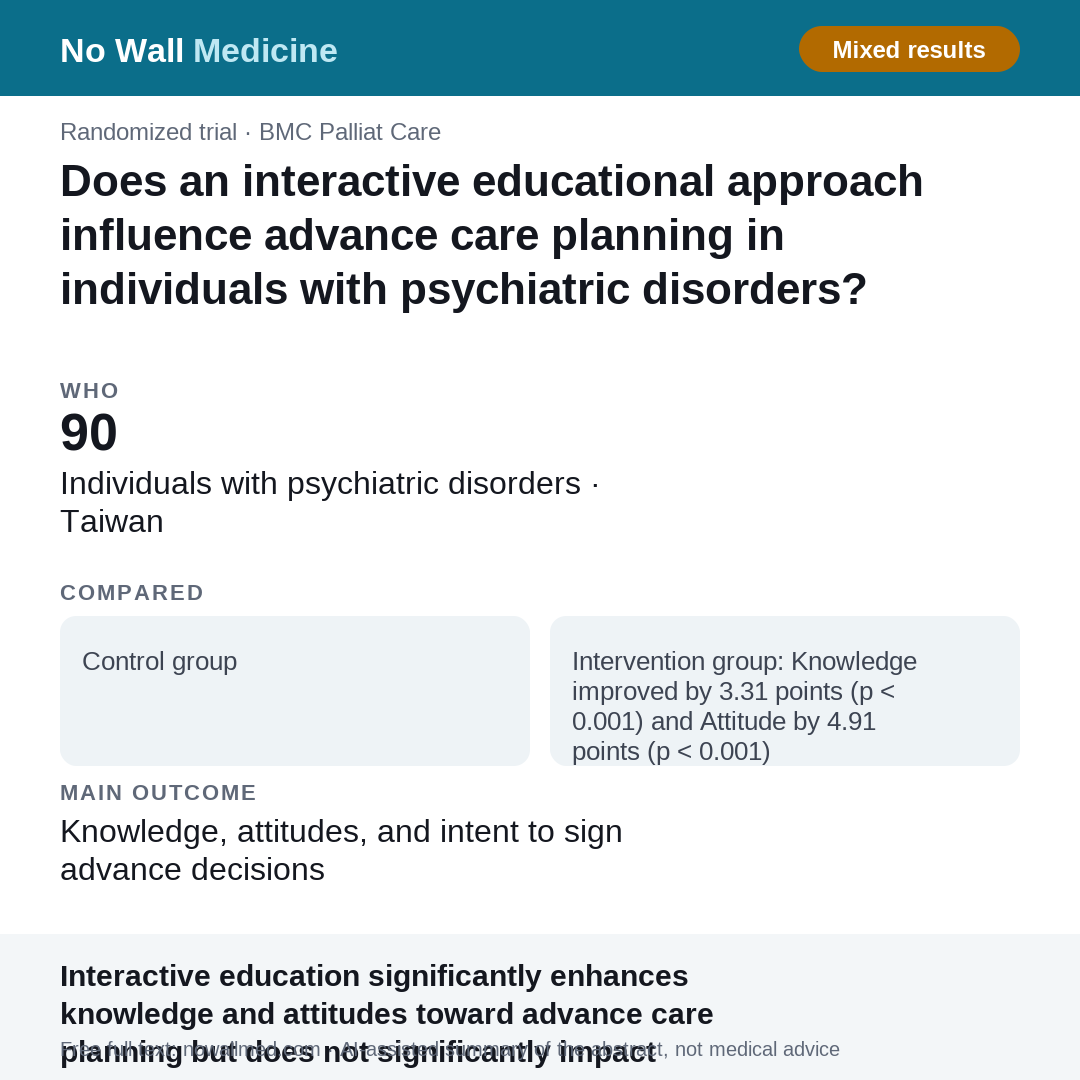
Clinical question: Does an interactive educational approach influence advance care planning in individuals with psychiatric disorders?
Why it matters: It was unknown if an interactive educational approach could enhance comprehension, attitudes, and intentions regarding advance care planning among individuals with psychiatric disorders.
Key points
- Researchers conducted a randomized trial with 90 participants, comparing a standard self-care curriculum to an interactive educational approach involving six bi-weekly sessions.
- The intervention group showed improvements in knowledge by 3.31 points (p < 0.001) and attitude by 4.91 points (p < 0.001).
- The increase in the intention to sign advance decisions was 0.73 points (p = 0.222), which was not statistically significant.
Headline and key points written with AI from the paper’s abstract, with every number checked against it. Read the paper before relying on them.
Was this summary helpful?
Subject terms
Cite this article
Chen YC, Chu FY, Chang LY, Hsieh MY, Lee CH. The influence of an interactive educational approach on advance care planning counseling in individuals with psychiatric disorders. BMC Palliat Care. 2025. doi:10.1186/s12904-025-01723-4
Spotted a mistake? Suggest a correction
Top studies every Monday
The week’s key trials and guidelines in your specialties, plus any topics you follow. By email, free.
Get the weekly digest