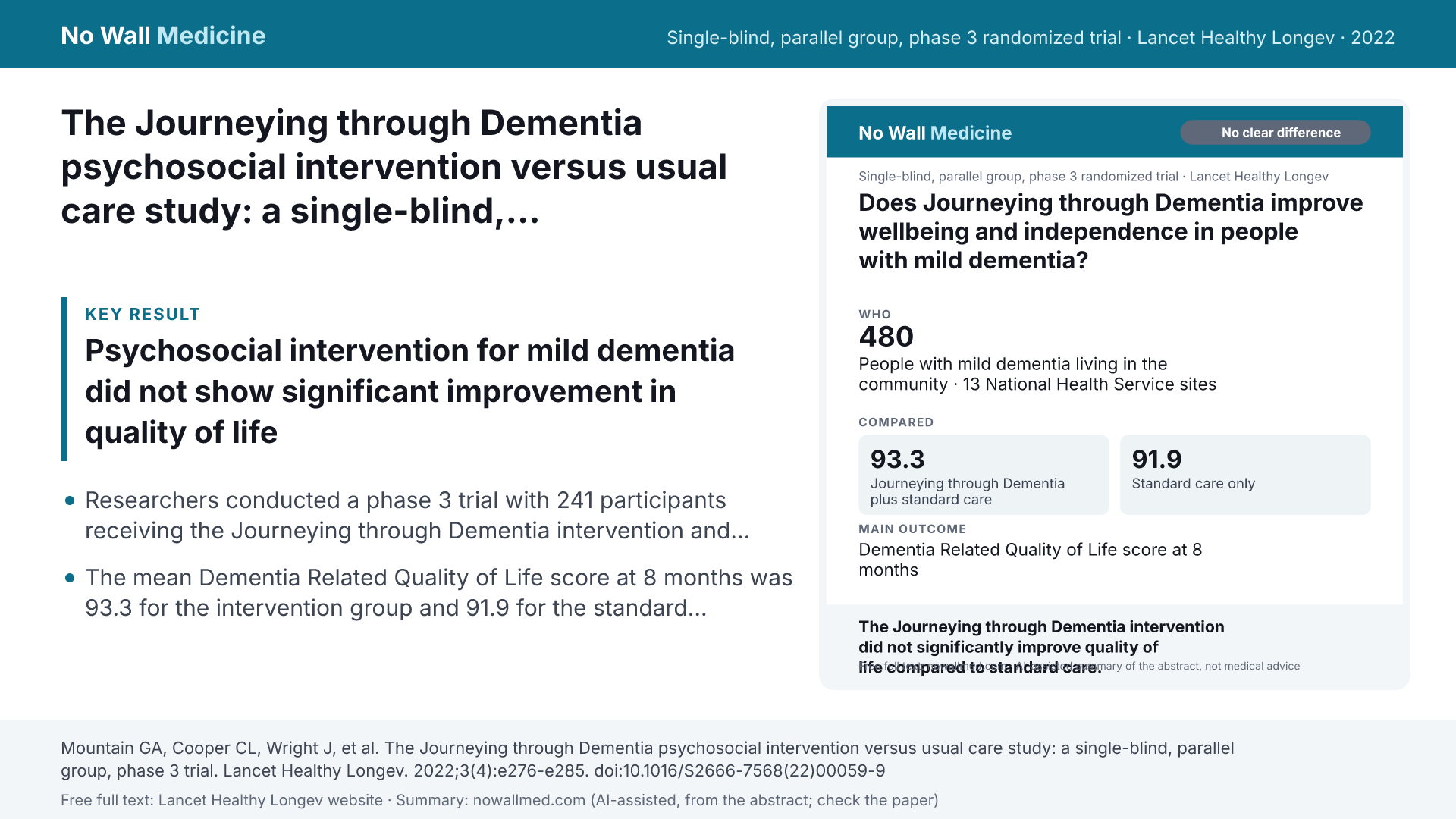
Psychosocial intervention for mild dementia did not show significant improvement in quality of life
The Journeying through Dementia psychosocial intervention versus usual care study: a single-blind, parallel group, phase 3 trial
Single-blind, parallel group, phase 3 randomized trialNo clear difference
Does Journeying through Dementia improve wellbeing and independence in people with mild dementia?
Who
480
People with mild dementia living in the community · 13 National Health Service sites across England
Compared
93.3Journeying through Dementia plus standard care (SD 13.0)
91.9Standard care only (SD 14.6)
Main outcome
Dementia Related Quality of Life score at 8 months
Result: difference in means 0.9 (95% CI -1.2 to 3.0)
Bottom line: The Journeying through Dementia intervention did not significantly improve quality of life compared to standard care.
Limitation: More research into methods of measuring small, meaningful changes in this population is needed.
Funded by: UK National Institute of Health Research Health Technology Assessment Programme
Lancet Healthy Longev · 2022-04-04 · Save PNG
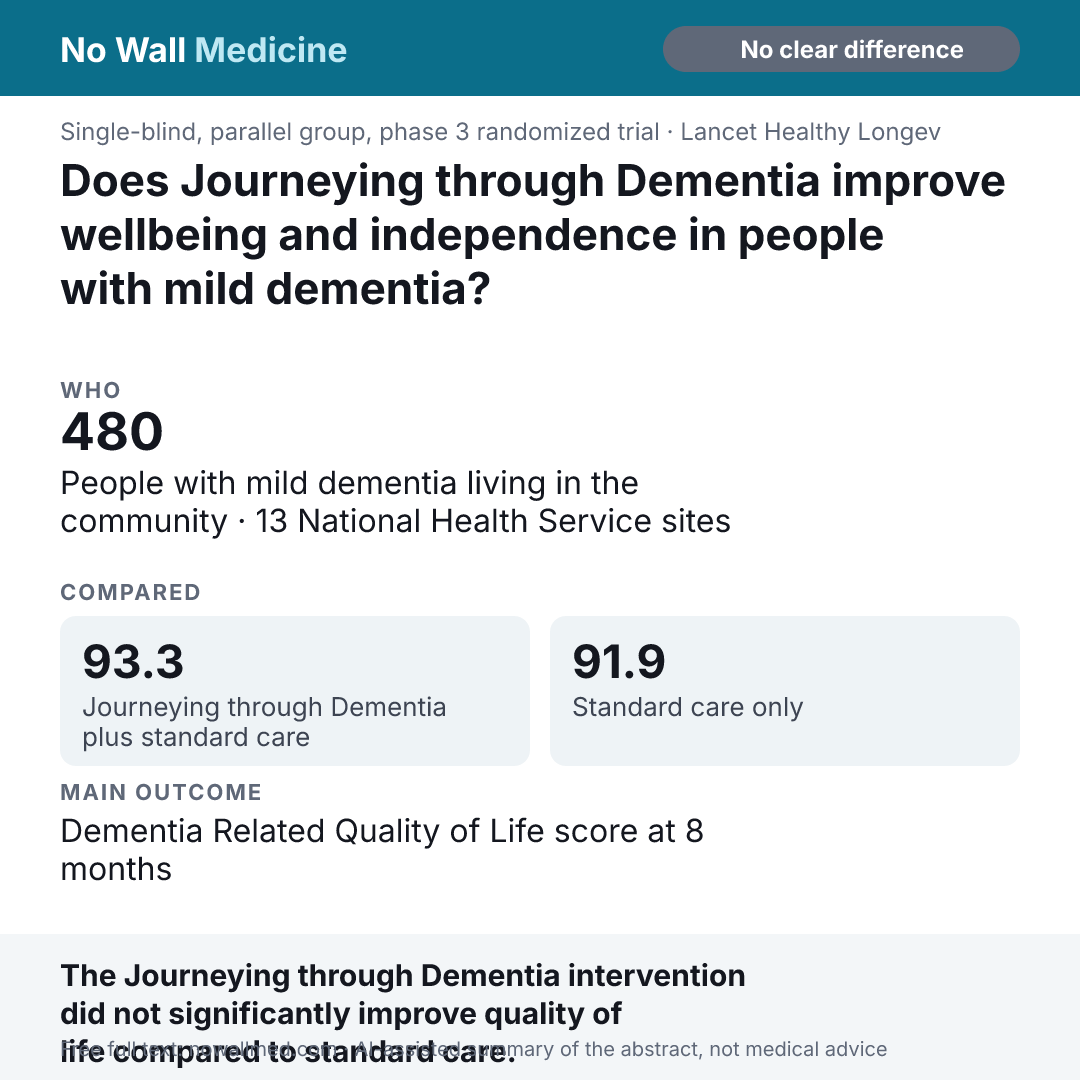
Clinical question: Does Journeying through Dementia improve wellbeing and independence in people with mild dementia?
Why it matters: There is an urgent clinical need for evidence-based psychosocial interventions that promote wellbeing and independence in people with mild dementia.
Key points
- Researchers conducted a phase 3 trial with 241 participants receiving the Journeying through Dementia intervention and 239 participants receiving standard care.
- The mean Dementia Related Quality of Life score at 8 months was 93.3 for the intervention group and 91.9 for the standard care group.
- The difference in mean scores was 0.9 (95% CI -1.2 to 3.0; p=0.38), which was not statistically significant and was lower than the clinically meaningful threshold.
Limitation the authors note: The authors state that more research is needed into methods of measuring small, meaningful changes in this population.
Headline and key points written with AI from the paper’s abstract, with every number checked against it. Read the paper before relying on them.
Was this summary helpful?
Abstract
Background
There is an urgent clinical need for evidence-based psychosocial interventions for people with mild dementia. We aimed to determine the clinical benefits and cost-effectiveness of Journeying through Dementia (JtD), an intervention designed to promote wellbeing and independence in people with mild dementia. Methods
We did a single-blind, parallel group, individually randomised, phase 3 trial at 13 National Health Service sites across England. People with mild dementia (Mini-Mental State Examination score of ≥18) who lived in the community were eligible for inclusion. Patients were centrally randomly assigned (1:1) to receive the JtD intervention plus standard care (JtD group) or standard care only (standard care group). Randomisation was stratified by study site. The JtD intervention included 12 group and four one-to-one sessions, delivered in the community at each site. The primary endpoint was Dementia Related Quality of Life (DEMQOL) 8 months after randomisation, assessed according to the intention-to-treat principle. Only outcome assessors were masked to group assignment. A cost-effectiveness analysis reported cost per quality-adjusted life-year (QALY) from a UK NHS and social care perspective. The study is registered with ISRCTN, ISRCTN17993825. Findings
Between Nov 30, 2016, and Aug 31, 2018, 1183 patients were screened for inclusion, of whom 480 (41%) participants were randomly assigned: 241 (50%) to the JtD group and 239 (50%) to the standard care group. Intervention adherence was very good: 165 (68%) of 241 participants in the JtD group attended at least ten of the 16 sessions. Mean DEMQOL scores at 8 months were 93·3 (SD 13·0) for the JtD group and 91·9 (SD 14·6) for the control group. Difference in means was 0·9 (95% CI -1·2 to 3·0; p=0·38) after adjustment for covariates, lower than that identified as clinically meaningful. Incremental cost per QALY ranged from £88 000 to -£205 000, suggesting that JtD was not cost-effective. Unrelated serious adverse events were reported by 40 (17%) patients in the JtD group and 35 (15%) patients in the standard care group. Interpretation
In common with other studies, the JtD intervention was not proven effective. However, this complex trial successfully recruited and retained people with dementia without necessarily involving carers. Additionally, people with dementia were actively involved as participants and study advisers throughout. More research into methods of measuring small, meaningful changes in this population is needed. Questions remain regarding how services can match the complex, diverse, and individual needs of people with mild dementia, and how interventions to meet such needs can be delivered at scale. Funding
UK National Institute of Health Research Health Technology Assessment Programme.
Abstract reproduced under the article’s CC BY NC ND licence.
Subject terms
Headline, design, result, key points, caveat and citation as plain text.
Cite this article
Mountain GA, Cooper CL, Wright J, et al. The Journeying through Dementia psychosocial intervention versus usual care study: a single-blind, parallel group, phase 3 trial. Lancet Healthy Longev. 2022;3(4):e276-e285. doi:10.1016/S2666-7568(22)00059-9
Spotted a mistake? Suggest a correction