The Metabolic Vulnerability Index: A Novel Marker for Mortality Prediction in Heart Failure
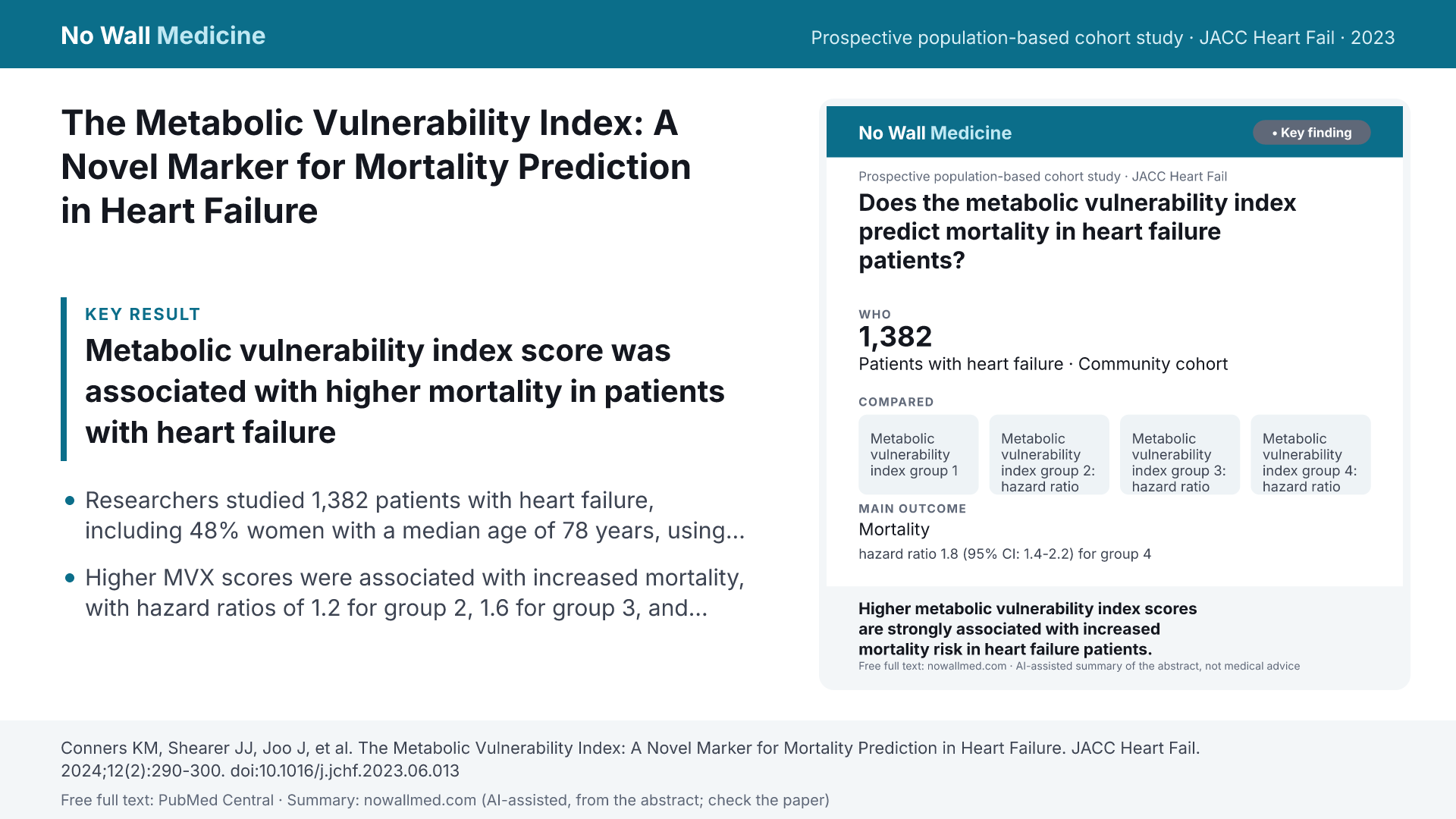
Key result: Metabolic vulnerability index score was associated with higher mortality in patients with heart failure
Prospective population-based cohort studyKey finding
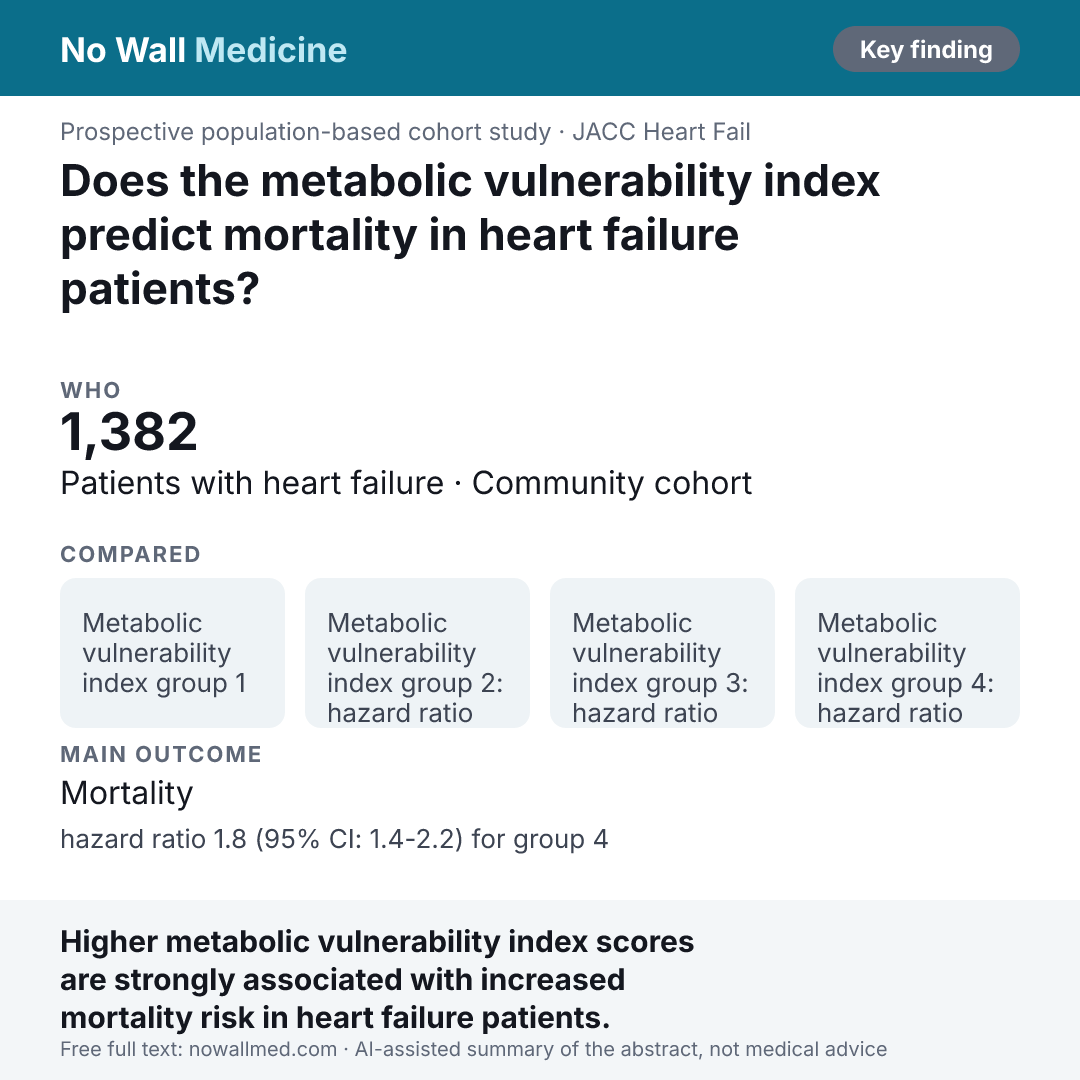
Does the metabolic vulnerability index predict mortality in heart failure patients?
Who
1,382
Patients with heart failure · Community cohort
Compared
Metabolic vulnerability index group 1
Metabolic vulnerability index group 2: hazard ratio 1.2 (95% CI: 0.9-1.4)
Metabolic vulnerability index group 3: hazard ratio 1.6 (95% CI: 1.3-2.0)
Metabolic vulnerability index group 4: hazard ratio 1.8 (95% CI: 1.4-2.2)
Main outcome
Mortality
Result: hazard ratio 1.8 (95% CI: 1.4-2.2) for group 4
Bottom line: Higher metabolic vulnerability index scores are strongly associated with increased mortality risk in heart failure patients.
JACC Heart Fail · 2023-07-19 · Save PNG
Key points
- Researchers studied 1,382 patients with heart failure, including 48% women with a median age of 78 years, using a metabolic vulnerability index (MVX) score.
- Higher MVX scores were associated with increased mortality, with hazard ratios of 1.2 for group 2, 1.6 for group 3, and 1.8 for group 4 compared to the lowest group.
- The MVX score was associated with mortality independently of the ejection fraction and the Meta-analysis Global Group in Chronic Heart Failure score.
Discussion prompts
- Would these patients look like yours? Who was left out?
- Is the main outcome one that matters to patients?
- Is the difference large enough to change what you do?
Cite: Conners KM, Shearer JJ, Joo J, et al. The Metabolic Vulnerability Index: A Novel Marker for Mortality Prediction in Heart Failure. JACC Heart Fail. 2024;12(2):290-300. doi:10.1016/j.jchf.2023.06.013
Free full text: PubMed Central · Summary and visual abstract: nowallmed.com/a/the-metabolic-vulnerability-index-a-novel-marker-for-mortality-1gzsqen/ (AI-assisted from the abstract; check the paper before relying on it).