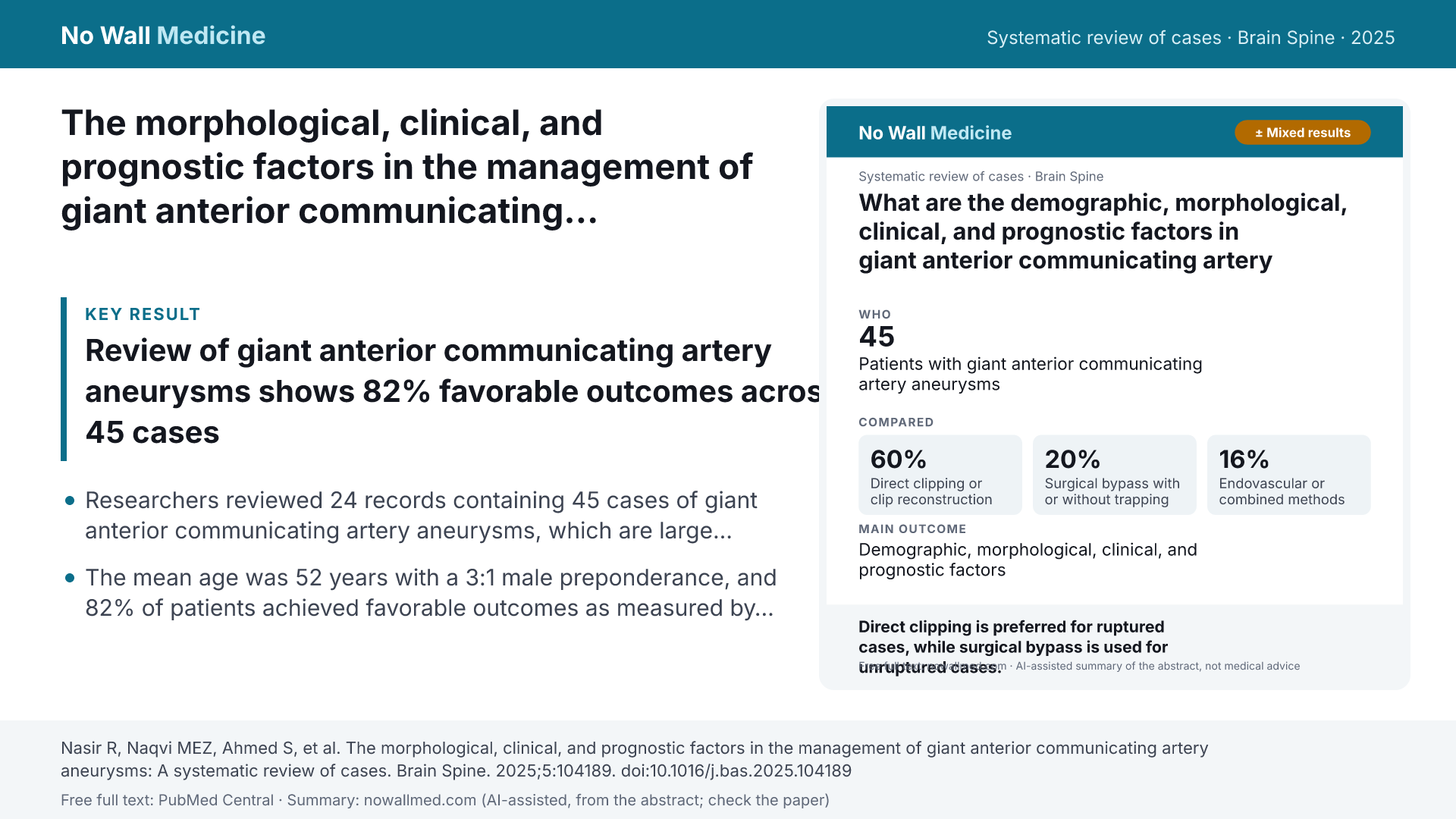
Review of giant anterior communicating artery aneurysms shows 82% favorable outcomes across 45 cases
The morphological, clinical, and prognostic factors in the management of giant anterior communicating artery aneurysms: A systematic review of cases
Systematic review of casesMixed results
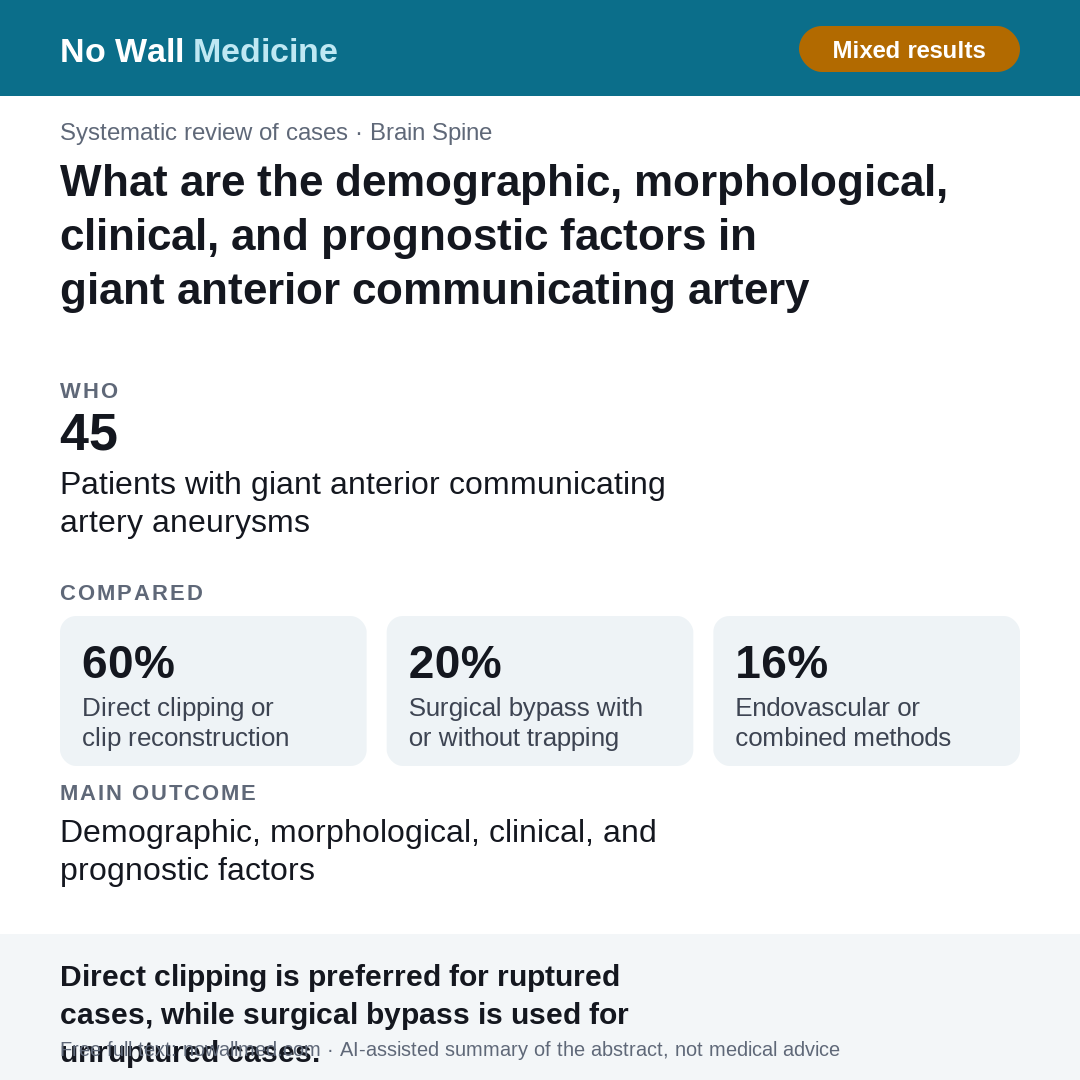
What are the demographic, morphological, clinical, and prognostic factors in giant anterior communicating artery aneurysm treatment?
Who
45
Patients with giant anterior communicating artery aneurysms
Compared
60%Direct clipping or clip reconstruction
20%Surgical bypass with or without trapping
16%Endovascular or combined methods
Main outcome
Demographic, morphological, clinical, and prognostic factors
Bottom line: Direct clipping is preferred for ruptured cases, while surgical bypass is used for unruptured cases.
Limitation: Evidence from case reports and series should be interpreted with caution.
Brain Spine · 2025-01-17Download image
Clinical question: What are the demographic, morphological, clinical, and prognostic factors in giant anterior communicating artery aneurysm treatment?
Why it matters: The specific demographic, morphological, clinical, and prognostic factors that inform decision-making for treating rare giant anterior communicating artery aneurysms are not well established.
Key points
- Researchers reviewed 24 records containing 45 cases of giant anterior communicating artery aneurysms, which are large bulges in a specific artery at the base of the brain.
- The mean age was 52 years with a 3:1 male preponderance, and 82% of patients achieved favorable outcomes as measured by the modified Rankin Scale score of 0-2.
- Treatment methods included direct clipping or reconstruction in 60% of cases, surgical bypass or trapping in 20%, and endovascular or combined methods in 16%.
Limitation the authors note: Evidence from case reports and case series should be interpreted with caution.
Headline and key points written with AI from the paper’s abstract, with every number checked against it. Read the paper before relying on them.
Was this summary helpful?
Cite this article
Nasir R, Naqvi MEZ, Ahmed S, et al. The morphological, clinical, and prognostic factors in the management of giant anterior communicating artery aneurysms: A systematic review of cases. Brain Spine. 2025. doi:10.1016/j.bas.2025.104189
Spotted a mistake? Suggest a correction