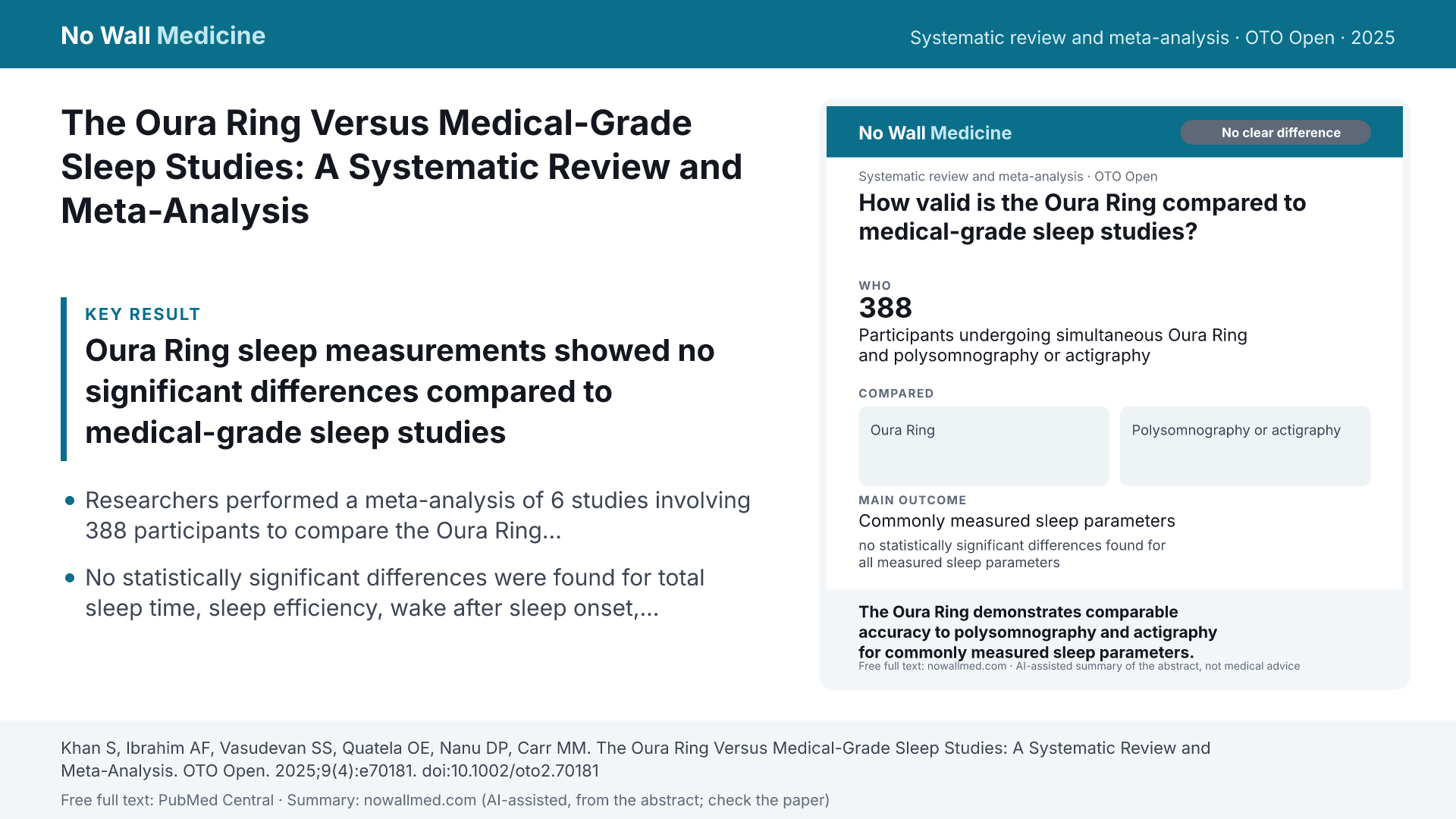
Oura Ring sleep measurements showed no significant differences compared to medical-grade sleep studies
The Oura Ring Versus Medical-Grade Sleep Studies: A Systematic Review and Meta-Analysis
Systematic review and meta-analysisNo clear difference
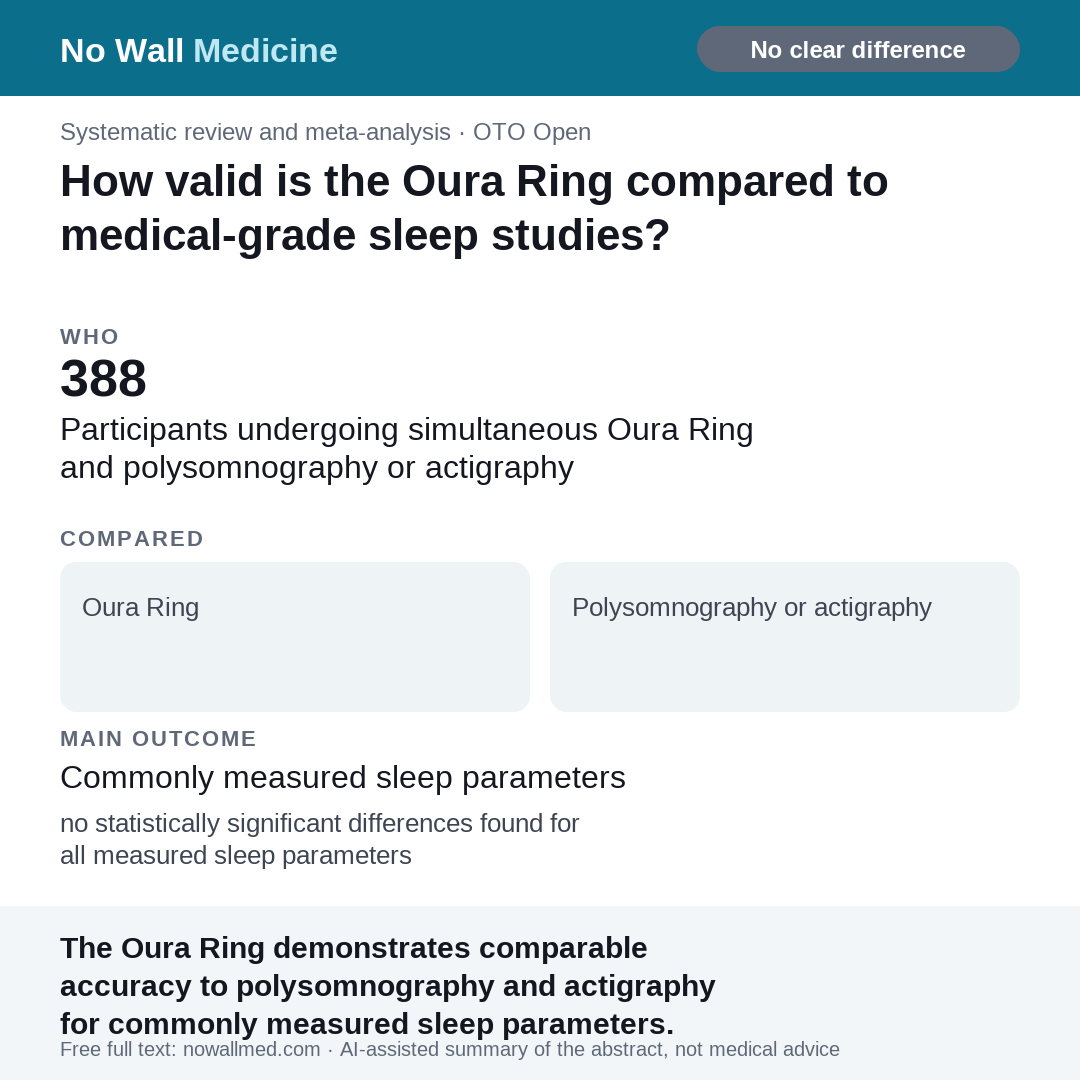
How valid is the Oura Ring compared to medical-grade sleep studies?
Who
388
Participants undergoing simultaneous Oura Ring and polysomnography or actigraphy
Compared
Oura Ring
Polysomnography or actigraphy
Main outcome
Commonly measured sleep parameters
Result: no statistically significant differences found for all measured sleep parameters
Bottom line: The Oura Ring demonstrates comparable accuracy to polysomnography and actigraphy for commonly measured sleep parameters.
OTO Open · 2025-11-10Download image
Clinical question: How valid is the Oura Ring compared to medical-grade sleep studies?
Why it matters: It is unclear how accurately wearable devices like the Oura Ring measure sleep parameters compared to standard medical-grade tools.
Key points
- Researchers performed a meta-analysis of 6 studies involving 388 participants to compare the Oura Ring against polysomnography (a sleep study using brain waves) and actigraphy (movement tracking).
- No statistically significant differences were found for total sleep time, sleep efficiency, wake after sleep onset, sleep onset latency, light sleep, deep sleep, or rapid eye movement sleep.
- The mean difference for sleep efficiency was -1.32% (95% confidence interval: -2.76% to 0.12%) and the mean difference for total sleep time was -2.97 minutes (95% confidence interval: -10.27 to 4.33).
Headline and key points written with AI from the paper’s abstract, with every number checked against it. Read the paper before relying on them.
Was this summary helpful?
Cite this article
Khan S, Ibrahim AF, Vasudevan SS, Quatela OE, Nanu DP, Carr MM. The Oura Ring Versus Medical-Grade Sleep Studies: A Systematic Review and Meta-Analysis. OTO Open. 2025. doi:10.1002/oto2.70181
Spotted a mistake? Suggest a correction