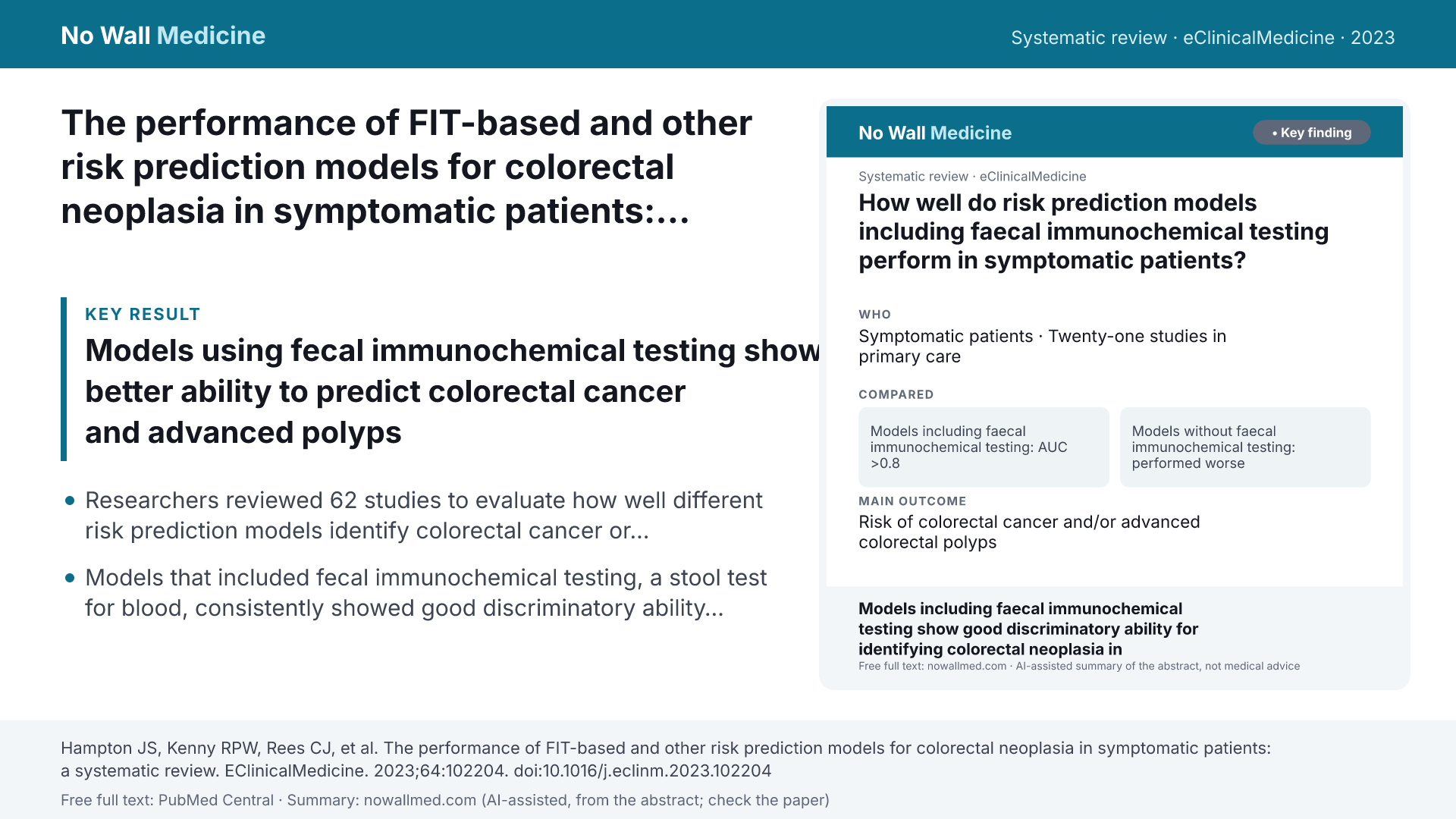
Models using fecal immunochemical testing show better ability to predict colorectal cancer and advanced polyps
The performance of FIT-based and other risk prediction models for colorectal neoplasia in symptomatic patients: a systematic review
Systematic reviewBenefit found
How well do risk prediction models including faecal immunochemical testing perform in symptomatic patients?
Who
Symptomatic patients · Twenty-one studies in primary care
Compared
Models including faecal immunochemical testing: AUC >0.8
Models without faecal immunochemical testing: performed worse
Main outcome
Risk of colorectal cancer and/or advanced colorectal polyps
Bottom line: Models including faecal immunochemical testing show good discriminatory ability for identifying colorectal neoplasia in symptomatic patients.
Limitation: Heterogeneity, high risk of bias, and lack of external validation.
Funded by: National Institute for Health and Care Research
eClinicalMedicine · 2023-09-21Download image
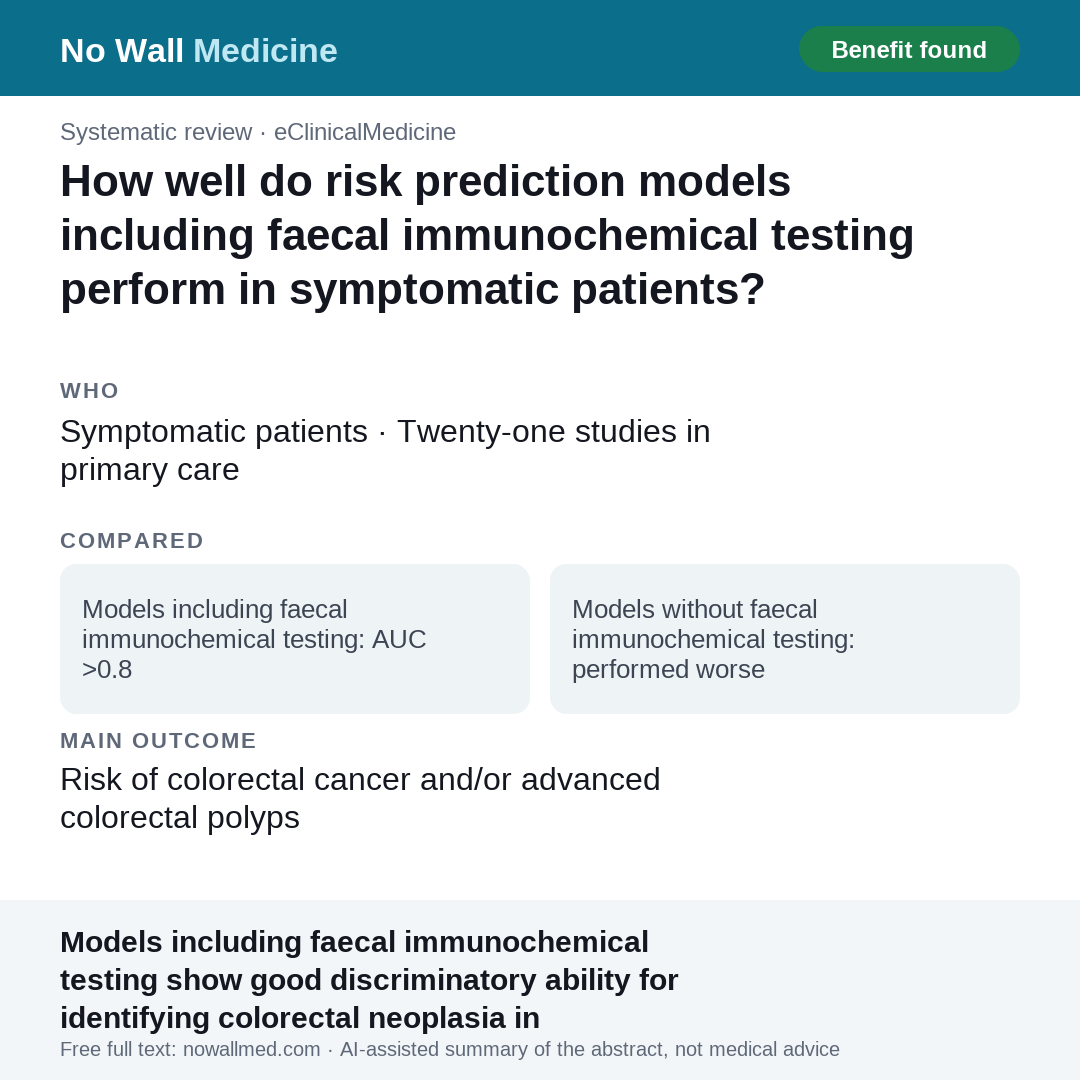
Clinical question: How well do risk prediction models including faecal immunochemical testing perform in symptomatic patients?
Why it matters: It is unknown if combining fecal immunochemical testing with other factors in risk prediction models improves the identification of symptomatic patients needing urgent investigation.
Key points
- Researchers reviewed 62 studies to evaluate how well different risk prediction models identify colorectal cancer or advanced colorectal polyps in symptomatic patients.
- Models that included fecal immunochemical testing, a stool test for blood, consistently showed good discriminatory ability with an area under the curve greater than 0.8.
- Models including fecal immunochemical testing generally performed better than models without the test, though some models without the test also performed well.
Limitation the authors note: The evidence is limited by study heterogeneity, high risk of bias, and a lack of external validation.
Headline and key points written with AI from the paper’s abstract, with every number checked against it. Read the paper before relying on them.
Was this summary helpful?
Cite this article
Hampton JS, Kenny RPW, Rees CJ, et al. The performance of FIT-based and other risk prediction models for colorectal neoplasia in symptomatic patients: a systematic review. eClinicalMedicine. 2023. doi:10.1016/j.eclinm.2023.102204
Spotted a mistake? Suggest a correction