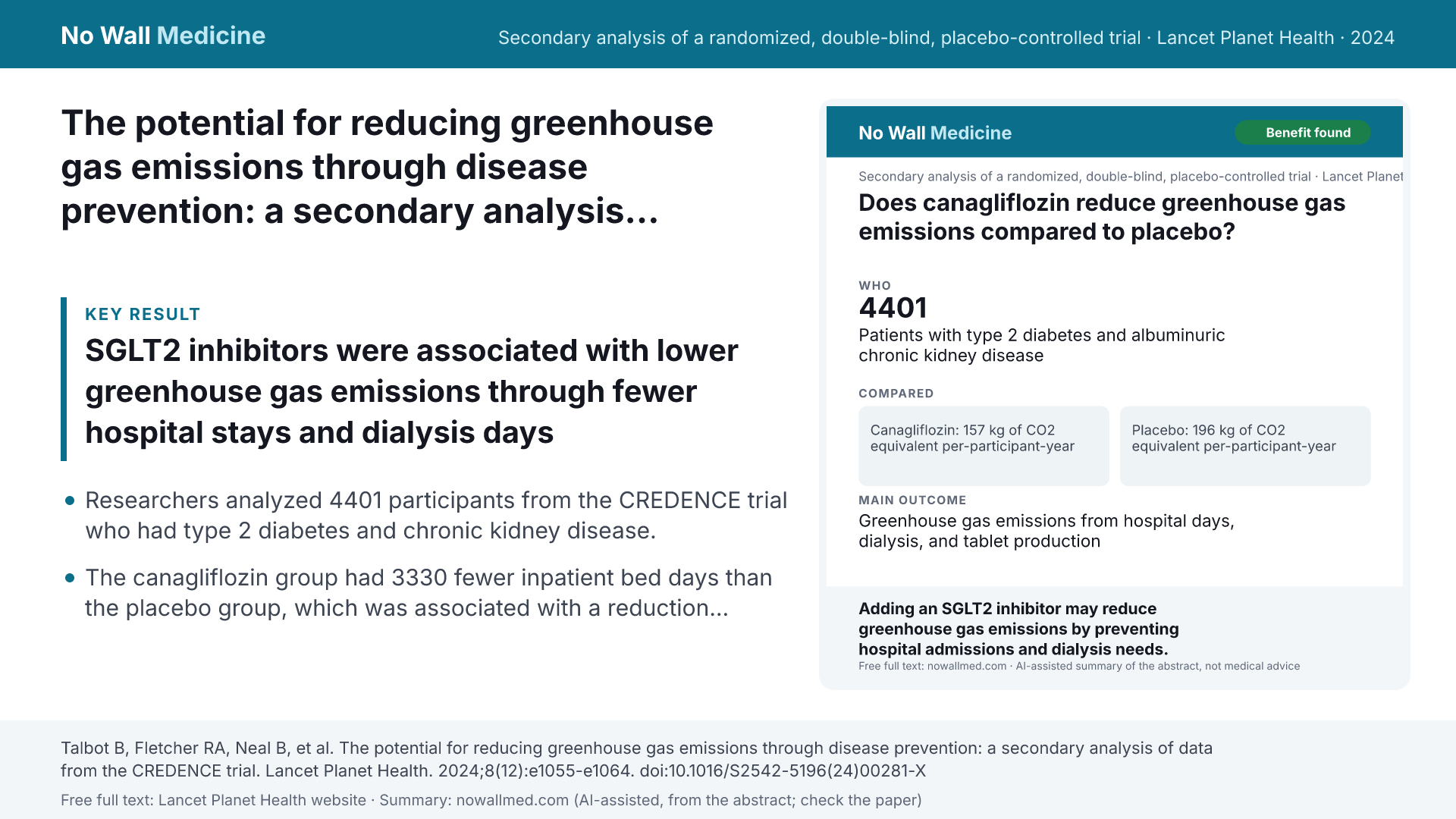
SGLT2 inhibitors were associated with lower greenhouse gas emissions through fewer hospital stays and dialysis days
The potential for reducing greenhouse gas emissions through disease prevention: a secondary analysis of data from the CREDENCE trial
Secondary analysis of a randomized, double-blind, placebo-controlled trialBenefit found
Does canagliflozin reduce greenhouse gas emissions compared to placebo?
Who
4401
Patients with type 2 diabetes and albuminuric chronic kidney disease
Compared
Canagliflozin: 157 kg of CO2 equivalent per-participant-year
Placebo: 196 kg of CO2 equivalent per-participant-year
Main outcome
Greenhouse gas emissions from hospital days, dialysis, and tablet production
Bottom line: Adding an SGLT2 inhibitor may reduce greenhouse gas emissions by preventing hospital admissions and dialysis needs.
Lancet Planet Health · 2024-12-15Download image
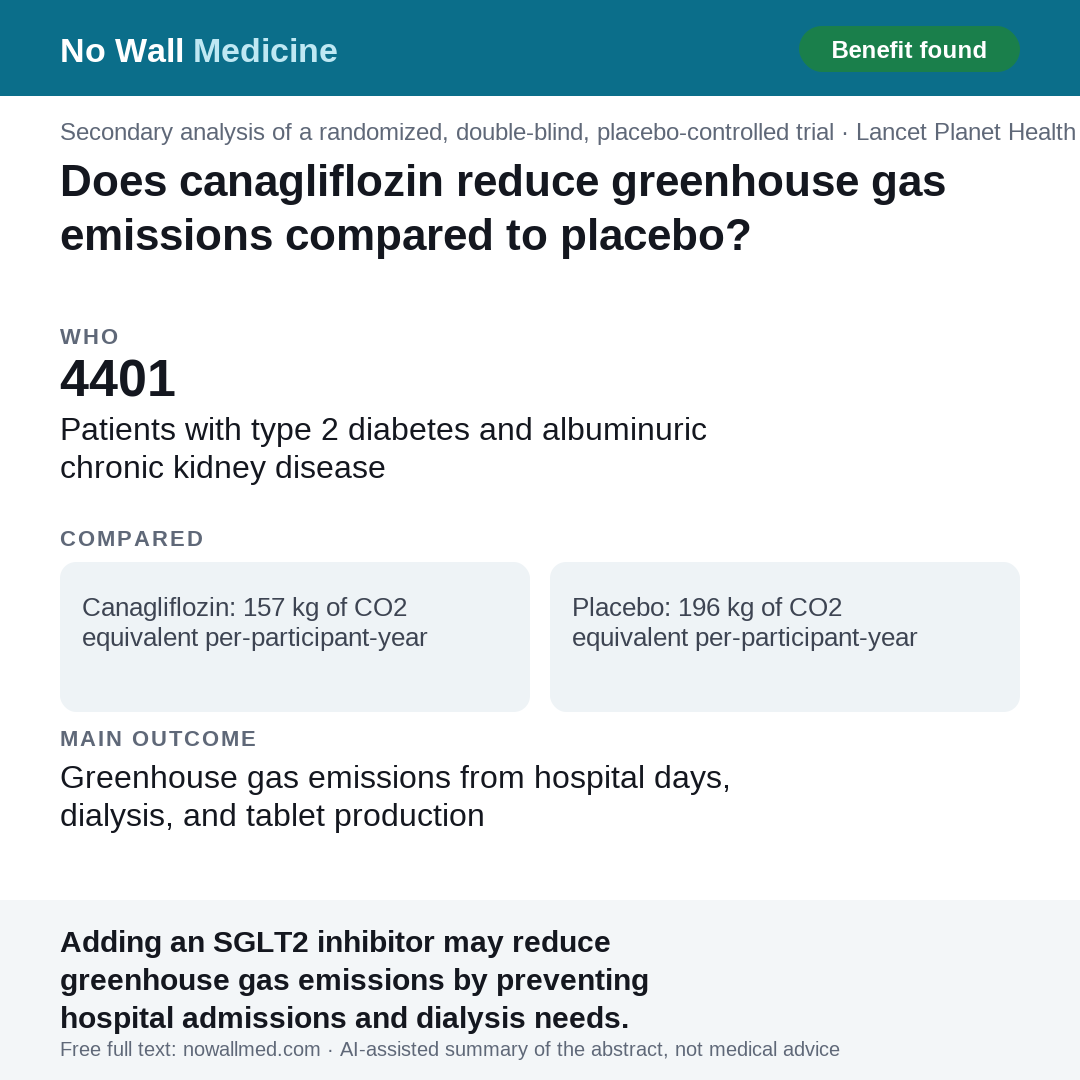
Clinical question: Does canagliflozin reduce greenhouse gas emissions compared to placebo?
Why it matters: Little data exist regarding the environmental impact of disease management strategies such as the use of SGLT2 inhibitors.
Key points
- Researchers analyzed 4401 participants from the CREDENCE trial who had type 2 diabetes and chronic kidney disease.
- The canagliflozin group had 3330 fewer inpatient bed days than the placebo group, which was associated with a reduction of approximately 126 tonnes of CO2 equivalent.
- Mean greenhouse gas emissions per participant-year were reduced from 196 kg of CO2 equivalent to 157 kg of CO2 equivalent.
Headline and key points written with AI from the paper’s abstract, with every number checked against it. Read the paper before relying on them.
Was this summary helpful?
Abstract
Background
The health-care sector is responsible for 5·2% of global emissions, however, little data exist regarding the environmental impact of disease management strategies. SGLT2 inhibitors are now widely used to reduce the risk of hospital admission and kidney failure in people with type 2 diabetes and chronic kidney disease. This study aimed to estimate the impact of SGLT2 inhibitors on greenhouse gas emissions using data from the CREDENCE trial. Methods
For this modelling analysis, we used data from the randomised, double-blind, placebo-controlled, CREDENCE trial, which compared the effect of canagliflozin versus placebo on kidney and cardiovascular outcomes in patients with type 2 diabetes and albuminuric chronic kidney disease. For this secondary analysis, we included all participants randomly assigned to canagliflozin or placebo at baseline in the CREDENCE trial. Data on greenhouse gas emissions resulting from hospital inpatient days, maintenance dialysis therapy, and SGLT2 inhibitor tablet production were derived from published reports and used to model greenhouse gas emissions from total number of hospital inpatient days, total number of days of maintenance dialysis therapy, and from SGLT2 inhibitor treatment over the course of the CREDENCE trial. We compared greenhouse gas emission estimates for participants in the canagliflozin group and placebo group of the CREDENCE trial. We used bootstrapping analyses to calculate uncertainty estimates and permutation tests to generate p values for the difference in number of days on dialysis and inpatient bed days between treatment groups. Findings
4401 participants who were randomly assigned to the canagliflozin (n=2202) or placebo group (n=2199) were included in the secondary analyses. During a median follow-up of 2·62 years (IQR 0·02 to 4·53), SGLT2 inhibitor production for 2202 participants resulted in greenhouse gas emissions of 63 tonnes of CO2 equivalent (CO2e; 95% CI 62 to 64). The total number of inpatient bed days was 17 002 days in the placebo group versus 13 672 days in the canagliflozin group; the 3330 fewer inpatient days (95% CI 1037 to 5686; p=0·042) with SGLT2 inhibitor treatment equated to a reduction of approximately 126 tonnes of CO2e (95% CI 39 to 216). Participants in the placebo group required 24 877 days of maintenance dialysis compared with 16 605 days in the treatment group; 8272 fewer days of dialysis ( -168 to 16 755; p=0·16), equated to a reduction of 161 tonnes of CO2e (-3 to 327). Overall, mean greenhouse gas emissions per-participant-year were reduced from 196 kg of CO2e per-participant-year to 157 kg of CO2e per-participant-year. Interpretation
The addition of an SGLT2 inhibitor to routine therapy for people with type 2 diabetes and chronic kidney disease has the potential to reduce greenhouse gas emissions through the prevention of hospital admissions and need for dialysis. Funding
None.
Abstract reproduced under the article’s CC BY NC ND licence.
Subject terms
Cite this article
Talbot B, Fletcher RA, Neal B, et al. The potential for reducing greenhouse gas emissions through disease prevention: a secondary analysis of data from the CREDENCE trial. Lancet Planet Health. 2024. doi:10.1016/S2542-5196(24)00281-X
Spotted a mistake? Suggest a correction