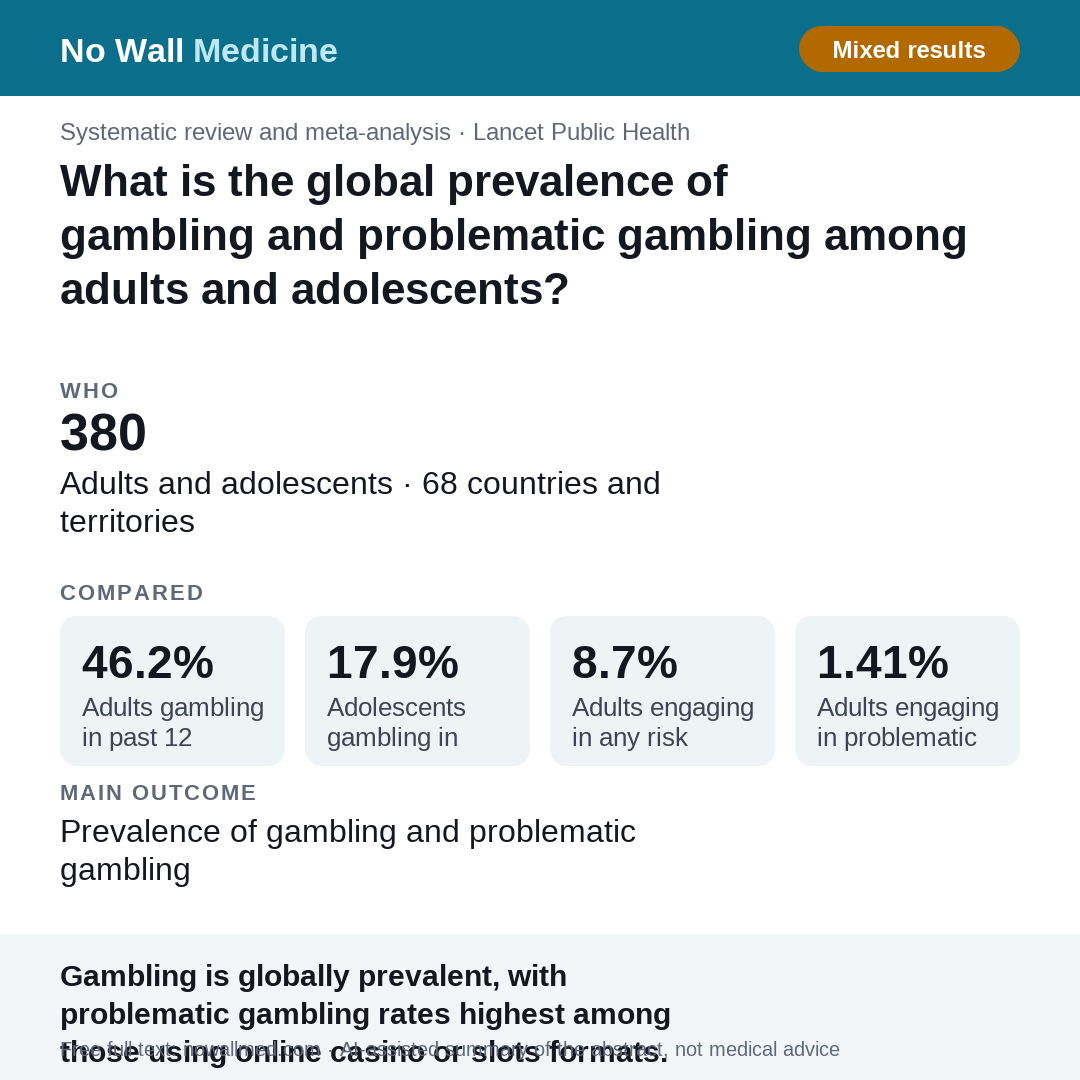
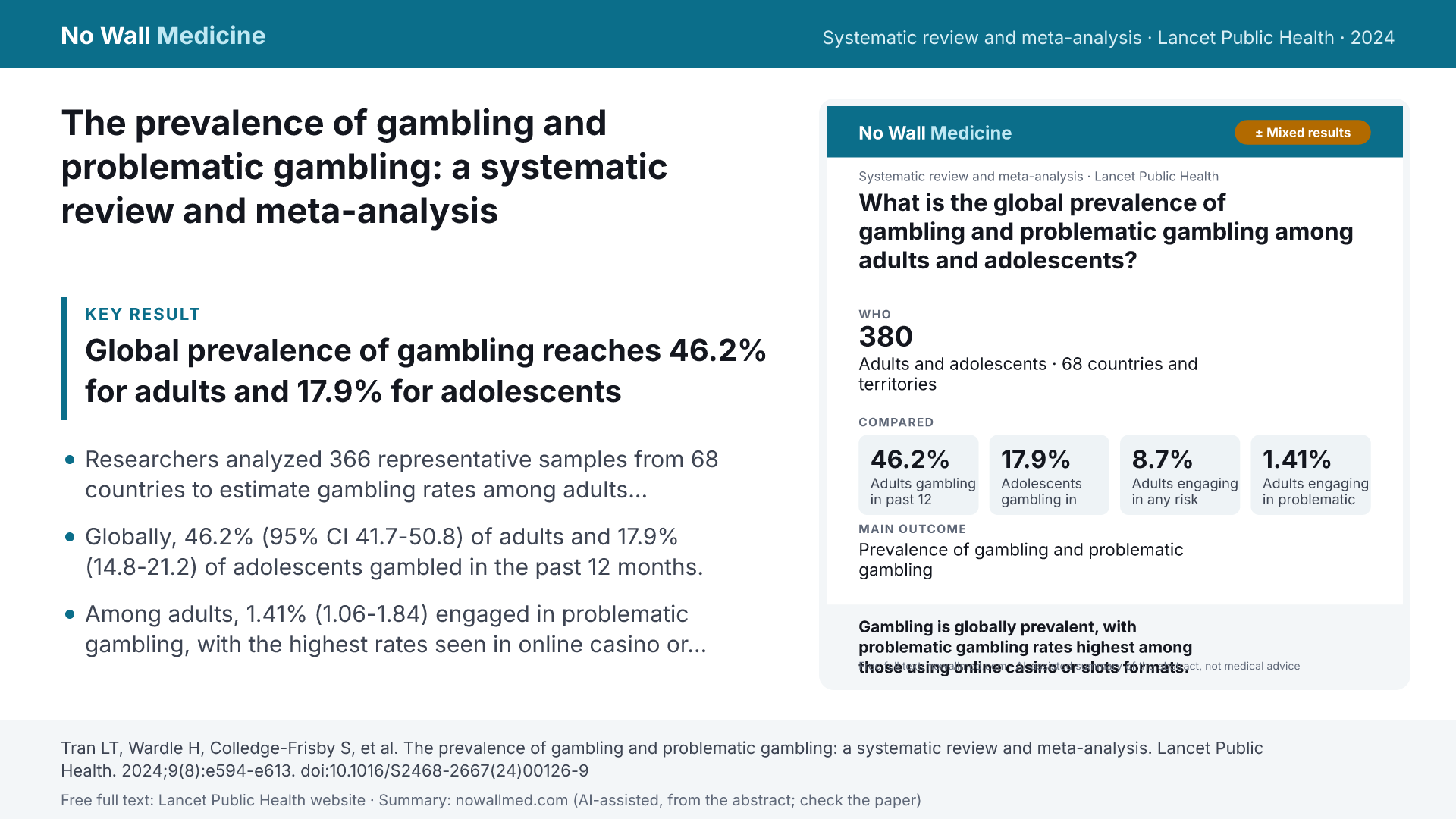
Global prevalence of gambling reaches 46.2% for adults and 17.9% for adolescents
The prevalence of gambling and problematic gambling: a systematic review and meta-analysis
Systematic review and meta-analysisMixed results
What is the global prevalence of gambling and problematic gambling among adults and adolescents?
Who
380
Adults and adolescents · 68 countries and territories
Compared
46.2%Adults gambling in past 12 months (95% CI 41.7-50.8)
17.9%Adolescents gambling in past 12 months (14.8-21.2)
8.7%Adults engaging in any risk gambling (6.6-11.3)
1.41%Adults engaging in problematic gambling (1.06-1.84)
Main outcome
Prevalence of gambling and problematic gambling
Bottom line: Gambling is globally prevalent, with problematic gambling rates highest among those using online casino or slots formats.
Limitation: There were few data reported on any risk and problematic gambling among adolescent samples.
Funded by: Australian National Health and Medical Research Council
Lancet Public Health · 2024-07-15Download image
Clinical question: What is the global prevalence of gambling and problematic gambling among adults and adolescents?
Why it matters: Data on the global prevalence of gambling and problematic gambling behaviors for adults and adolescents remain scarce.
Key points
- Researchers analyzed 366 representative samples from 68 countries to estimate gambling rates among adults and adolescents.
- Globally, 46.2% (95% CI 41.7-50.8) of adults and 17.9% (14.8-21.2) of adolescents gambled in the past 12 months.
- Among adults, 1.41% (1.06-1.84) engaged in problematic gambling, with the highest rates seen in online casino or slots gambling at 15.8% (10.7-21.6).
Limitation the authors note: There were few data reported on any risk and problematic gambling among adolescent samples.
Headline and key points written with AI from the paper’s abstract, with every number checked against it. Read the paper before relying on them.
Was this summary helpful?
Abstract
Background
Gambling behaviours have become of increased public health interest, but data on prevalence remain scarce. In this study, we aimed to estimate for adults and adolescents the prevalence of any gambling activity, the prevalence of engaging in specific gambling activities, the prevalence of any risk gambling and problematic gambling, and the prevalence of any risk and problematic gambling by gambling activity. Methods
We performed a systematic review and meta-analysis. We systematically searched for peer-reviewed literature (on MEDLINE, Embase, and PsycInfo) and grey literature to identify papers published between Jan 1, 2010, and March 4, 2024. We searched for any gambling, including engagement with individual gambling activities, and problematic gambling data among adults and adolescents. We included papers that reported the prevalence or proportion of a gambling outcome of interest. We excluded papers of non-original data or based on a biased sample. Data were extracted into a bespoke Microsoft Access database, with the Joanna Briggs Institute Critical Appraisal Tool used to identify the risk of bias for each sample. Representative population survey estimates were firstly meta-analysed into country-level prevalence estimates, using metaprop, of any gambling, any risk gambling, problematic gambling, and by gambling activity. Secondly, population-weighted regional-level and global estimates were generated for any gambling, any risk gambling, problematic gambling, and specific gambling activity. This review is registered on PROSPERO (CRD42021251835). Findings
We screened 3692 reports, with 380 representative unique samples, in 68 countries and territories. Overall, the included samples consisted of slightly more men or male individuals, with a mean age of 29·72 years, and most samples identified were from high-income countries. Of these samples, 366 were included in the meta-analysis. Globally, 46·2% (95% CI 41·7-50·8) of adults and 17·9% (14·8-21·2) of adolescents had gambled in the past 12 months. Rates of gambling were higher among men (49·1%; 45·5-52·6) than women (37·4%; 32·0-42·5). Among adults, 8·7% (6·6-11·3) were classified as engaging in any risk gambling, and 1·41% (1·06-1·84) were engaging in problematic gambling. Among adults, rates of problematic gambling were greatest among online casino or slots gambling (15·8%; 10·7-21·6). There were few data reported on any risk and problematic gambling among adolescent samples. Interpretation
Existing evidence suggests that gambling is prevalent globally, that a substantial proportion of the population engage in problematic gambling, and that rates of problematic gambling are greatest among those gambling on online formats. Given the growth of the online gambling industry and the association between gambling and a range of public health harms, governments need to give greater attention to the strict regulation and monitoring of gambling globally. Funding
Australian National Health and Medical Research Council.
Abstract reproduced under the article’s CC BY NC ND licence.
Subject terms
Cite this article
Tran LT, Wardle H, Colledge-Frisby S, Taylor S, Lynch M, Rehm J. The prevalence of gambling and problematic gambling: a systematic review and meta-analysis. Lancet Public Health. 2024. doi:10.1016/S2468-2667(24)00126-9
Spotted a mistake? Suggest a correction