Wake after sleep onset linked to PTSD symptoms in 1847 participants
The relation between passively collected data and PTSD: a systematic review and meta-analysis
Systematic review and meta-analysisMixed results
What is the association between mobile sensing features and post-traumatic stress disorder symptoms?
Who
1847
Participants in studies assessing mobile sensing and post-traumatic stress disorder
Compared
wake after sleep onset: r = 0.14 (95% CI [0.03, 0.25])
relative amplitude of physical activity: r = -0.10 (95% CI [-0.17, -0.03])
Main outcome
Association between mobile sensing features and post-traumatic stress disorder symptoms
Bottom line: Only wake after sleep onset and relative amplitude of physical activity were significantly associated with post-traumatic stress disorder symptoms.
NPJ Digit Med · 2025-07-05Download image
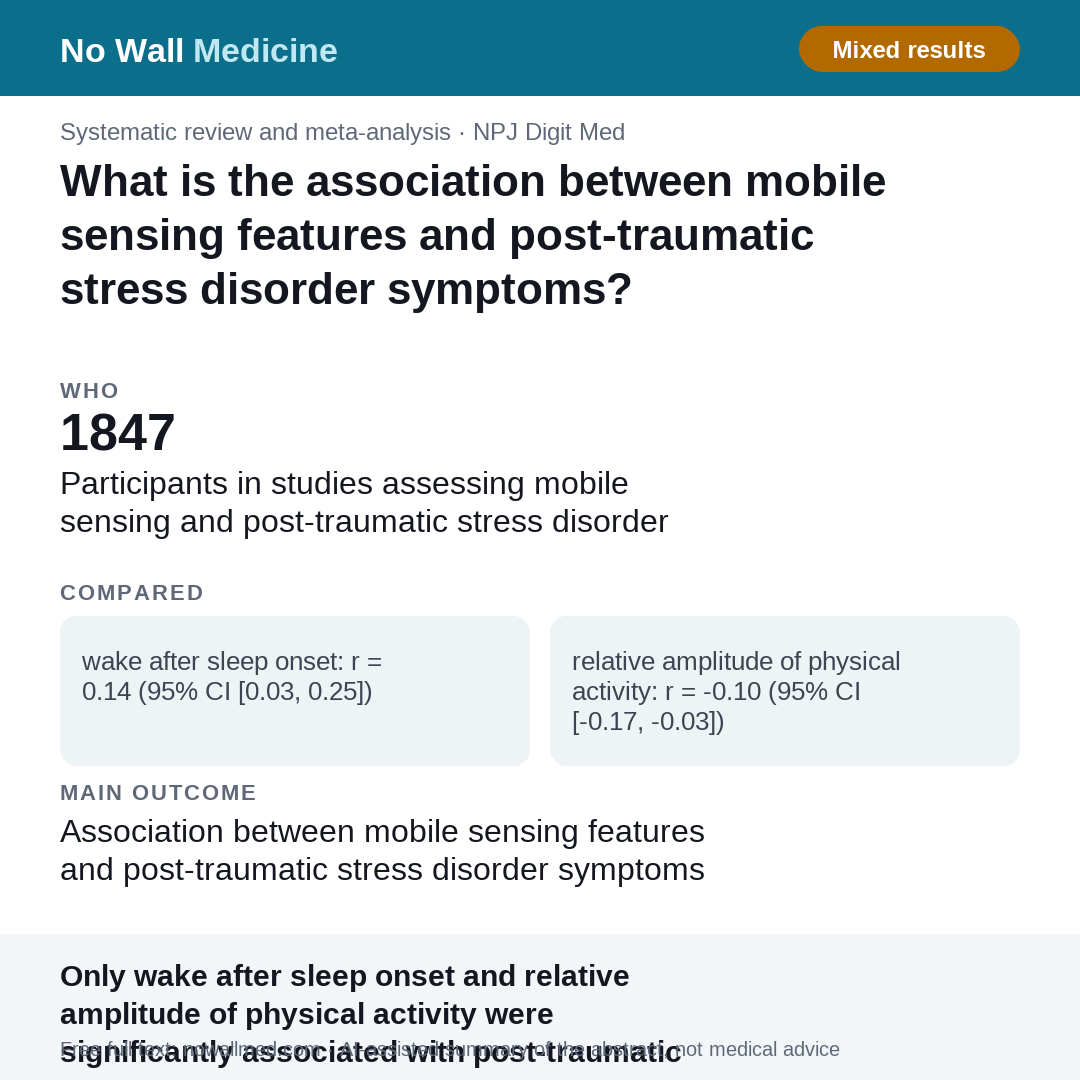
Clinical question: What is the association between mobile sensing features and post-traumatic stress disorder symptoms?
Why it matters: The relation between mobile sensing data and PTSD symptoms is examined
Key points
- 1847 participants with mean age 38.68 were studied for PTSD symptoms.
- Wake after sleep onset was linked to PTSD symptoms with r = 0.14.
- Relative amplitude of physical activity was also linked to PTSD symptoms with r = -0.10.
Headline and key points written with AI from the paper’s abstract, with every number checked against it. Read the paper before relying on them.
Cite this article
Zhu N, Sarawgi A, Bühner M, Baumeister H, Garatva P, Ehring T. The relation between passively collected data and PTSD: a systematic review and meta-analysis. NPJ Digit Med. 2025. doi:10.1038/s41746-025-01825-6
Spotted a mistake? Suggest a correction