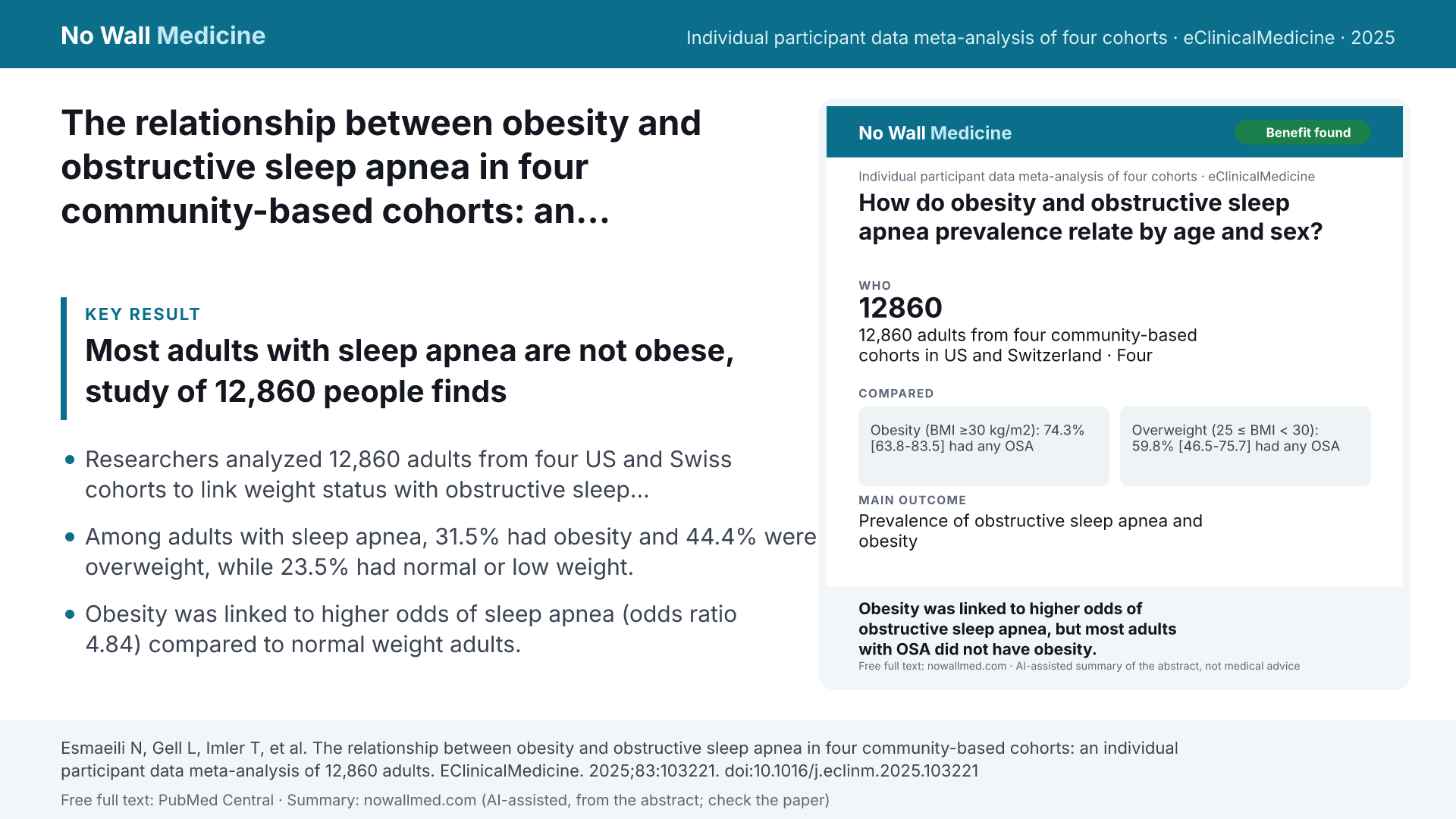
The relationship between obesity and obstructive sleep apnea in four community-based cohorts: an individual participant data meta-analysis of 12,860 adults
Key result: Most adults with sleep apnea are not obese, study of 12,860 people finds
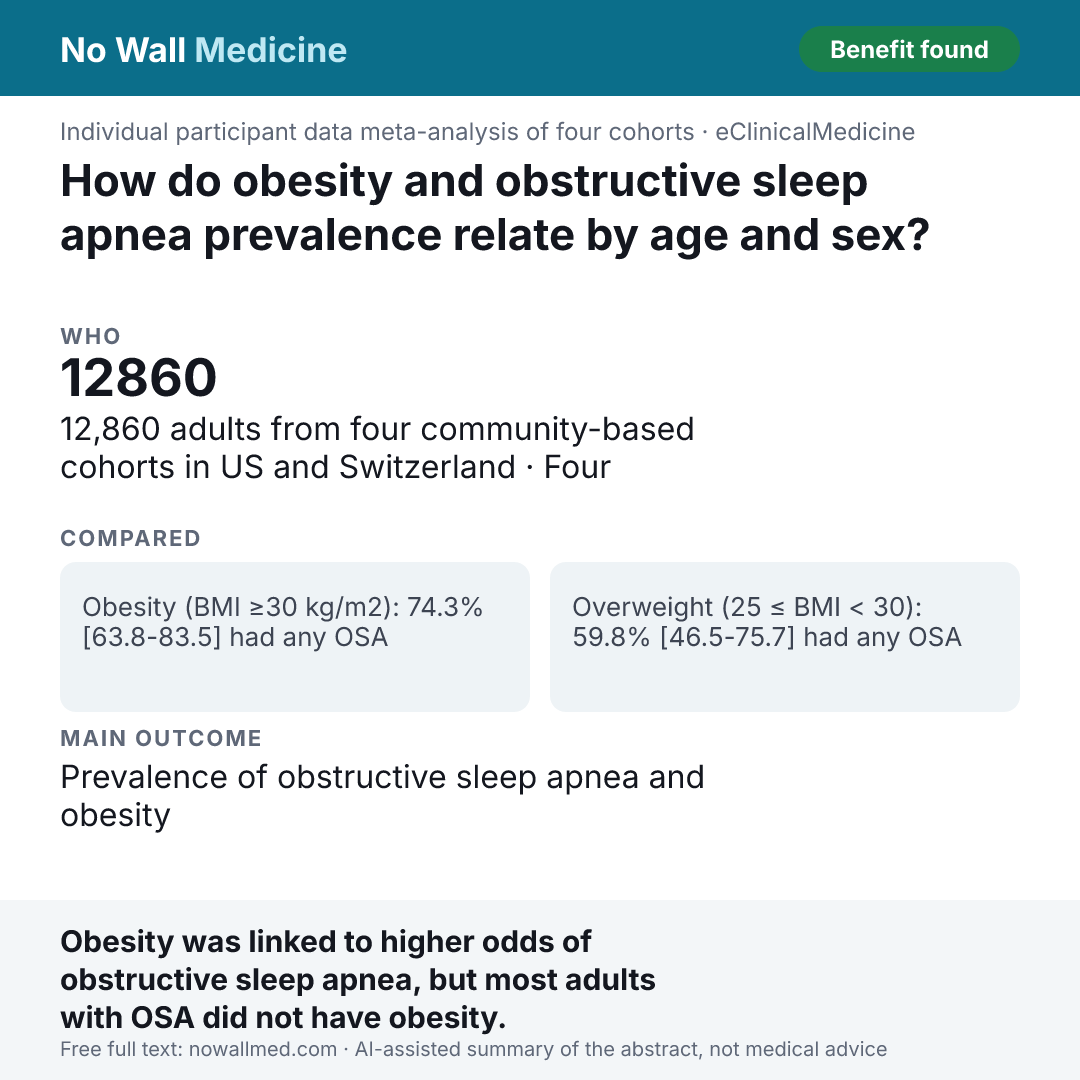
Individual participant data meta-analysis of four cohortsBenefit found
How do obesity and obstructive sleep apnea prevalence relate by age and sex?
Who
12860
12,860 adults from four community-based cohorts in US and Switzerland · Four community-based cohorts in the US and Switzerland
Compared
Obesity (BMI ≥30 kg/m2): 74.3% [63.8-83.5] had any OSA
Overweight (25 ≤ BMI < 30): 59.8% [46.5-75.7] had any OSA
Main outcome
Prevalence of obstructive sleep apnea and obesity
Result: Odds ratio 4.84 [3.09-6.00] for OSA in obesity vs BMI <25 kg/m2
Bottom line: Obesity was linked to higher odds of obstructive sleep apnea, but most adults with OSA did not have obesity.
Funded by: American Academy of Sleep Medicine, NHLBI, and Apnimed
eClinicalMedicine · 2025-04-23 · Save PNG
Key points
- Researchers analyzed 12,860 adults from four US and Swiss cohorts to link weight status with obstructive sleep apnea prevalence.
- Among adults with sleep apnea, 31.5% had obesity and 44.4% were overweight, while 23.5% had normal or low weight.
- Obesity was linked to higher odds of sleep apnea (odds ratio 4.84) compared to normal weight adults.
Why it matters: Applies to community-dwelling adults; highlights that sleep apnea affects many non-obese individuals, supporting personalized assessment beyond weight.
Discussion prompts
- Would these patients look like yours? Who was left out?
- Is the main outcome one that matters to patients?
- Is the difference large enough to change what you do?
Cite: Esmaeili N, Gell L, Imler T, et al. The relationship between obesity and obstructive sleep apnea in four community-based cohorts: an individual participant data meta-analysis of 12,860 adults. EClinicalMedicine. 2025;83:103221. doi:10.1016/j.eclinm.2025.103221
Free full text: PubMed Central · Summary and visual abstract: nowallmed.com/a/the-relationship-between-obesity-and-obstructive-sleep-apnea-in-four-1pqp0nb/ (AI-assisted from the abstract; check the paper before relying on it).