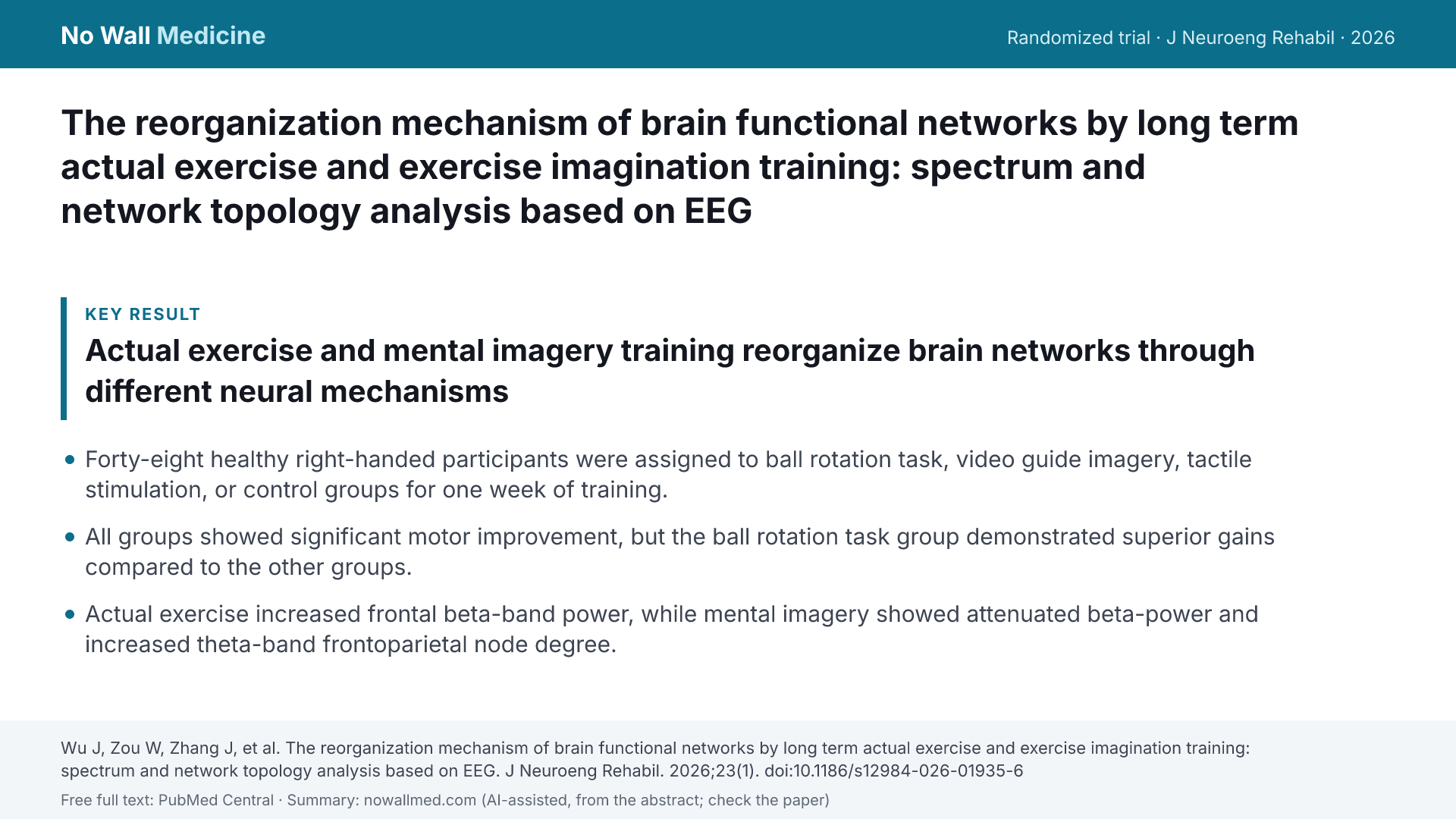
Actual exercise and mental imagery training reorganize brain networks through different neural mechanisms
The reorganization mechanism of brain functional networks by long term actual exercise and exercise imagination training: spectrum and network topology analysis based on EEG
Why it matters: The mechanisms underlying how long-term training reorganizes functional brain networks remain unclear, as most existing studies focus on short-term effects.
Key points
- Forty-eight healthy right-handed participants were assigned to ball rotation task, video guide imagery, tactile stimulation, or control groups for one week of training.
- All groups showed significant motor improvement, but the ball rotation task group demonstrated superior gains compared to the other groups.
- Actual exercise increased frontal beta-band power, while mental imagery showed attenuated beta-power and increased theta-band frontoparietal node degree.
Limitation the authors note: Future investigations should validate these findings in clinical populations with motor impairments.
Headline and key points written with AI from the paper’s abstract, with every number checked against it. Read the paper before relying on them.
Was this summary helpful?
Subject terms
Headline, design, result, key points, caveat and citation as plain text.
Cite this article
Wu J, Zou W, Zhang J, et al. The reorganization mechanism of brain functional networks by long term actual exercise and exercise imagination training: spectrum and network topology analysis based on EEG. J Neuroeng Rehabil. 2026;23(1). doi:10.1186/s12984-026-01935-6
Spotted a mistake? Suggest a correction