Artificial intelligence models using multiple data types show potential for predicting chronic obstructive pulmonary disease exacerbations
The role of artificial intelligence in predicting COPD exacerbations using multimodal data: a systematic review
Systematic reviewBenefit found
Can artificial intelligence using multimodal data predict chronic obstructive pulmonary disease exacerbations?
Who
Patients with chronic obstructive pulmonary disease · PubMed, Embase and Google Scholar
Compared
Multimodal artificial intelligence models: area under the curve 0.73 to 0.92
Wearable-driven models: sensitivity 0.94
Main outcome
Predictive performance for chronic obstructive pulmonary disease exacerbations
Bottom line: Multimodal artificial intelligence shows potential for predicting exacerbations, but requires more external validation and transparent reporting.
Limitation: Methodological heterogeneity, limited external validation, and incomplete reporting of preprocessing and explainability methods.
ERJ Open Res · 2026-06-17Download image
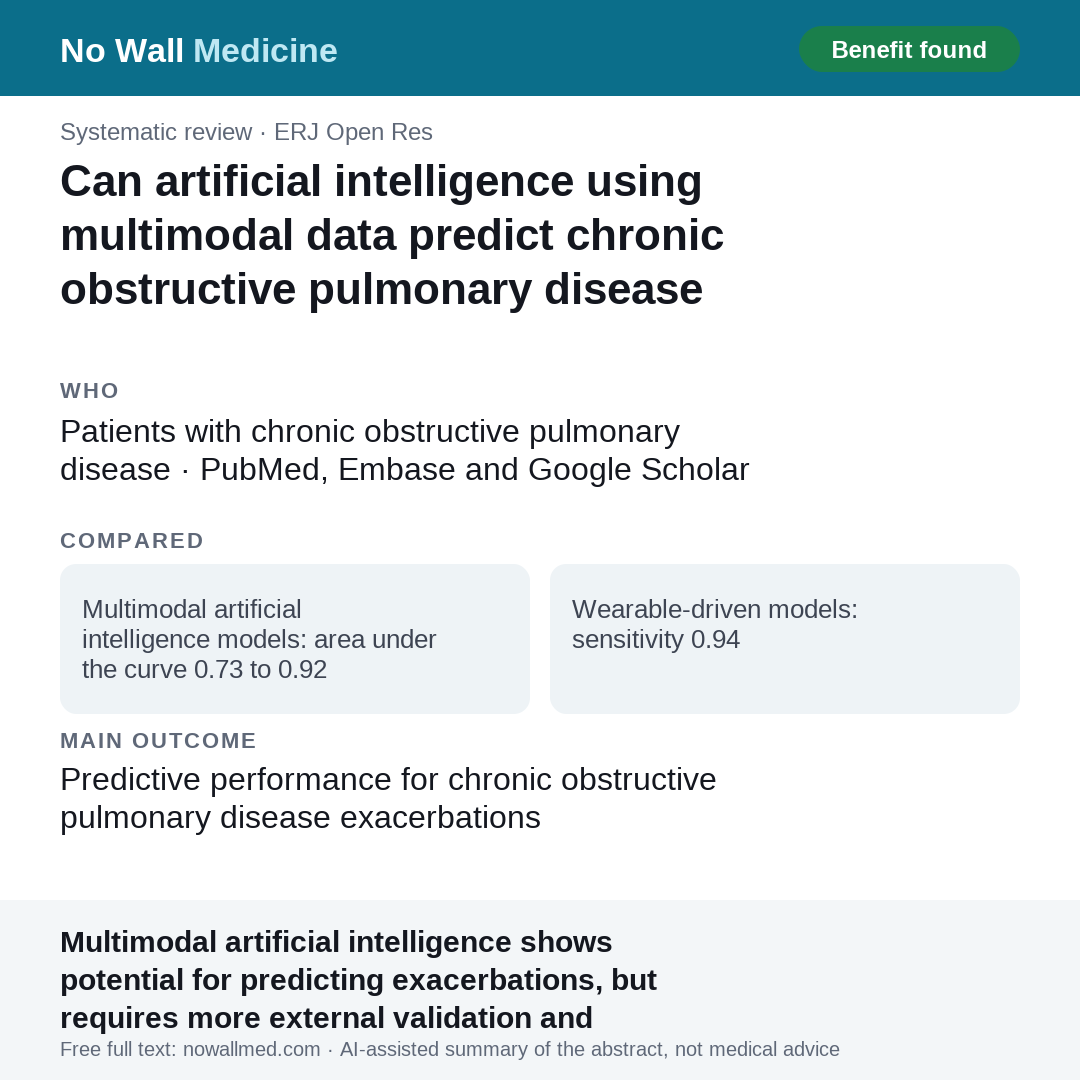
Clinical question: Can artificial intelligence using multimodal data predict chronic obstructive pulmonary disease exacerbations?
Why it matters: Acute exacerbations of chronic obstructive pulmonary disease drive disease progression and healthcare use, but predicting these events remains a challenge.
Key points
- Researchers reviewed five studies published between 2021 and 2025 that used artificial intelligence to predict exacerbations of chronic obstructive pulmonary disease.
- The models showed moderate to high performance with area under the curve values between 0.73 and 0.92 and accuracies up to 0.92.
- Sensitivity reached 0.94 in models driven by wearable sensors, though most performance metrics were derived from internal validation.
Limitation the authors note: The authors state that methodological heterogeneity, limited external validation, and incomplete reporting of preprocessing and explainability methods restrict clinical translation.
Headline and key points written with AI from the paper’s abstract, with every number checked against it. Read the paper before relying on them.
Spotted a mistake? Suggest a correction