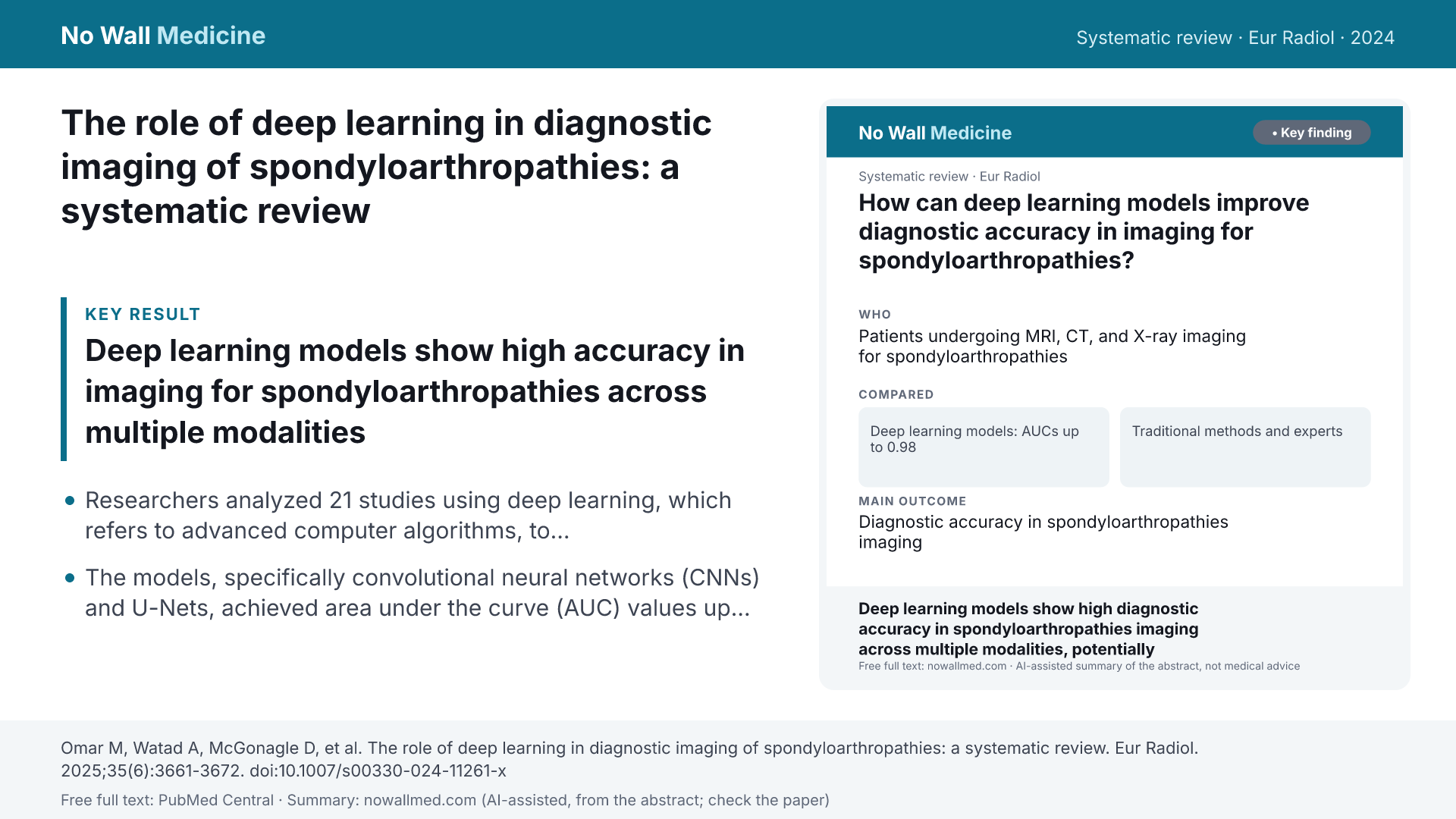
Deep learning models show high accuracy in imaging for spondyloarthropathies across multiple modalities
The role of deep learning in diagnostic imaging of spondyloarthropathies: a systematic review
Systematic reviewKey finding
How can deep learning models improve diagnostic accuracy in imaging for spondyloarthropathies?
Who
Patients undergoing MRI, CT, and X-ray imaging for spondyloarthropathies
Compared
Deep learning models: AUCs up to 0.98
Traditional methods and experts
Main outcome
Diagnostic accuracy in spondyloarthropathies imaging
Bottom line: Deep learning models show high diagnostic accuracy in spondyloarthropathies imaging across multiple modalities, potentially matching expert radiologists.
Limitation: Small sample sizes in some studies and need for prospective and external validation.
Eur Radiol · 2024-12-10 · Save PNG

Clinical question: How can deep learning models improve diagnostic accuracy in imaging for spondyloarthropathies?
Why it matters: Interpreting diagnostic images for spondyloarthropathies can be challenging, particularly regarding early detection and differentiation from other types of arthritis.
Key points
- Researchers analyzed 21 studies using deep learning, which refers to advanced computer algorithms, to diagnose spondyloarthropathies using magnetic resonance imaging (MRI), computed tomography (CT), and X-ray.
- The models, specifically convolutional neural networks (CNNs) and U-Nets, achieved area under the curve (AUC) values up to 0.98 and matched the performance of expert radiologists.
- These computer models demonstrated high accuracy in identifying arthritis forms and assessing how the disease progresses.
Limitation the authors note: Some studies included in the review had small sample sizes, which may limit how well these models work in different settings.
Headline and key points written with AI from the paper’s abstract, with every number checked against it. Read the paper before relying on them.
Was this summary helpful?
Subject terms
Headline, design, result, key points, caveat and citation as plain text.
Cite this article
Omar M, Watad A, McGonagle D, et al. The role of deep learning in diagnostic imaging of spondyloarthropathies: a systematic review. Eur Radiol. 2025;35(6):3661-3672. doi:10.1007/s00330-024-11261-x
Spotted a mistake? Suggest a correction