Diffusion tensor imaging was associated with favorable neurological outcomes in children undergoing epilepsy surgery
The role of preoperative diffusion tensor imaging in predicting and improving functional outcome in pediatric patients undergoing epilepsy surgery: a systematic review
Systematic review of 13 studiesBenefit found
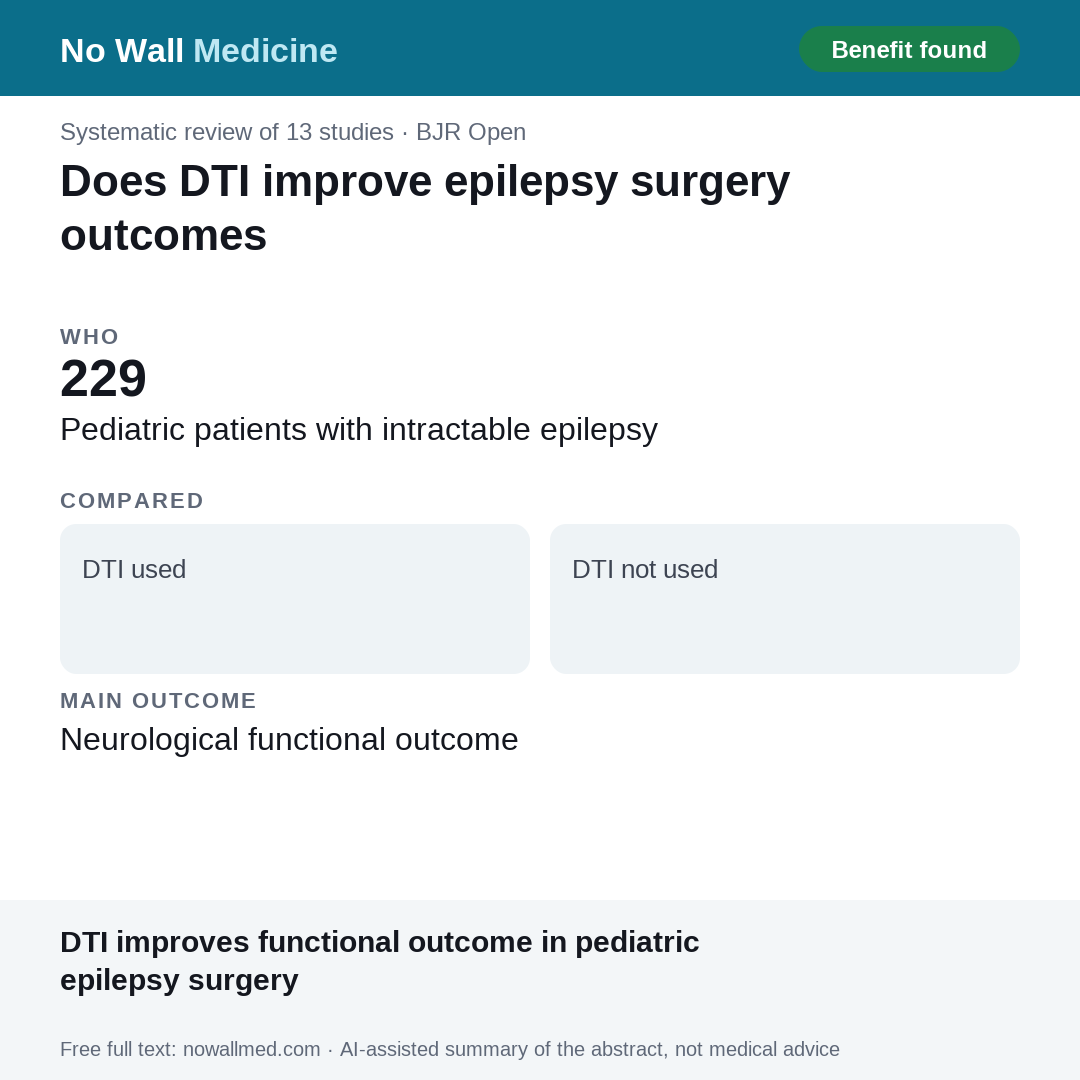
Does DTI improve epilepsy surgery outcomes
Who
229
Pediatric patients with intractable epilepsy
Compared
DTI used
DTI not used
Main outcome
Neurological functional outcome
Bottom line: DTI improves functional outcome in pediatric epilepsy surgery
Limitation: More studies are required
BJR Open · 2021-07-05Download image
Why it matters: It was unknown if diffusion tensor imaging provides benefit for preoperative analysis and planning to predict or improve neurological outcomes in children with intractable epilepsy.
Key points
- Researchers reviewed 13 studies involving 229 pediatric patients with drug-resistant epilepsy to evaluate the utility of diffusion tensor imaging, a non-invasive brain imaging technique.
- The use of diffusion tensor imaging was associated with a high degree of favorable neurological outcomes after surgery for epilepsy.
- In seven studies reporting motor outcomes, three studies showed motor outcome prediction with a sensitivity of 80 to 85.7% and a specificity of 69.6 to 100%.
Limitation the authors note: The included studies consisted of case reports, case series, retrospective cohorts, and prospective cohorts rather than randomized controlled trials.
Headline and key points written with AI from the paper’s abstract, with every number checked against it. Read the paper before relying on them.
Was this summary helpful?
Cite this article
Leon-Rojas J, Cornell I, Rojas-Garcia A, D'Arco F, Panovska-Griffiths J, Cross H. The role of preoperative diffusion tensor imaging in predicting and improving functional outcome in pediatric patients undergoing epilepsy surgery: a systematic review. BJR Open. 2021. doi:10.1259/bjro.20200002
Spotted a mistake? Suggest a correction
Top studies every Monday
The week’s key trials and guidelines in your specialties, plus any topics you follow. By email, free.
Get the weekly digest