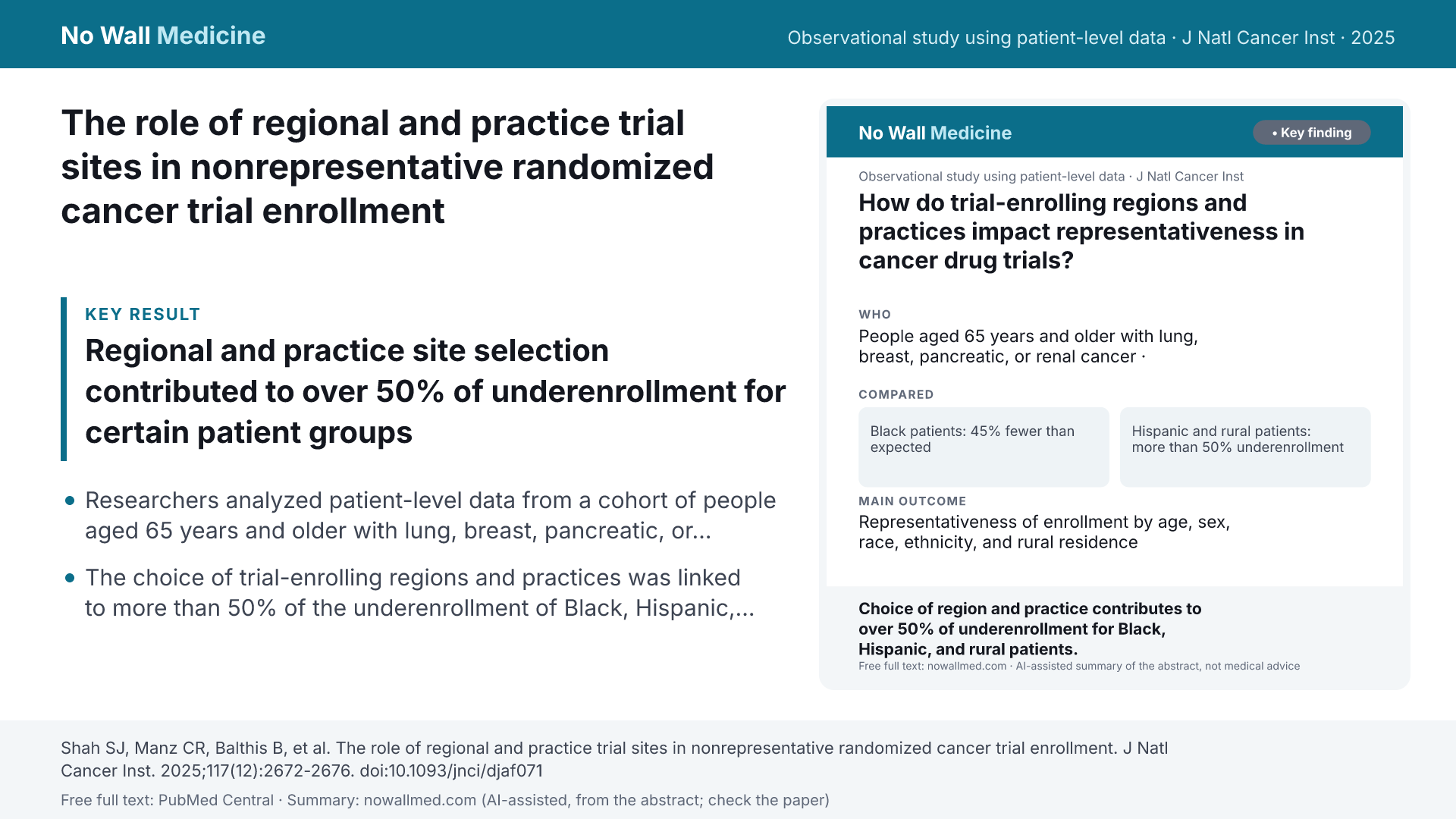
Regional and practice site selection contributed to over 50% of underenrollment for certain patient groups
The role of regional and practice trial sites in nonrepresentative randomized cancer trial enrollment
Observational study using patient-level dataHarm found
How do trial-enrolling regions and practices impact representativeness in cancer drug trials?
Who
People aged 65 years and older with lung, breast, pancreatic, or renal cancer · Surveillance, Epidemiology, and End Results-Medicare cohort
Compared
Black patients: 45% fewer than expected
Hispanic and rural patients: more than 50% underenrollment
Main outcome
Representativeness of enrollment by age, sex, race, ethnicity, and rural residence
Bottom line: Choice of region and practice contributes to over 50% of underenrollment for Black, Hispanic, and rural patients.
J Natl Cancer Inst · 2025-03-20Download image
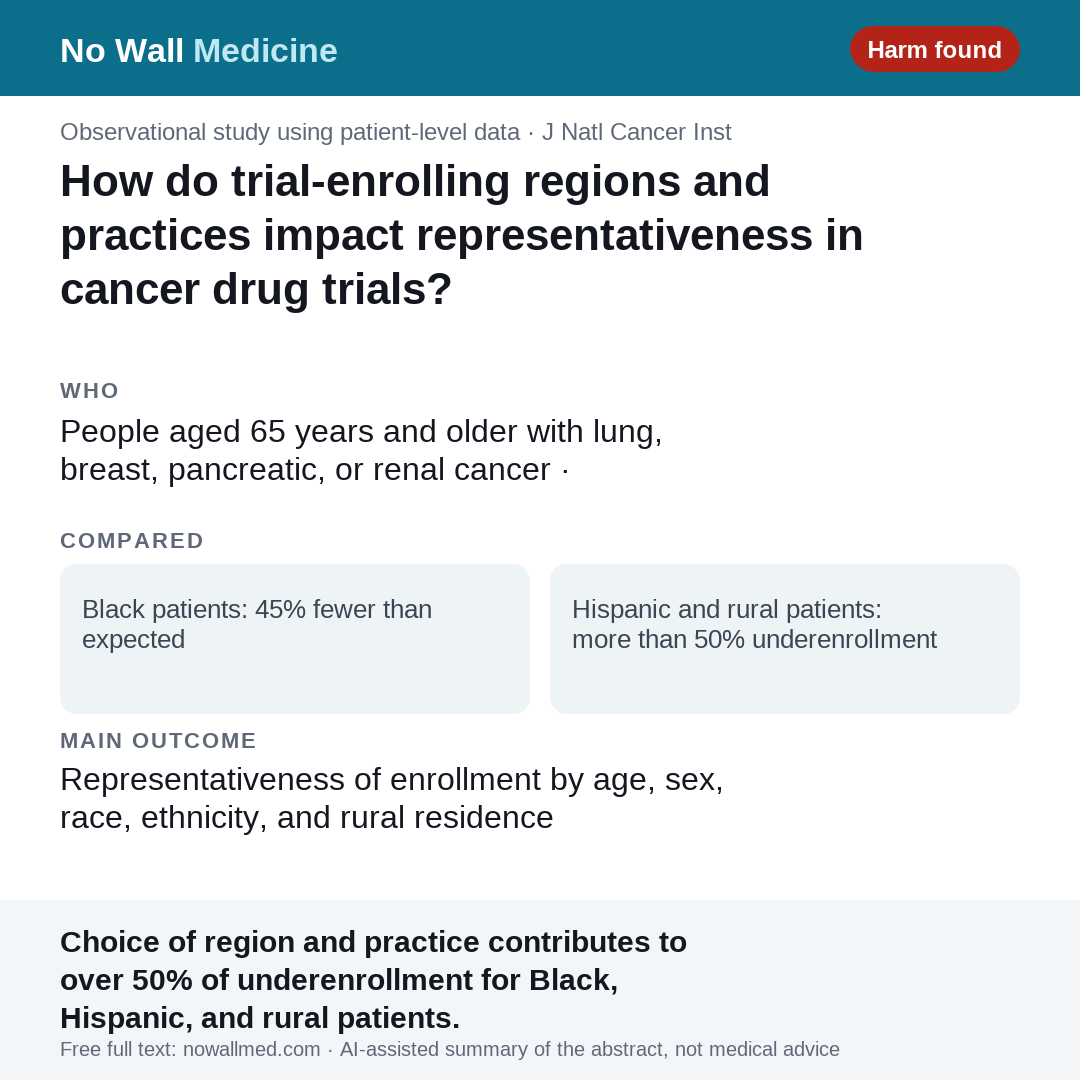
Clinical question: How do trial-enrolling regions and practices impact representativeness in cancer drug trials?
Why it matters: It was unknown how the choice of geographic regions and specific medical practices contributes to the lack of representative enrollment in randomized cancer drug trials.
Key points
- Researchers analyzed patient-level data from a cohort of people aged 65 years and older with lung, breast, pancreatic, or renal cancer between 2014 and 2019.
- The choice of trial-enrolling regions and practices was linked to more than 50% of the underenrollment of Black, Hispanic, and rural patients.
- Cancer trials enrolled 45% fewer Black patients than expected based on proportional representation.
Headline and key points written with AI from the paper’s abstract, with every number checked against it. Read the paper before relying on them.
Was this summary helpful?
Subject terms
Cite this article
Shah SJ, Manz CR, Balthis B, et al. The role of regional and practice trial sites in nonrepresentative randomized cancer trial enrollment. J Natl Cancer Inst. 2025. doi:10.1093/jnci/djaf071
Spotted a mistake? Suggest a correction