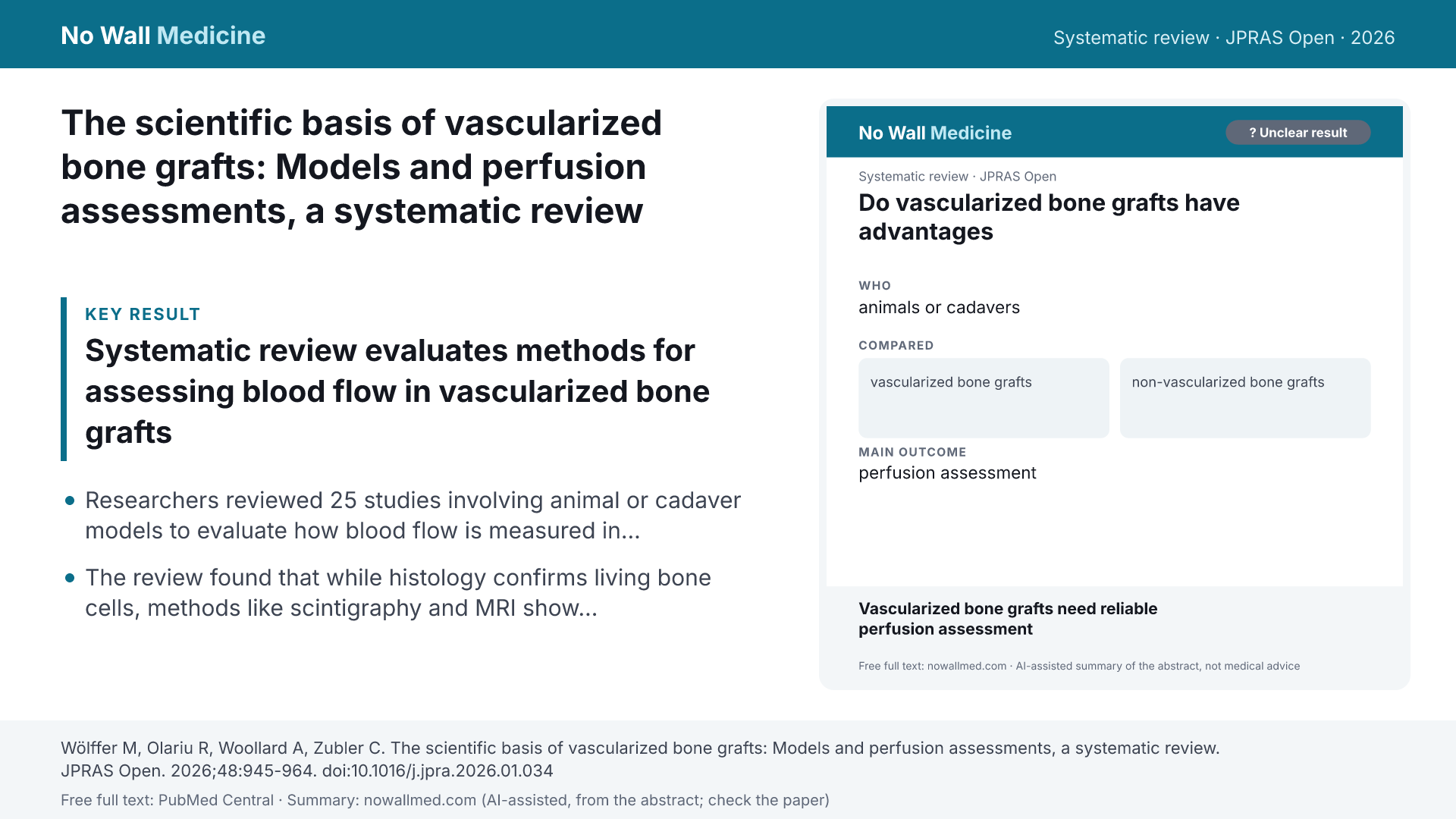
Systematic review evaluates methods for assessing blood flow in vascularized bone grafts
The scientific basis of vascularized bone grafts: Models and perfusion assessments, a systematic review
Systematic reviewUnclear result
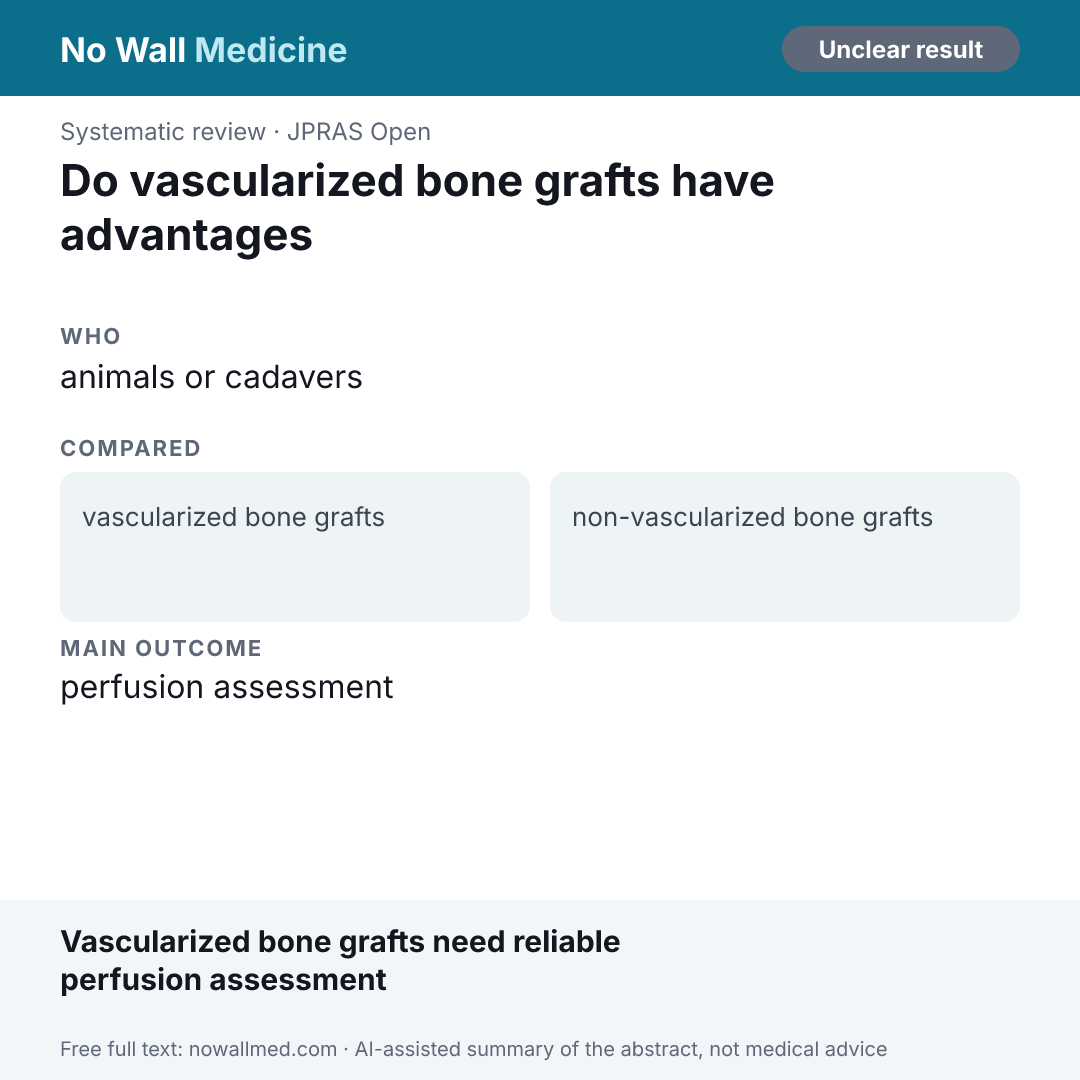
Do vascularized bone grafts have advantages
Who
animals or cadavers
Compared
vascularized bone grafts
non-vascularized bone grafts
Main outcome
perfusion assessment
Bottom line: Vascularized bone grafts need reliable perfusion assessment
Limitation: limited clinical evidence
JPRAS Open · 2026-01-30 · Save PNG
Why it matters: Clinical evidence for the superiority of vascularized bone grafts is limited, requiring a better understanding of how to assess blood flow in research models.
Key points
- Researchers reviewed 25 studies involving animal or cadaver models to evaluate how blood flow is measured in vascularized bone grafts.
- The review found that while histology confirms living bone cells, methods like scintigraphy and MRI show high false-positive rates.
- Near-infrared fluorescence imaging was found to be accurate during surgery but has limited use after the operation is finished.
Headline and key points written with AI from the paper’s abstract, with every number checked against it. Read the paper before relying on them.
Was this summary helpful?
Headline, design, result, key points, caveat and citation as plain text.
Cite this article
Wölffer M, Olariu R, Woollard A, Zubler C. The scientific basis of vascularized bone grafts: Models and perfusion assessments, a systematic review. JPRAS Open. 2026;48:945-964. doi:10.1016/j.jpra.2026.01.034
Spotted a mistake? Suggest a correction