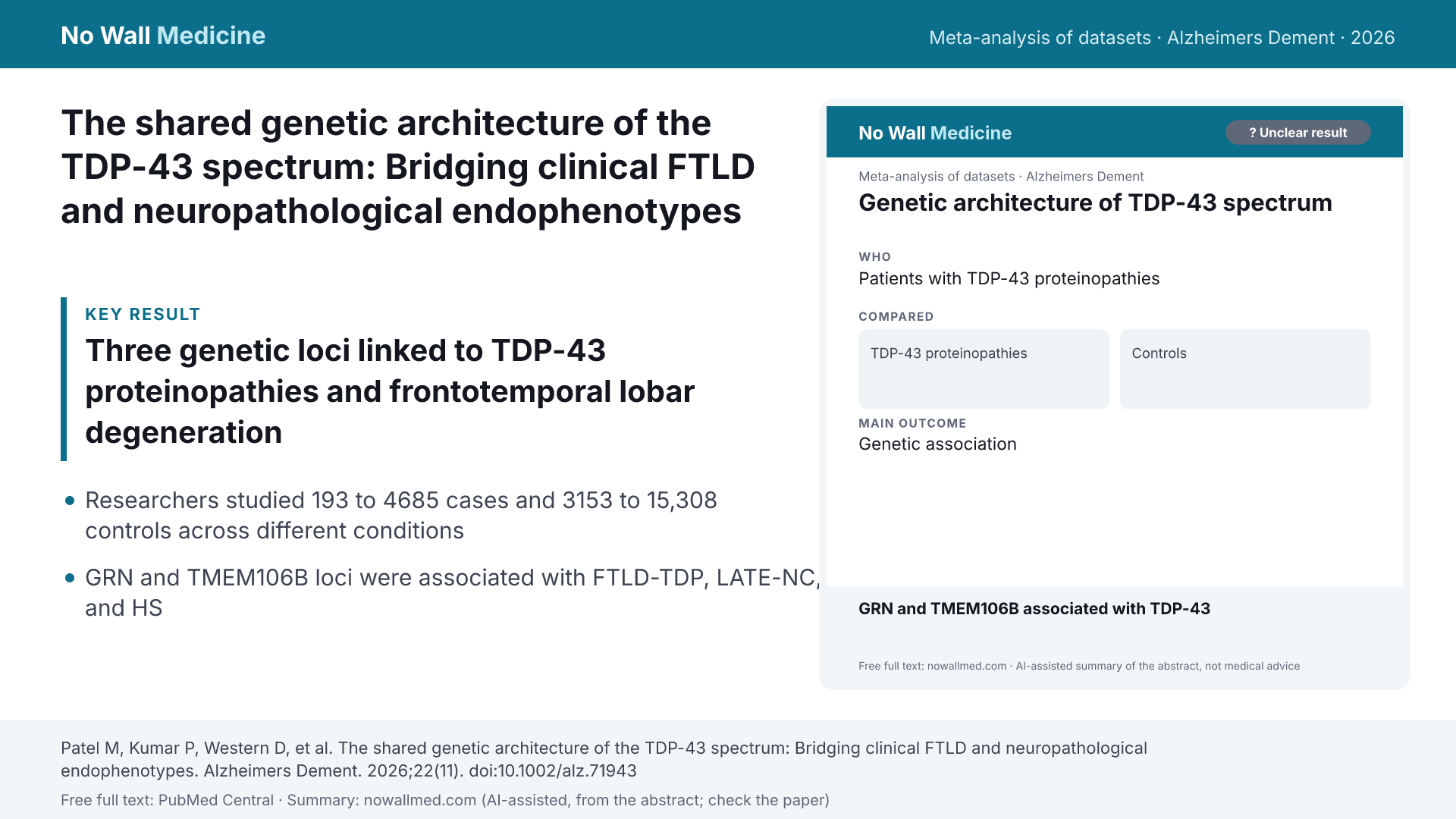
Three genetic loci linked to TDP-43 proteinopathies and frontotemporal lobar degeneration
The shared genetic architecture of the TDP-43 spectrum: Bridging clinical FTLD and neuropathological endophenotypes
Meta-analysis of datasetsUnclear result
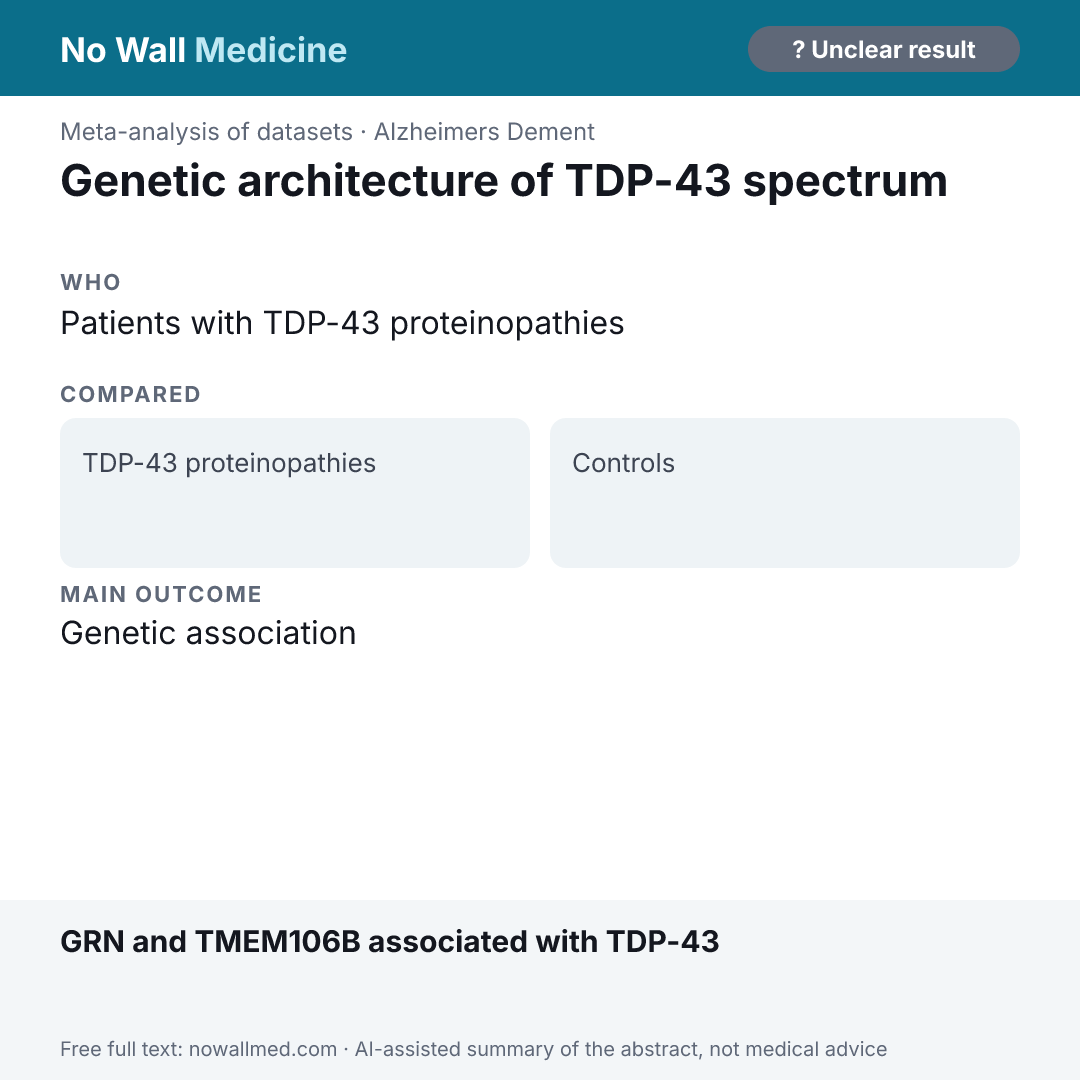
Genetic architecture of TDP-43 spectrum
Who
Patients with TDP-43 proteinopathies
Compared
TDP-43 proteinopathies
Controls
Main outcome
Genetic association
Bottom line: GRN and TMEM106B associated with TDP-43
Alzheimers Dement · 2026-11-04 · Save PNG
Why it matters: Genetic discoveries have been hindered by clinical and neuropathological variability across TDP-43 conditions
Key points
- Researchers studied 193 to 4685 cases and 3153 to 15,308 controls across different conditions.
- GRN and TMEM106B loci were associated with FTLD-TDP, LATE-NC, and HS.
- MAPT was associated with most TDP-43 proteinopathies and clinical frontotemporal lobar degeneration.
Headline and key points written with AI from the paper’s abstract, with every number checked against it. Read the paper before relying on them.
Was this summary helpful?
Subject terms
Headline, design, result, key points, caveat and citation as plain text.
Cite this article
Patel M, Kumar P, Western D, et al. The shared genetic architecture of the TDP-43 spectrum: Bridging clinical FTLD and neuropathological endophenotypes. Alzheimers Dement. 2026;22(11). doi:10.1002/alz.71943
Spotted a mistake? Suggest a correction