Statistical fragility in studies comparing rotator cuff repair with and without bone shaving
The Statistical Fragility of Functional Outcomes for Arthroscopic Rotator Cuff Repair With and Without Acromioplasty: A Systematic Review and Meta-analysis
Systematic review and meta-analysisUnclear result
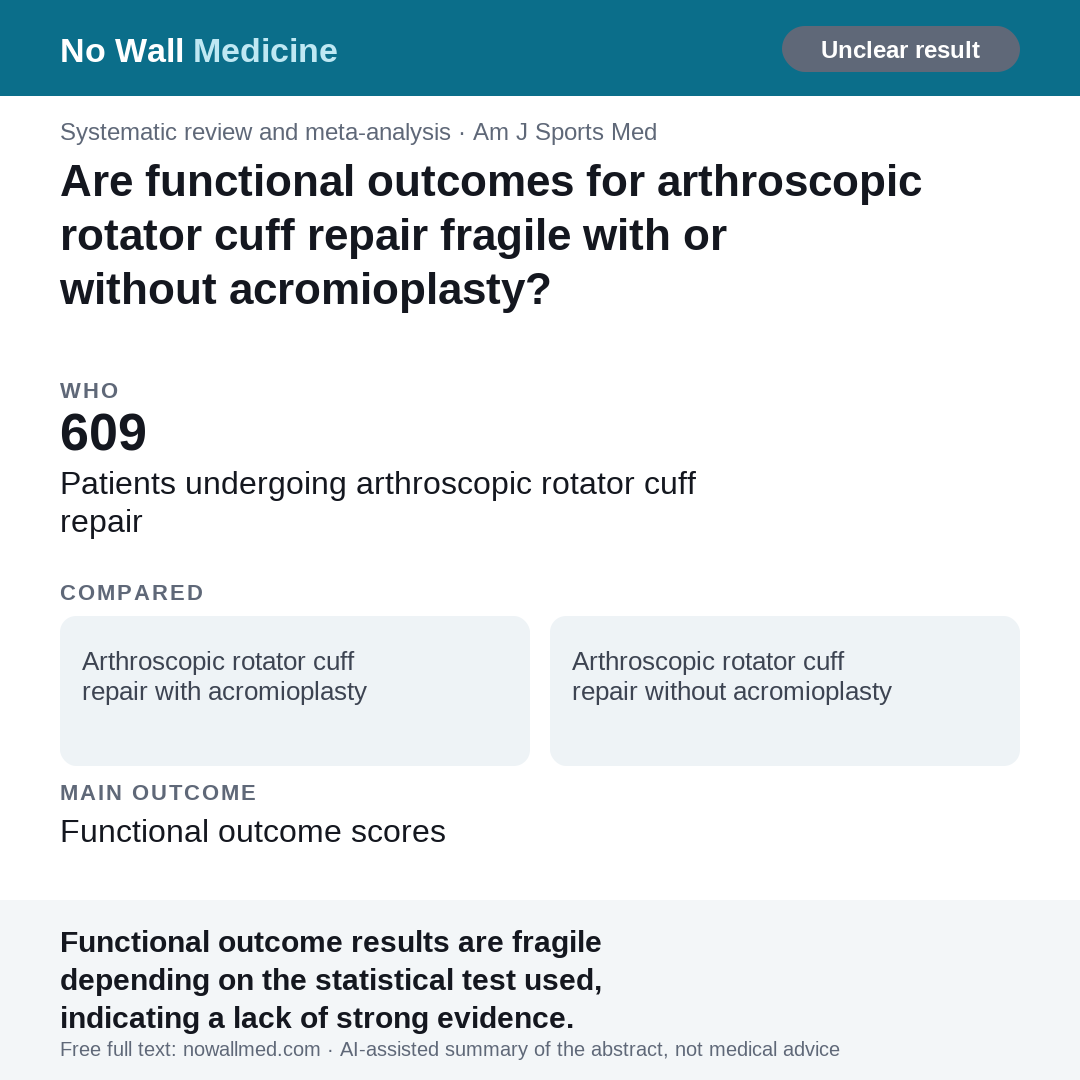
Are functional outcomes for arthroscopic rotator cuff repair fragile with or without acromioplasty?
Who
609
Patients undergoing arthroscopic rotator cuff repair
Compared
Arthroscopic rotator cuff repair with acromioplasty
Arthroscopic rotator cuff repair without acromioplasty
Main outcome
Functional outcome scores
Result: median RCFI 14 (IQR, 13-19) for Student t test
Bottom line: Functional outcome results are fragile depending on the statistical test used, indicating a lack of strong evidence.
Am J Sports Med · 2025-01-21Download image
Clinical question: Are functional outcomes for arthroscopic rotator cuff repair fragile with or without acromioplasty?
Why it matters: It is unclear if previous conclusions regarding functional outcomes after rotator cuff repair with or without acromioplasty are supported by strong evidence.
Key points
- Researchers analyzed 6 clinical trials involving 609 patients to assess the stability of functional outcome scores after arthroscopic rotator cuff repair with or without acromioplasty, which is bone shaving.
- Using the Student t test, the median reverse continuous fragility index was 14, meaning only 14 data points would need to change to alter the statistical significance of the results.
- When using the Student t test or Wilcoxon rank-sum test, only 32% of study outcomes had a fragility index greater than the loss to follow-up rate.
Limitation the authors note: The authors note a small number of studies and loss to follow-up rates that are close to or exceed 20%.
Headline and key points written with AI from the paper’s abstract, with every number checked against it. Read the paper before relying on them.
Was this summary helpful?
Subject terms
Cite this article
Clark DS, Tingey BC, Shi JL, Somerson JS. The Statistical Fragility of Functional Outcomes for Arthroscopic Rotator Cuff Repair With and Without Acromioplasty: A Systematic Review and Meta-analysis. Am J Sports Med. 2025. doi:10.1177/03635465241302797
Spotted a mistake? Suggest a correction
Top studies every Monday
The week’s key trials and guidelines in your specialties, plus any topics you follow. By email, free.
Get the weekly digest