Subcortical brain regions are part of the default mode network and show alterations in Alzheimer's disease
The subcortical default mode network and Alzheimer's disease: a systematic review and meta-analysis
Systematic review and meta-analysisBenefit found
Does the subcortical default mode network involve specific regions and change in Alzheimer's disease?
Who
Healthy adults and patients with Alzheimer's disease
Compared
Healthy adults: includes thalamus, cerebellum, and amygdala
Alzheimer's disease: decrease in left medial temporal lobe and amygdala connectivity
Main outcome
Subcortical default mode network involvement and functional connectivity alterations
Bottom line: The default mode network includes subcortical regions which show altered functional connectivity in Alzheimer's disease.
Brain Commun · 2024-04-10Download image
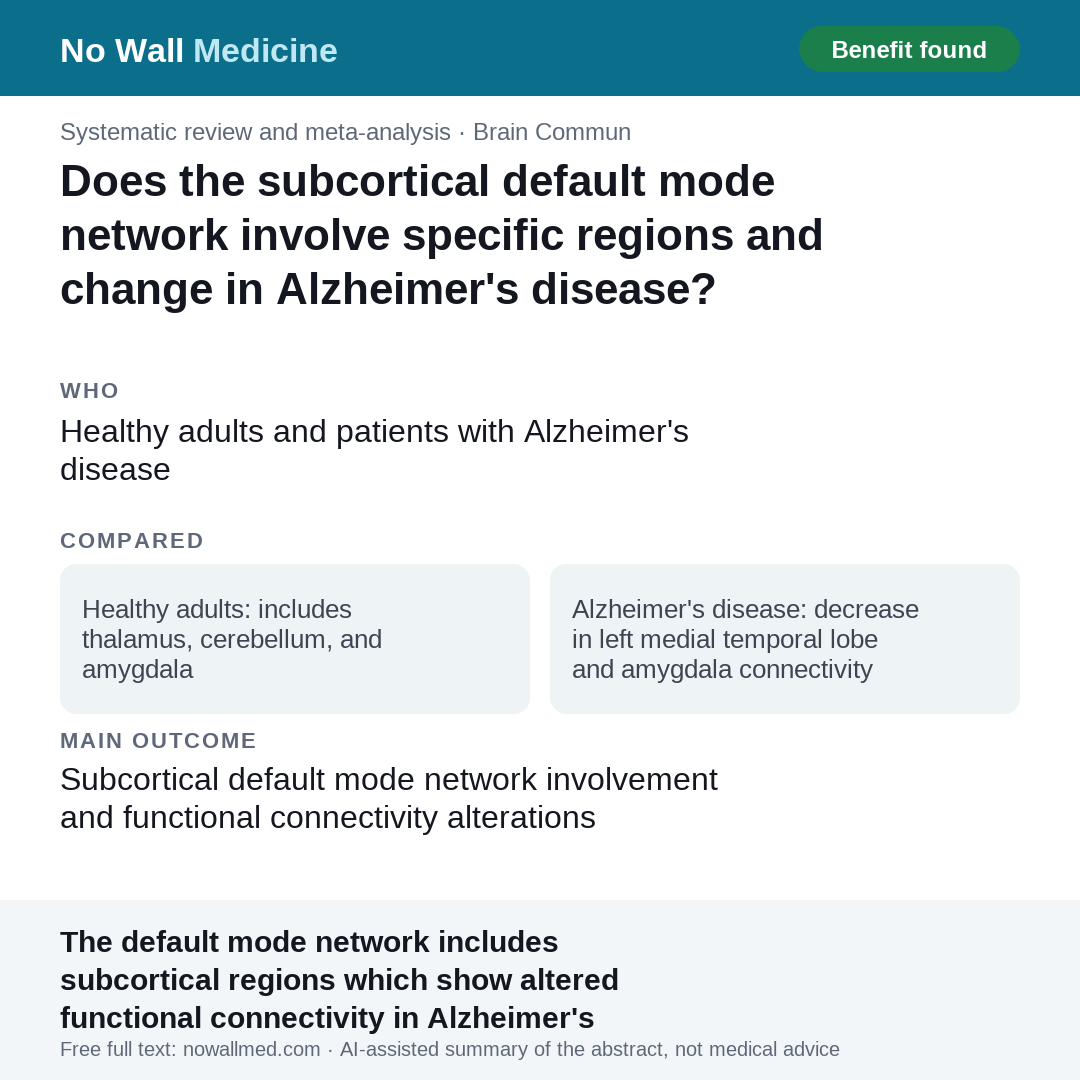
Clinical question: Does the subcortical default mode network involve specific regions and change in Alzheimer's disease?
Why it matters: The extent of subcortical involvement in the default mode network and how these areas change in Alzheimer's disease was largely unknown.
Key points
- Researchers performed a systematic review and meta-analysis to identify subcortical areas within the default mode network, a brain network active during rest.
- The default mode network consistently includes the thalamus, amygdala, and parts of the cerebellum in healthy adults.
- In Alzheimer's disease, decreased functional connectivity—the strength of communication between brain regions—was associated with the left amygdala and left anterior hippocampus.
Headline and key points written with AI from the paper’s abstract, with every number checked against it. Read the paper before relying on them.
Was this summary helpful?
Cite this article
Seoane S, van den Heuvel M, Acebes Á, Janssen N. The subcortical default mode network and Alzheimer's disease: a systematic review and meta-analysis. Brain Commun. 2024. doi:10.1093/braincomms/fcae128
Spotted a mistake? Suggest a correction
Top studies every Monday
The week’s key trials and guidelines in your specialties, plus any topics you follow. By email, free.
Get the weekly digest