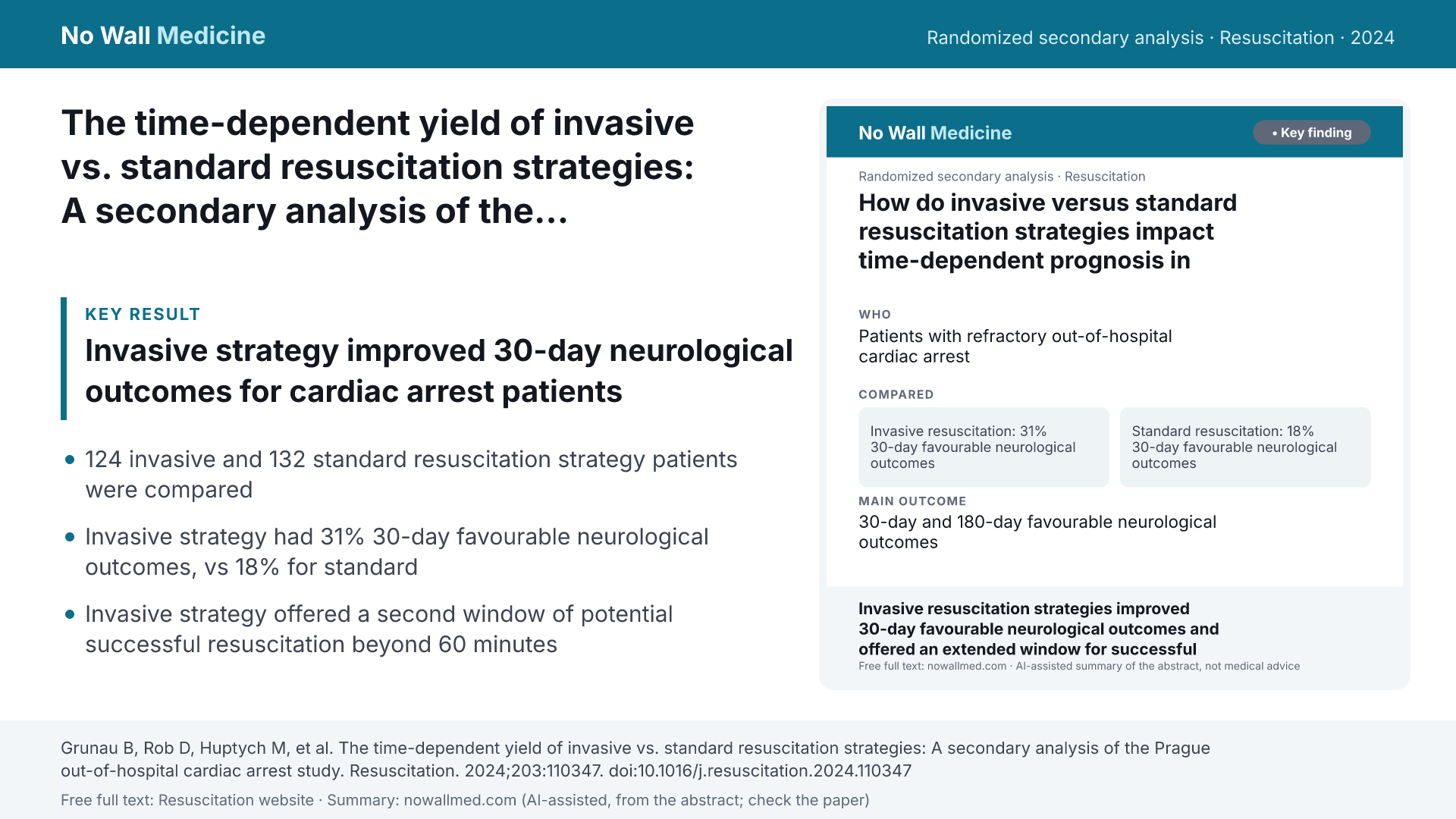
Invasive strategy improved 30-day neurological outcomes for cardiac arrest patients
The time-dependent yield of invasive vs. standard resuscitation strategies: A secondary analysis of the Prague out-of-hospital cardiac arrest study
Randomized secondary analysisKey finding
How do invasive versus standard resuscitation strategies impact time-dependent prognosis in out-of-hospital cardiac arrest?
Who
Patients with refractory out-of-hospital cardiac arrest
Compared
Invasive resuscitation: 31% 30-day favourable neurological outcomes
Standard resuscitation: 18% 30-day favourable neurological outcomes
Main outcome
30-day and 180-day favourable neurological outcomes
Result: difference 12%; 95%CI 2.0, 23
Bottom line: Invasive resuscitation strategies improved 30-day favourable neurological outcomes and offered an extended window for successful resuscitation.
Resuscitation · 2024-08-02 · Save PNG
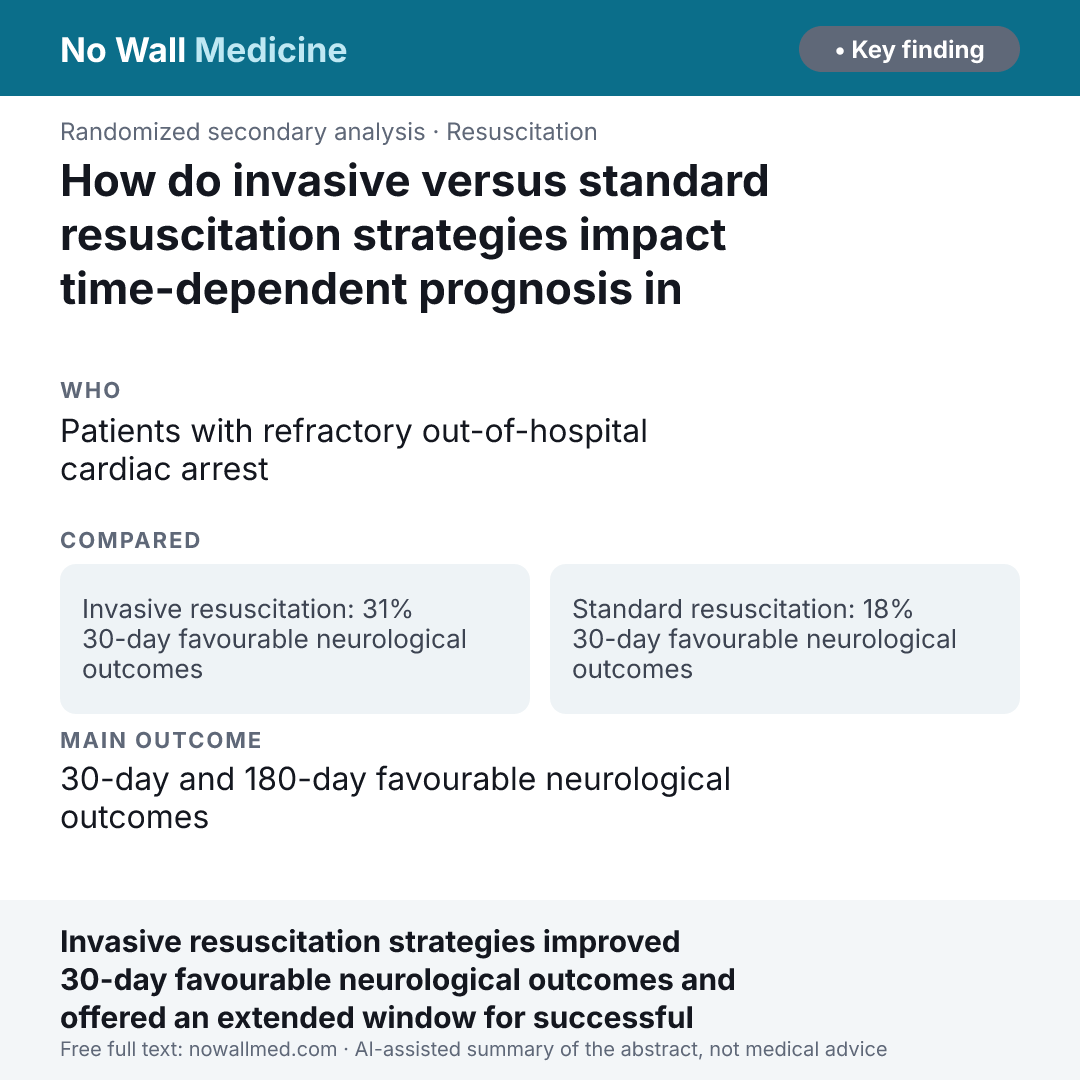
Clinical question: How do invasive versus standard resuscitation strategies impact time-dependent prognosis in out-of-hospital cardiac arrest?
Key points
- 124 invasive and 132 standard resuscitation strategy patients were compared.
- Invasive strategy had 31% 30-day favourable neurological outcomes, vs 18% for standard.
- Invasive strategy offered a second window of potential successful resuscitation beyond 60 minutes.
Limitation the authors note: None stated in the abstract
Headline and key points written with AI from the paper’s abstract, with every number checked against it. Read the paper before relying on them.
Was this summary helpful?
Subject terms
Headline, design, result, key points, caveat and citation as plain text.
Cite this article
Grunau B, Rob D, Huptych M, et al. The time-dependent yield of invasive vs. standard resuscitation strategies: A secondary analysis of the Prague out-of-hospital cardiac arrest study. Resuscitation. 2024;203:110347. doi:10.1016/j.resuscitation.2024.110347
Spotted a mistake? Suggest a correction