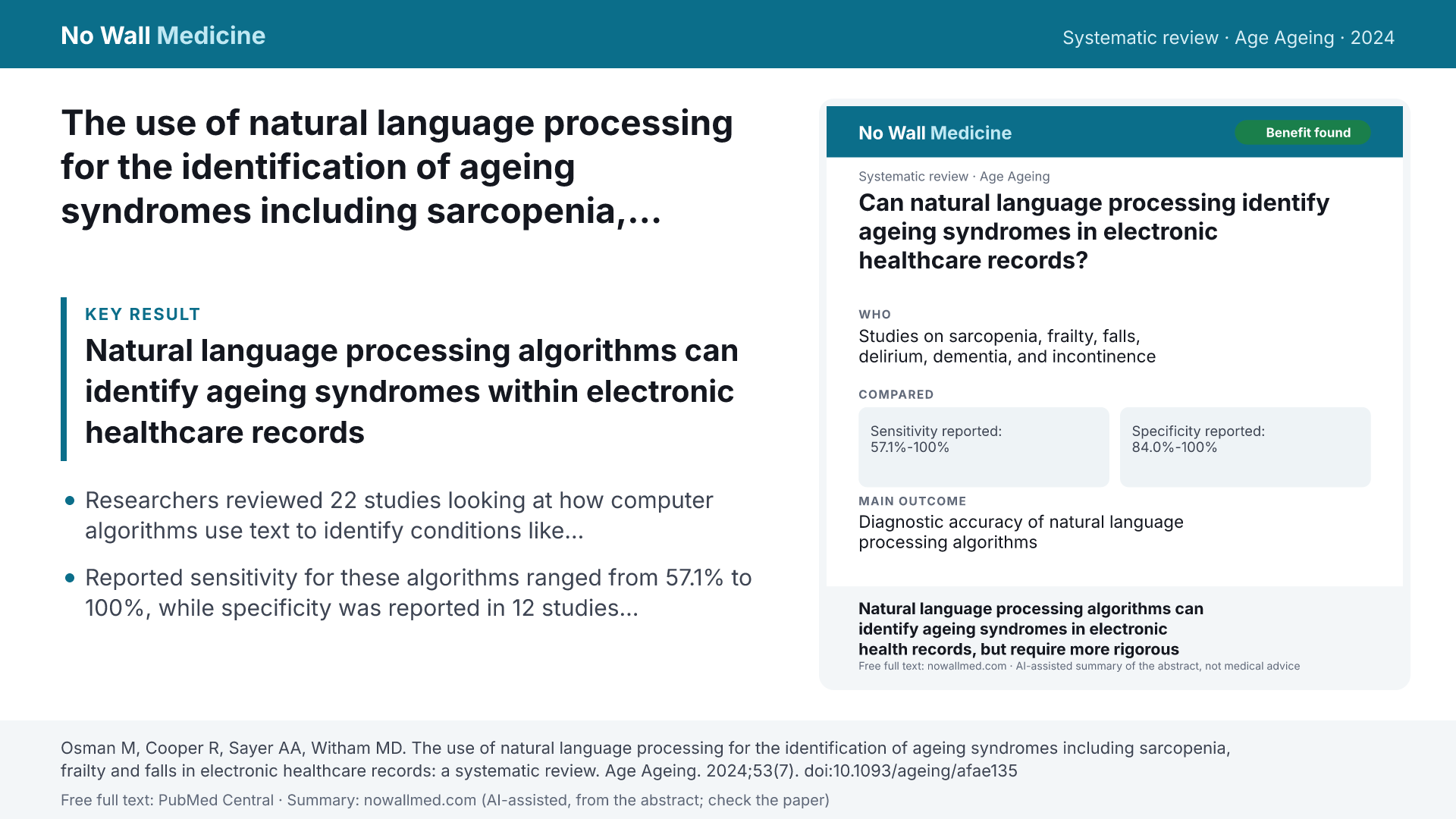
The use of natural language processing for the identification of ageing syndromes including sarcopenia, frailty and falls in electronic healthcare records: a systematic review
Key result: Natural language processing algorithms can identify ageing syndromes within electronic healthcare records
Systematic reviewBenefit found
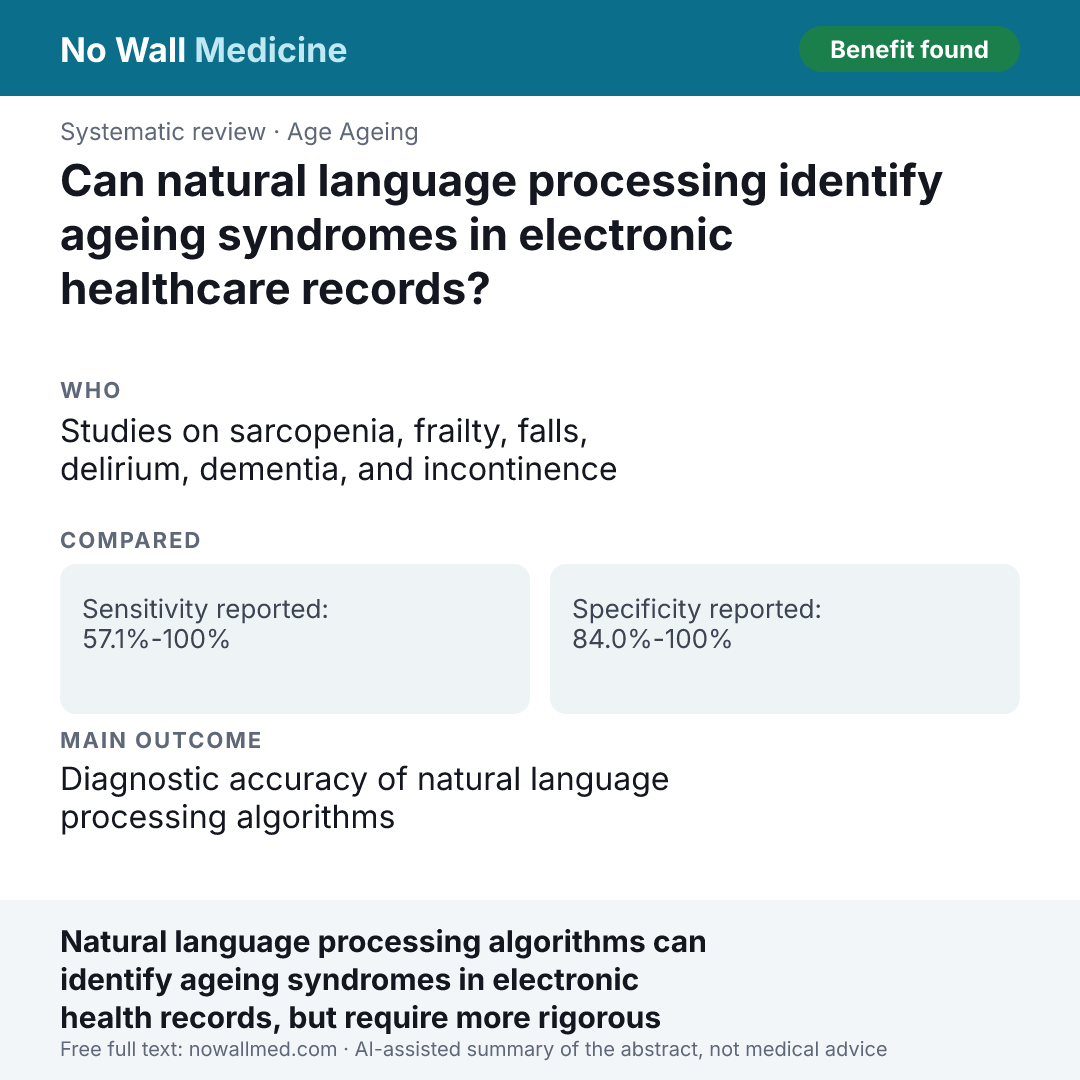
Can natural language processing identify ageing syndromes in electronic healthcare records?
Who
Studies on sarcopenia, frailty, falls, delirium, dementia, and incontinence
Compared
Sensitivity reported: 57.1%-100%
Specificity reported: 84.0%-100%
Main outcome
Diagnostic accuracy of natural language processing algorithms
Bottom line: Natural language processing algorithms can identify ageing syndromes in electronic health records, but require more rigorous diagnostic accuracy studies.
Limitation: Variable study quality, inconsistent reporting of diagnostic accuracy, and few studies with external validation.
Age Ageing · 2024-07-06 · Save PNG
Key points
- Researchers reviewed 22 studies looking at how computer algorithms use text to identify conditions like sarcopenia, frailty, falls, delirium, dementia, and incontinence.
- Reported sensitivity for these algorithms ranged from 57.1% to 100%, while specificity was reported in 12 studies between 84.0% and 100%.
- The quality of study designs was variable, and few studies performed external validation of the algorithms.
Discussion prompts
- Would these patients look like yours? Who was left out?
- Is the main outcome one that matters to patients?
- Is the difference large enough to change what you do?
Cite: Osman M, Cooper R, Sayer AA, Witham MD. The use of natural language processing for the identification of ageing syndromes including sarcopenia, frailty and falls in electronic healthcare records: a systematic review. Age Ageing. 2024;53(7). doi:10.1093/ageing/afae135
Free full text: PubMed Central · Summary and visual abstract: nowallmed.com/a/the-use-of-natural-language-processing-for-the-identification-of-1vbo5vy/ (AI-assisted from the abstract; check the paper before relying on it).