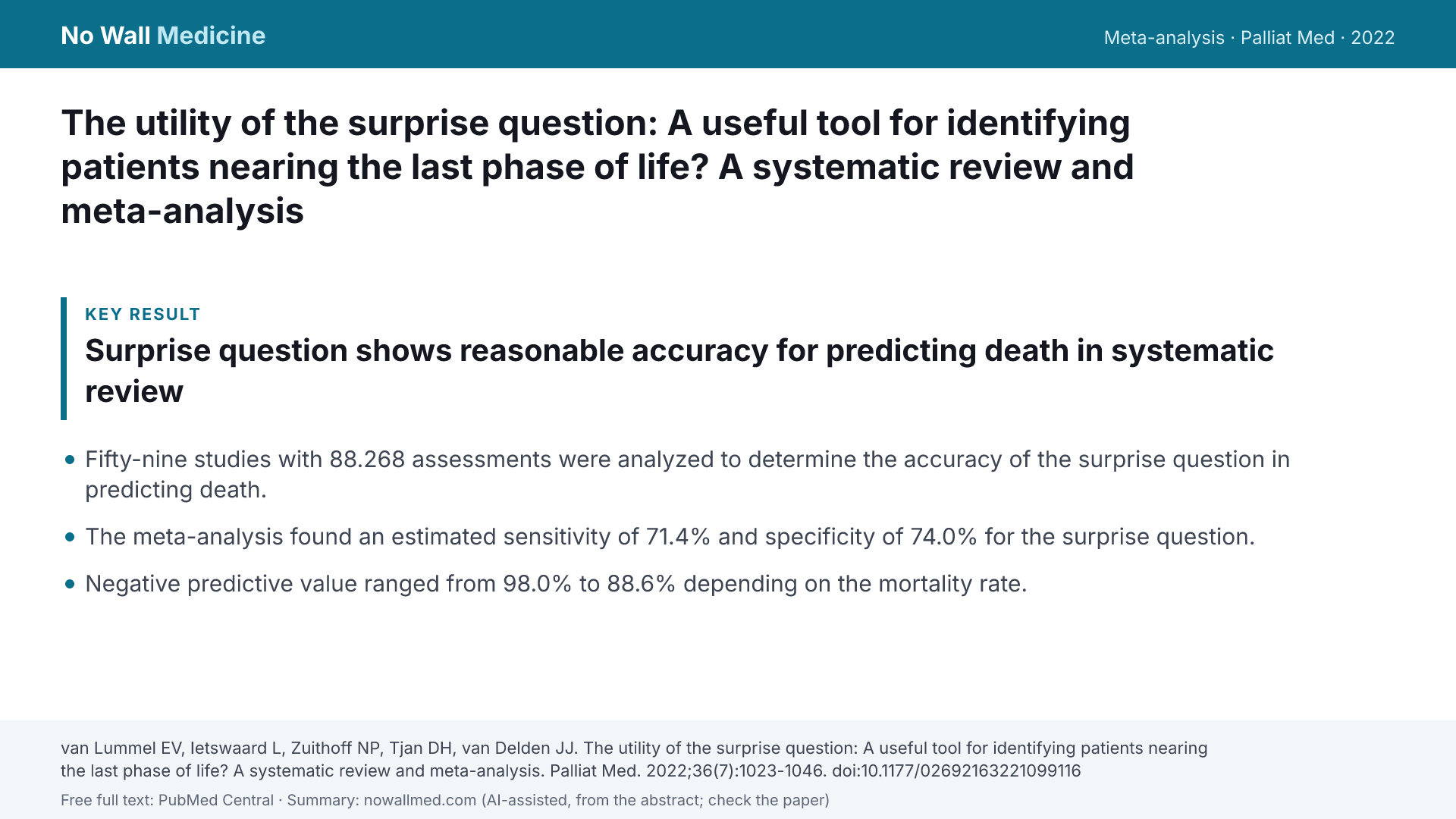
Surprise question shows reasonable accuracy for predicting death in systematic review
The utility of the surprise question: A useful tool for identifying patients nearing the last phase of life? A systematic review and meta-analysis
Why it matters: Potential differences in accuracy between timeframe, patient subgroups and type of healthcare professionals answering the surprise question have been suggested.
Key points
- Fifty-nine studies with 88.268 assessments were analyzed to determine the accuracy of the surprise question in predicting death.
- The meta-analysis found an estimated sensitivity of 71.4% and specificity of 74.0% for the surprise question.
- Negative predictive value ranged from 98.0% to 88.6% depending on the mortality rate.
Headline and key points written with AI from the paper’s abstract, with every number checked against it. Read the paper before relying on them.
Was this summary helpful?
Subject terms
Headline, design, result, key points, caveat and citation as plain text.
Cite this article
van Lummel EV, Ietswaard L, Zuithoff NP, Tjan DH, van Delden JJ. The utility of the surprise question: A useful tool for identifying patients nearing the last phase of life? A systematic review and meta-analysis. Palliat Med. 2022. doi:10.1177/02692163221099116
Spotted a mistake? Suggest a correction