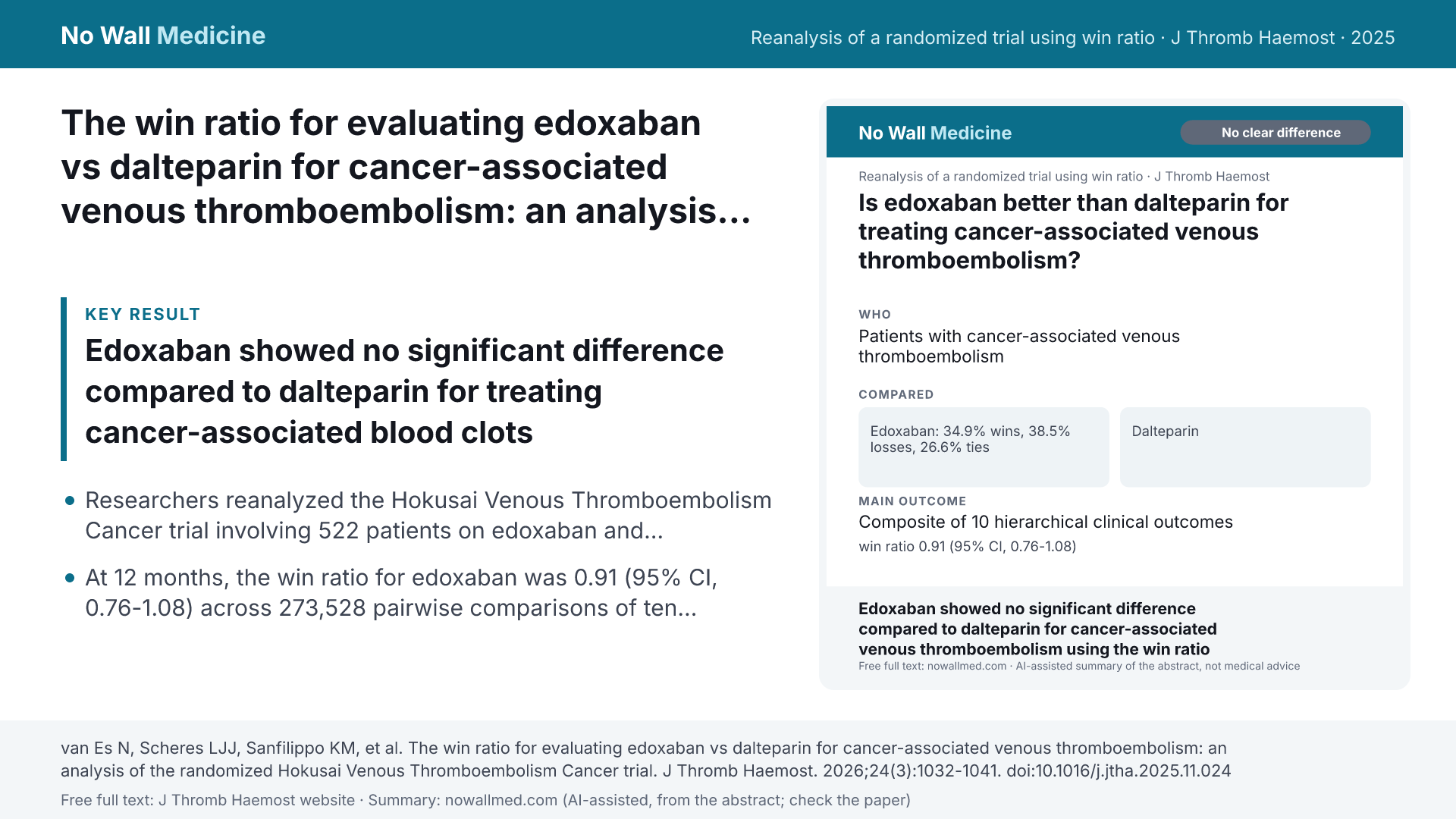
Edoxaban showed no significant difference compared to dalteparin for treating cancer-associated blood clots
The win ratio for evaluating edoxaban vs dalteparin for cancer-associated venous thromboembolism: an analysis of the randomized Hokusai Venous Thromboembolism Cancer trial
Reanalysis of a randomized trial using win ratioNo clear difference
Is edoxaban better than dalteparin for treating cancer-associated venous thromboembolism?
Who
Patients with cancer-associated venous thromboembolism
Compared
Edoxaban: 34.9% wins, 38.5% losses, 26.6% ties
Dalteparin
Main outcome
Composite of 10 hierarchical clinical outcomes
Result: win ratio 0.91 (95% CI, 0.76-1.08)
Bottom line: Edoxaban showed no significant difference compared to dalteparin for cancer-associated venous thromboembolism using the win ratio approach.
J Thromb Haemost · 2025-12-19Download image
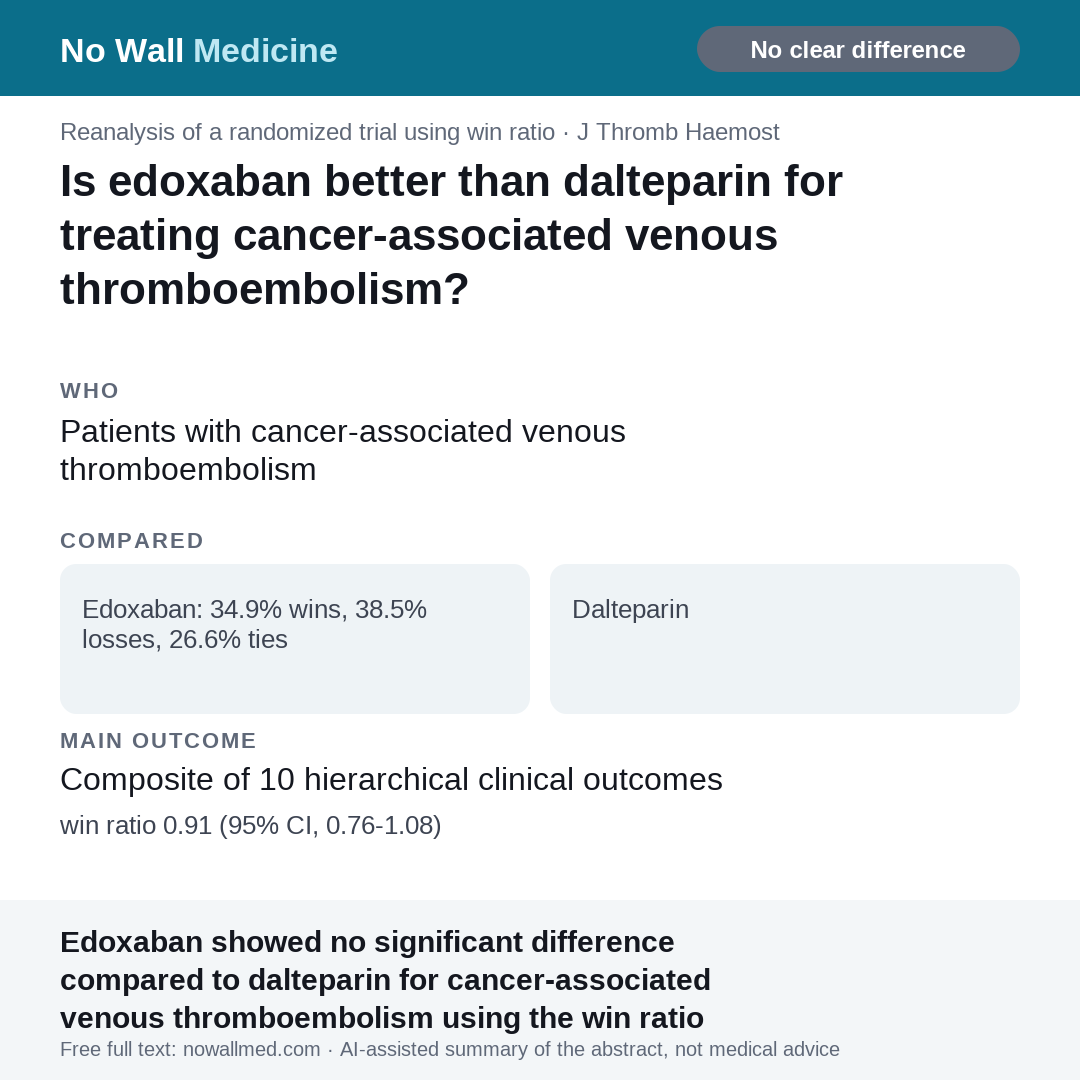
Clinical question: Is edoxaban better than dalteparin for treating cancer-associated venous thromboembolism?
Why it matters: Researchers used a win ratio approach to evaluate a composite of ten different clinical outcomes in a hierarchical order for patients with cancer-associated venous thromboembolism.
Key points
- Researchers reanalyzed the Hokusai Venous Thromboembolism Cancer trial involving 522 patients on edoxaban and 524 patients on dalteparin.
- At 12 months, the win ratio for edoxaban was 0.91 (95% CI, 0.76-1.08) across 273,528 pairwise comparisons of ten ranked outcomes.
- The win ratio remained unchanged at 6 months with a value of 0.91 (95% CI, 0.75-1.11).
Headline and key points written with AI from the paper’s abstract, with every number checked against it. Read the paper before relying on them.
Was this summary helpful?
Subject terms
Headline, design, result, key points, caveat and citation as plain text.
Cite this article
van Es N, Scheres LJJ, Sanfilippo KM, et al. The win ratio for evaluating edoxaban vs dalteparin for cancer-associated venous thromboembolism: an analysis of the randomized Hokusai Venous Thromboembolism Cancer trial. J Thromb Haemost. 2025. doi:10.1016/j.jtha.2025.11.024
Spotted a mistake? Suggest a correction