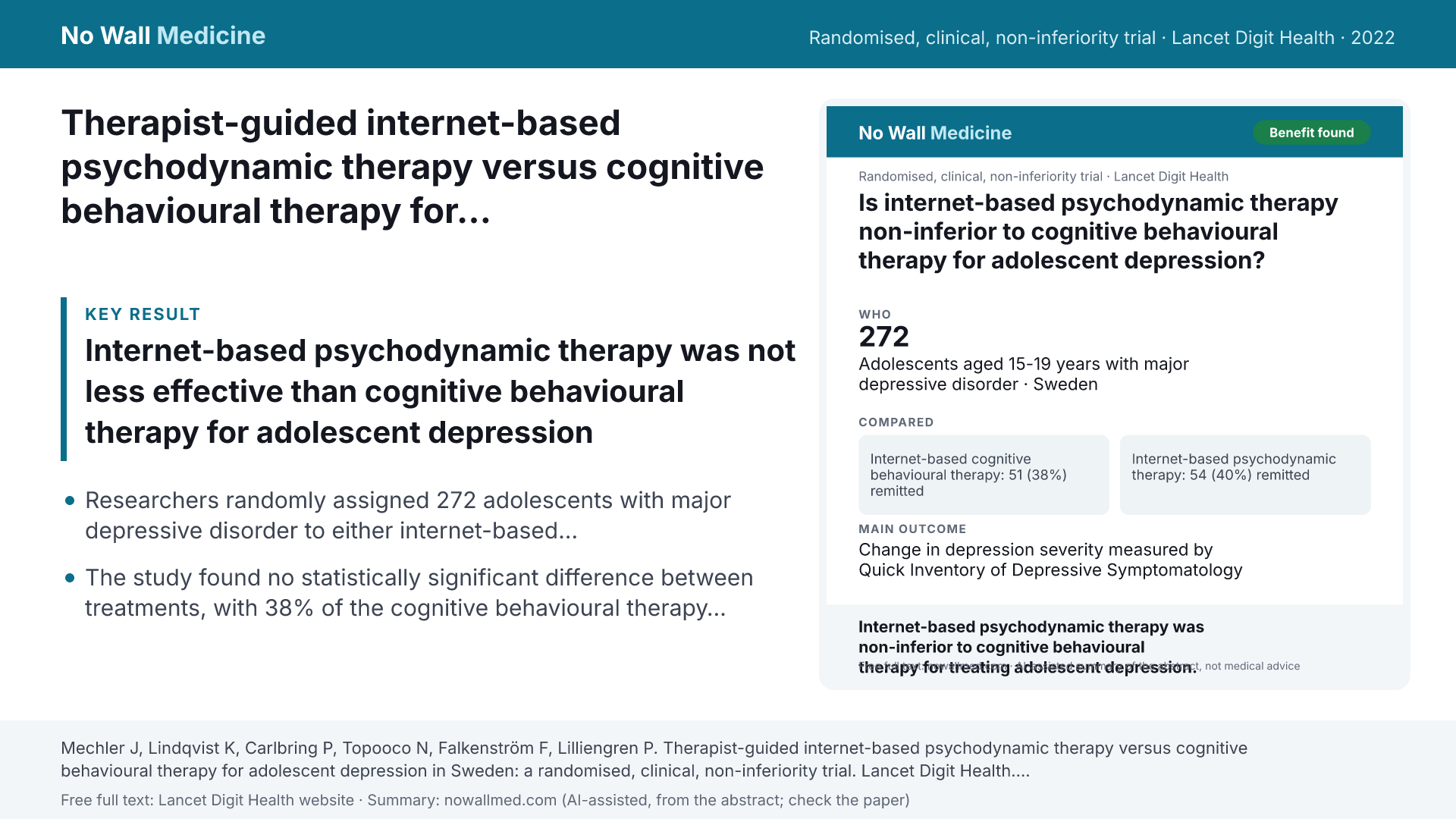
Internet-based psychodynamic therapy was not less effective than cognitive behavioural therapy for adolescent depression
Therapist-guided internet-based psychodynamic therapy versus cognitive behavioural therapy for adolescent depression in Sweden: a randomised, clinical, non-inferiority trial
Randomised, clinical, non-inferiority trialBenefit found
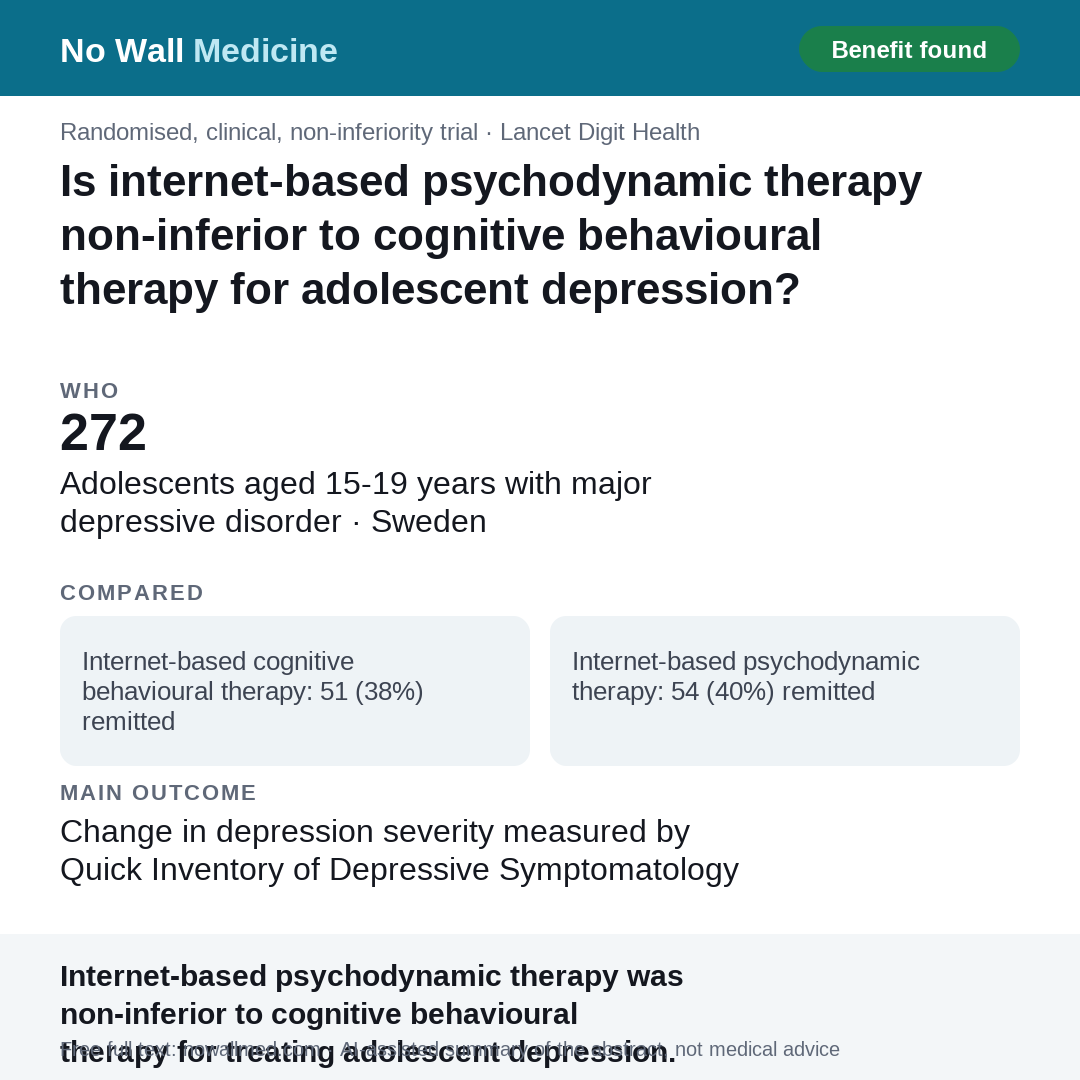
Is internet-based psychodynamic therapy non-inferior to cognitive behavioural therapy for adolescent depression?
Who
272
Adolescents aged 15-19 years with major depressive disorder · Sweden
Compared
Internet-based cognitive behavioural therapy: 51 (38%) remitted
Internet-based psychodynamic therapy: 54 (40%) remitted
Main outcome
Change in depression severity measured by Quick Inventory of Depressive Symptomatology for Adolescents
Result: d=-0·18, 90% CI -0·49 to 0·13
Bottom line: Internet-based psychodynamic therapy was non-inferior to cognitive behavioural therapy for treating adolescent depression.
Funded by: Kavli trust
Lancet Digit Health · 2022-07-05Download image
Clinical question: Is internet-based psychodynamic therapy non-inferior to cognitive behavioural therapy for adolescent depression?
Why it matters: Accessible treatment alternatives are needed for adolescents with major depressive disorder beyond established evidence-based options.
Key points
- Researchers randomly assigned 272 adolescents with major depressive disorder to either internet-based cognitive behavioural therapy or internet-based psychodynamic therapy.
- The study found no statistically significant difference between treatments, with 38% of the cognitive behavioural therapy group and 40% of the psychodynamic therapy group reaching remission.
- Psychodynamic therapy met the predefined non-inferiority margin for changes in depression severity during the 10-week treatment period.
Headline and key points written with AI from the paper’s abstract, with every number checked against it. Read the paper before relying on them.
Was this summary helpful?
Abstract
Background
Adolescent major depressive disorder (MDD) is highly prevalent and associated with lifelong adversity. Evidence-based treatments exist, but accessible treatment alternatives are needed. We aimed to compare internet-based psychodynamic therapy (IPDT) with an established evidence-based treatment (internet-based cognitive behavioural therapy [ICBT]) for the treatment of adolescents with depression. Methods
In this randomised, clinical trial, we tested whether IPDT was non-inferior to ICBT in the treatment of adolescent MDD. Eligible participants were 15-19 years old, presenting with a primary diagnosis of MDD according to DSM-5. Participants were recruited nationwide in Sweden through advertisements on social media, as well as contacts with junior and senior high schools, youth associations, social workers, and health-care providers. Adolescents who scored 9 or higher on the Quick Inventory of Depressive Symptomatology for Adolescents (QIDS-A17-SR) in an initial online screening were contacted by telephone for a diagnostic assessment using the Mini International Neuropsychiatric Interview. Participants were randomly assigned to ICBT or IPDT. Both interventions comprised eight self-help modules delivered over 10 weeks on a secure online platform. The primary outcome was change in depression severity measured weekly by the QIDS-A17-SR. Primary analyses were based on an intention-to-treat sample including all participants randomly assigned. A non-inferiority margin of Cohen's d=0·30 was predefined. The study is registered at ISRCTN, ISRCTN12552584. Findings
Between Aug 19, 2019, and Oct 7, 2020, 996 young people completed screening; 516 (52%) were contacted for a diagnostic interview. 272 participants were eligible and randomly assigned to ICBT (n=136) or IPDT (n=136). In the ICBT group, 51 (38%) of 136 participants were classified as remitted, and 54 (40%) of 136 participants were classified as remitted in the IPDT group. Within-group effects were large (ICBT: within-group d=1·75, 95% CI 1·49 to 2·01; IPDT: within-group d=1·93, 1·67 to 2·20; both p<0·0001). No statistically significant treatment difference was found in the intention-to-treat analysis. Non-inferiority for IPDT was shown for the estimated change in depression during treatment (d=-0·18, 90% CI -0·49 to 0·13; p=0·34). All secondary outcomes showed non-significant between-group differences. Interpretation
IPDT was non-inferior to ICBT in terms of change in depression for the treatment of adolescents with MDD. This finding increases the range of accessible and effective treatment alternatives for adolescents with depression. Funding
Kavli trust.
Abstract reproduced under the article’s CC BY licence.
Subject terms
Cite this article
Mechler J, Lindqvist K, Carlbring P, Topooco N, Falkenström F, Lilliengren P. Therapist-guided internet-based psychodynamic therapy versus cognitive behavioural therapy for adolescent depression in Sweden: a randomised, clinical, non-inferiority trial. Lancet Digit Health. 2022. doi:10.1016/S2589-7500(22)00095-4
Spotted a mistake? Suggest a correction