Thompson Versus Judet Techniques for Quadricepsplasty: A Systematic Review and Meta-analysis of Outcomes and Complications
Systematic review and meta-analysisNo clear difference
How do Thompson and Judet quadricepsplasty techniques compare for knee contractures?
Who
797
Patients with knee contractures undergoing quadricepsplasty
Compared
Thompson quadricepsplasty: mean postoperative active flexion of 106.4°
Judet quadricepsplasty: mean postoperative active flexion of 92.7°
Main outcome
postoperative range of motion, outcome scores, and complication rates
Bottom line: Both techniques are successful, though Thompson showed greater flexion which may be clinically negligible.
JBJS Open Access · 2024-07-30Download image
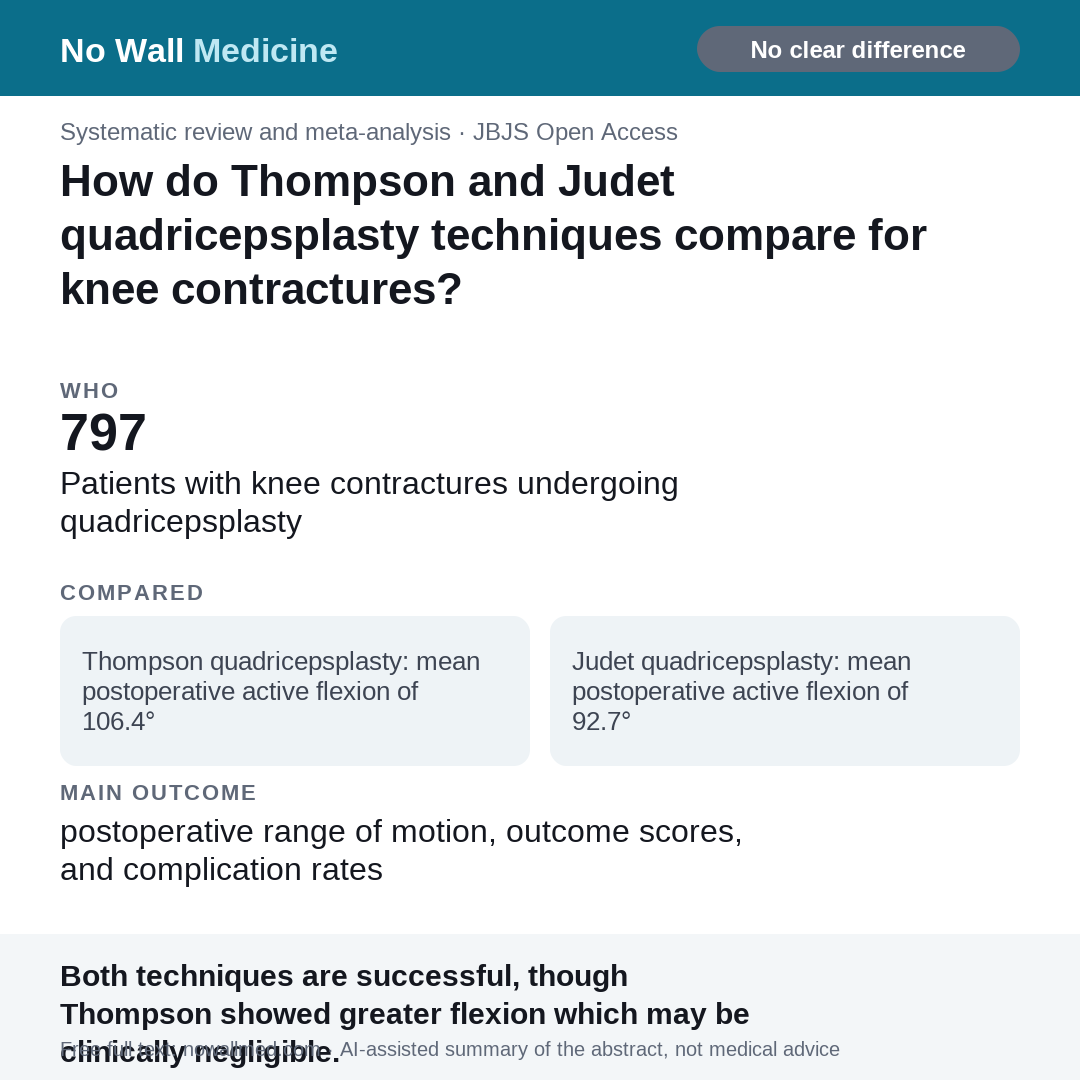
Clinical question: How do Thompson and Judet quadricepsplasty techniques compare for knee contractures?
Abstract
Background
Quadricepsplasty has been used for over half a century to improve range of motion (ROM) in knees with severe arthrofibrosis. Various surgical techniques for quadricepsplasty exist, including Judet and Thompson, as well as novel minimally invasive approaches. The goal of this review was to compare outcomes between quadricepsplasty techniques for knee contractures. Methods
A systematic review was performed according to the Preferred Reporting Items for Systematic Reviews and Meta-Analyses guidelines. Available databases were queried for all articles on quadricepsplasty. Outcomes included postoperative ROM, outcome scores, and complication rates. Secondarily, we summarized rehabilitation protocols and descriptions of all modified and novel techniques. Results
Thirty-three articles comprising 797 patients were included in final analysis. Thirty-five percent of patients underwent Thompson quadricepsplasty, 36% underwent Judet, and 29% underwent other techniques. After Judet and Thompson quadricepsplasty, patients achieved a mean postoperative active flexion of 92.7° and 106.4°, respectively (p < 0.01). Complication rates after Judet and Thompson were 17% and 24%, respectively. Wound infection was the most frequently recorded complication after Judet, whereas extension lag predominated for Thompson. Conclusion
Both the Thompson and Judet quadricepsplasty techniques offer successful treatment options to restore functional knee ROM. Although the Thompson technique resulted in greater postoperative knee flexion compared with the Judet, the difference may be attributable to differences in preoperative flexion and time from injury to quadricepsplasty. Overall, the difference in flexion gained between the 2 techniques is comparable and clinically negligible. Level of evidence
Level IV. See Instructions for Authors for a complete description of levels of evidence.
Cite this article
Gutowski CT, Hedden K, Johnsen P, Dibato JE, Rivera-Pintado C, Graf K. Thompson Versus Judet Techniques for Quadricepsplasty: A Systematic Review and Meta-analysis of Outcomes and Complications. JBJS Open Access. 2024. doi:10.2106/JBJS.OA.24.00040
Spotted a mistake? Suggest a correction
Top studies every Monday
The week’s key trials and guidelines in your specialties, by email. Free.
Get the weekly digest