Objectives
To evaluate the effectiveness of paravertebral blockade versus thoracic epidural during the perioperative period in reducing chronic post-thoracotomy pain. Design
Open label, parallel group, superiority, multicentre, randomised controlled trial. Setting
15 thoracic centres in the UK. Participants
Adult patients undergoing thoracotomy randomised (1:1) to either paravertebral blockade or thoracic epidural using a web based service between January 2019 and September 2023. Interventions
Participants in the paravertebral group received three single-shot paravertebral injections of local anaesthetic before incision followed by placement of a paravertebral catheter. Participants in the epidural group had a thoracic epidural catheter placed and loaded with local anaesthetic before incision. Main outcome measure
The primary outcome was incidence of chronic post-thoracotomy pain at six months after randomisation, defined as a 100 mm visual analogue score greater than or equal to 40 mm (indicating moderate pain) when considering worst chest pain over the past week. Secondary outcomes included acute pain (visual analogue score of 100 mm) and complications. Results
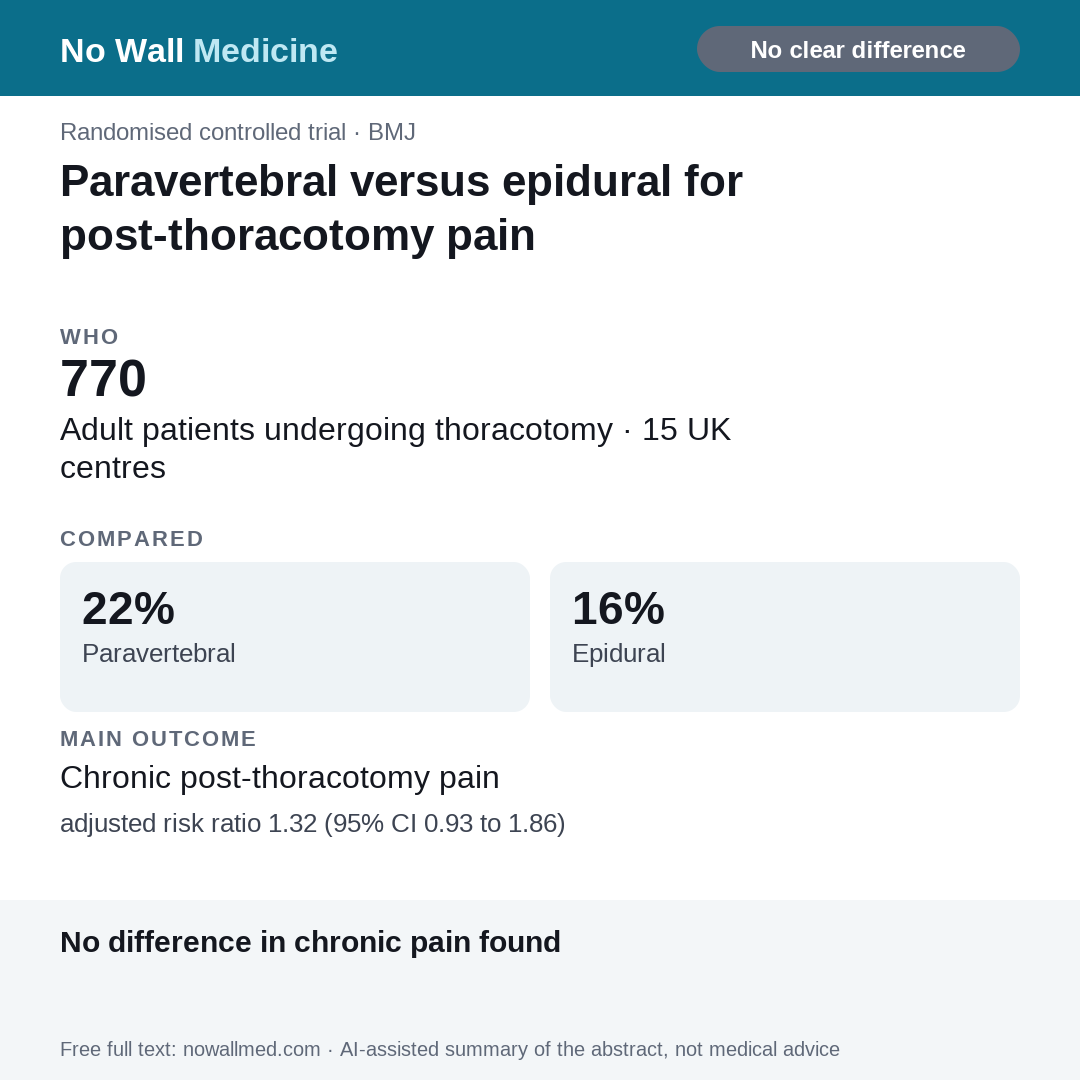
770 patients were enrolled, of which 428 (56%) were male (mean (standard deviation, SD) age 66.6 (11.0) years). After 33 exclusions of patients after randomisation who did not proceed to thoracotomy, 737 remained in the modified intention-to-treat population (364 in the paravertebral group, 373 in the epidural group). Six months after randomisation, 59 (22%) of 272 participants in the paravertebral group and 47 (16%) of 292 participants in the epidural group developed chronic post-thoracotomy pain (adjusted risk ratio 1.32 (95% confidence interval (CI) 0.93 to 1.86), adjusted risk difference 0.05 (95% CI -0.01 to 0.11), P=0.12). During the acute phase, worst and average pain was greater on day 1 with paravertebral blockade (adjusted mean difference 7.7 mm (95% CI 2.8 to 12.5 mm) and 7.0 mm (95% CI 2.7 to 11.2 mm), respectively), but no different on days 2-3. Hypotension was less common in the paravertebral group than the epidural group (12% v 18%, respectively, adjusted risk ratio 0.66 (95% CI 0.46 to 0.94), adjusted risk difference -0.06 (95% CI -0.11 to -0.01)), as was pruritis (4% v 12%, adjusted risk ratio 0.37 (95% CI 0.21 to 0.64), adjusted risk difference -0.07 (95% CI -0.11 to -0.03)), although more participants in this group experienced urinary retention (12% v 6%, adjusted risk ratio 2.21 (95% CI 1.35 to 3.61), adjusted risk difference 0.05 (95% CI 0.01 to 0.09)), complications were similar otherwise. Conclusions
Paravertebral blockade did not reduce chronic post-thoracotomy pain at six month follow-up compared to thoracic epidural. Thoracic epidural provided marginally better acute pain relief one day after the operation, but showed no difference thereafter. Postoperative complications were comparable between groups. The findings support the ongoing use of both techniques. Trial registration
ClinicalTrials.gov NCT03677856.
Abstract reproduced under the article’s CC BY NC licence.
Association of preoperative vaping-related disorder versus cigarette nicotine dependence with postoperative respiratory complications: a multicentre matched cohort study