Three-port versus four-port technique for laparoscopic cholecystectomy: systematic review and meta-analysis
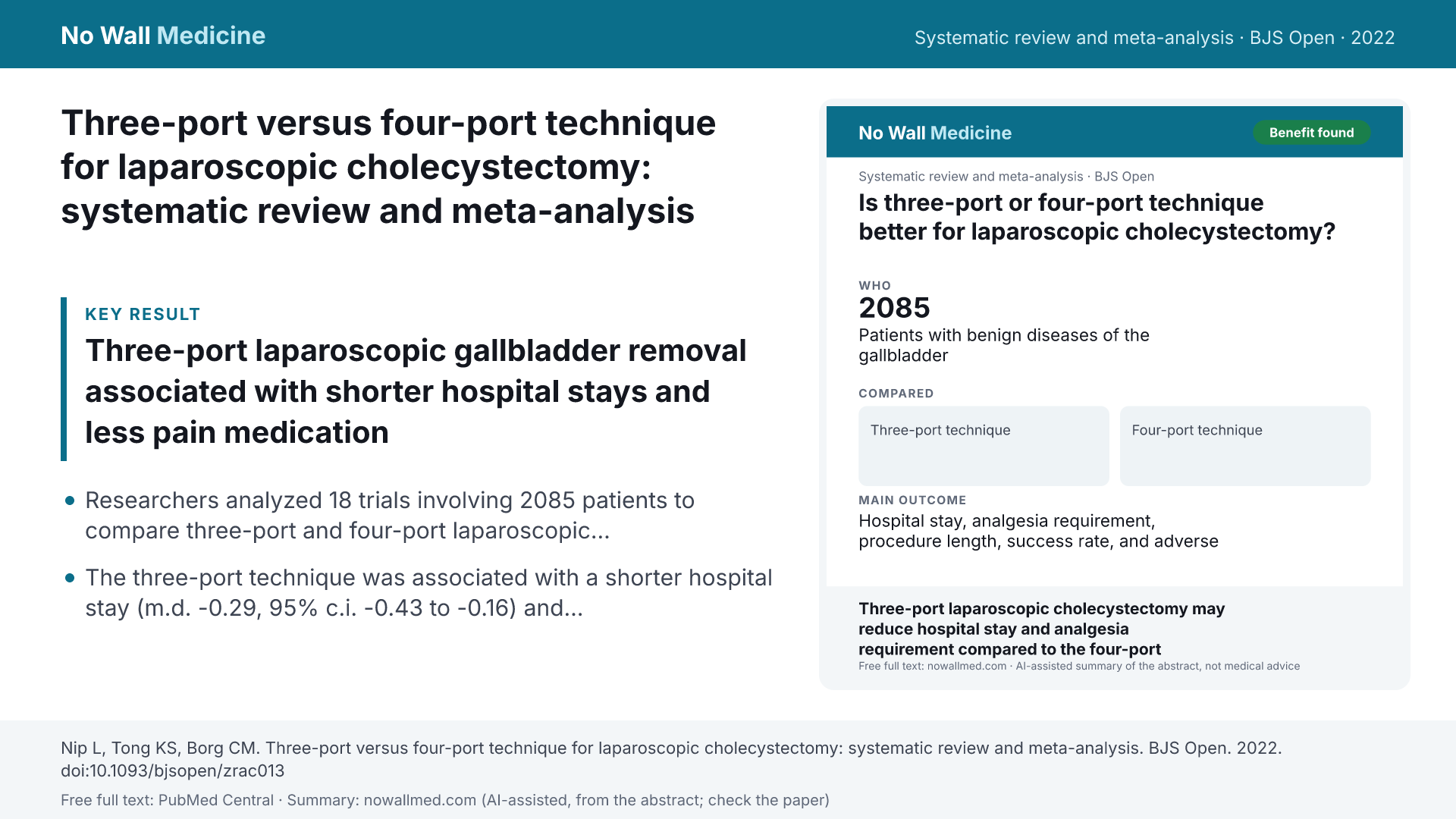
Key result: Three-port laparoscopic gallbladder removal associated with shorter hospital stays and less pain medication
Systematic review and meta-analysisBenefit found
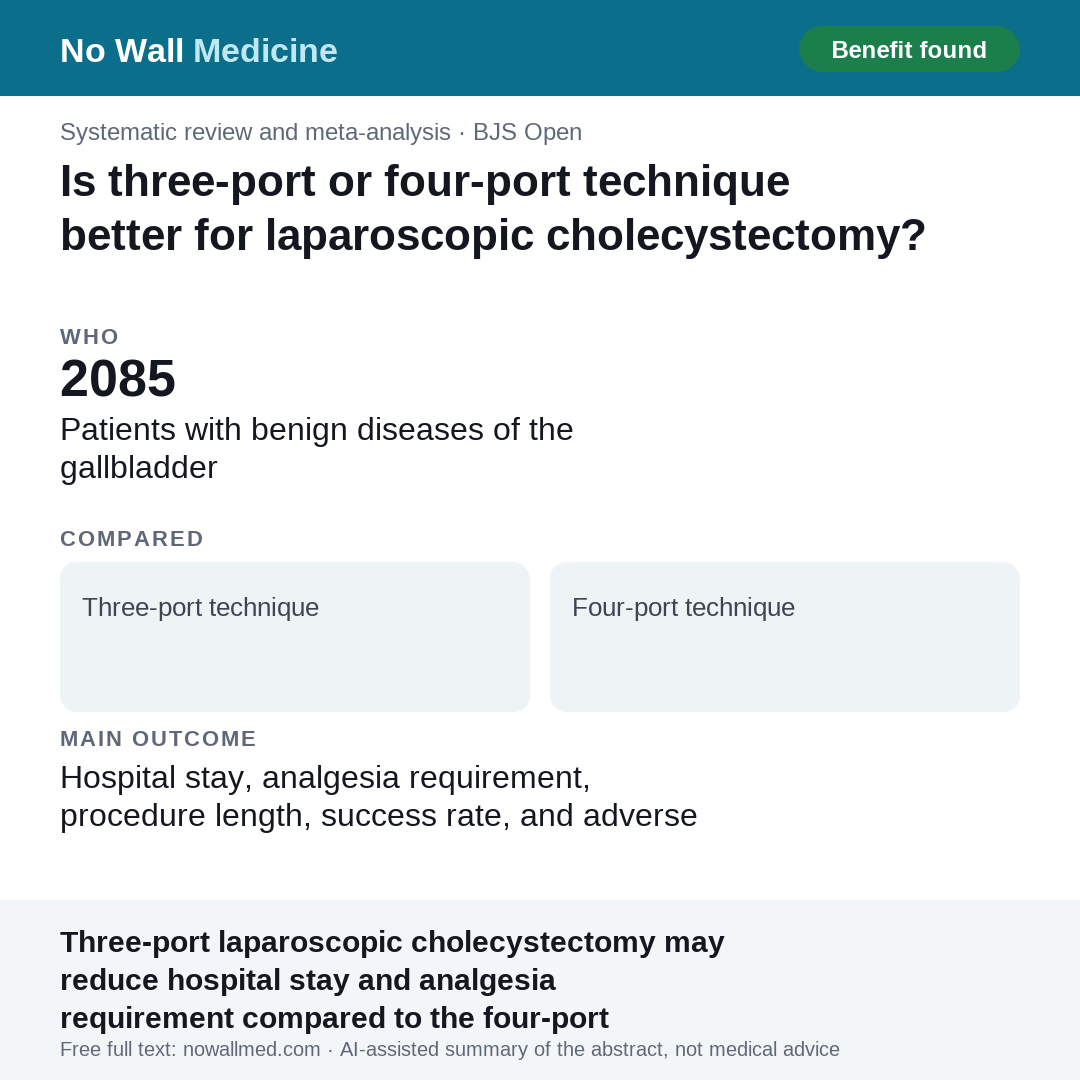
Is three-port or four-port technique better for laparoscopic cholecystectomy?
Who
2085
Patients with benign diseases of the gallbladder
Compared
Three-port technique
Four-port technique
Main outcome
Hospital stay, analgesia requirement, procedure length, success rate, and adverse events
Result: mean difference -0.29 (95 per cent c.i. -0.43 to -0.16) for hospital stay
Bottom line: Three-port laparoscopic cholecystectomy may reduce hospital stay and analgesia requirement compared to the four-port technique.
Limitation: The overall quality of evidence was low.
BJS Open · 2022-03-31Download image
Key points
- Researchers analyzed 18 trials involving 2085 patients to compare three-port and four-port laparoscopic cholecystectomy, which is minimally invasive gallbladder removal.
- The three-port technique was associated with a shorter hospital stay (m.d. -0.29, 95% c.i. -0.43 to -0.16) and lower postoperative pain medication needs (s.m.d. -0.68, 95% c.i. -1.03 to -0.33).
- There were no differences between the two techniques regarding procedure length, success rates, or adverse events.
Why it matters: There is no consensus regarding the outcomes and efficacy of using a three-port technique compared to the standard four-port approach for gallbladder removal.
Discussion prompts
- Would these patients look like yours? Who was left out?
- Is the main outcome one that matters to patients?
- Is the difference large enough to change what you do?
Cite: Nip L, Tong KS, Borg CM. Three-port versus four-port technique for laparoscopic cholecystectomy: systematic review and meta-analysis. BJS Open. 2022. doi:10.1093/bjsopen/zrac013
Free full text: PubMed Central · Summary and visual abstract: nowallmed.com/a/three-port-versus-four-port-technique-for-laparoscopic-1vdcsha/ (AI-assisted from the abstract; check the paper before relying on it).