Thrombectomy improved outcomes for stroke patients with mismatch 6 to 24 hours after onset
Thrombectomy 6 to 24 Hours after Stroke with a Mismatch between Deficit and Infarct
Why it matters: Extended thrombectomy to selected patients 6 to 24 hours after stroke onset.
Related landmark trials: MR CLEAN
Context written by the No Wall Medicine team.
Randomized trialBenefit found
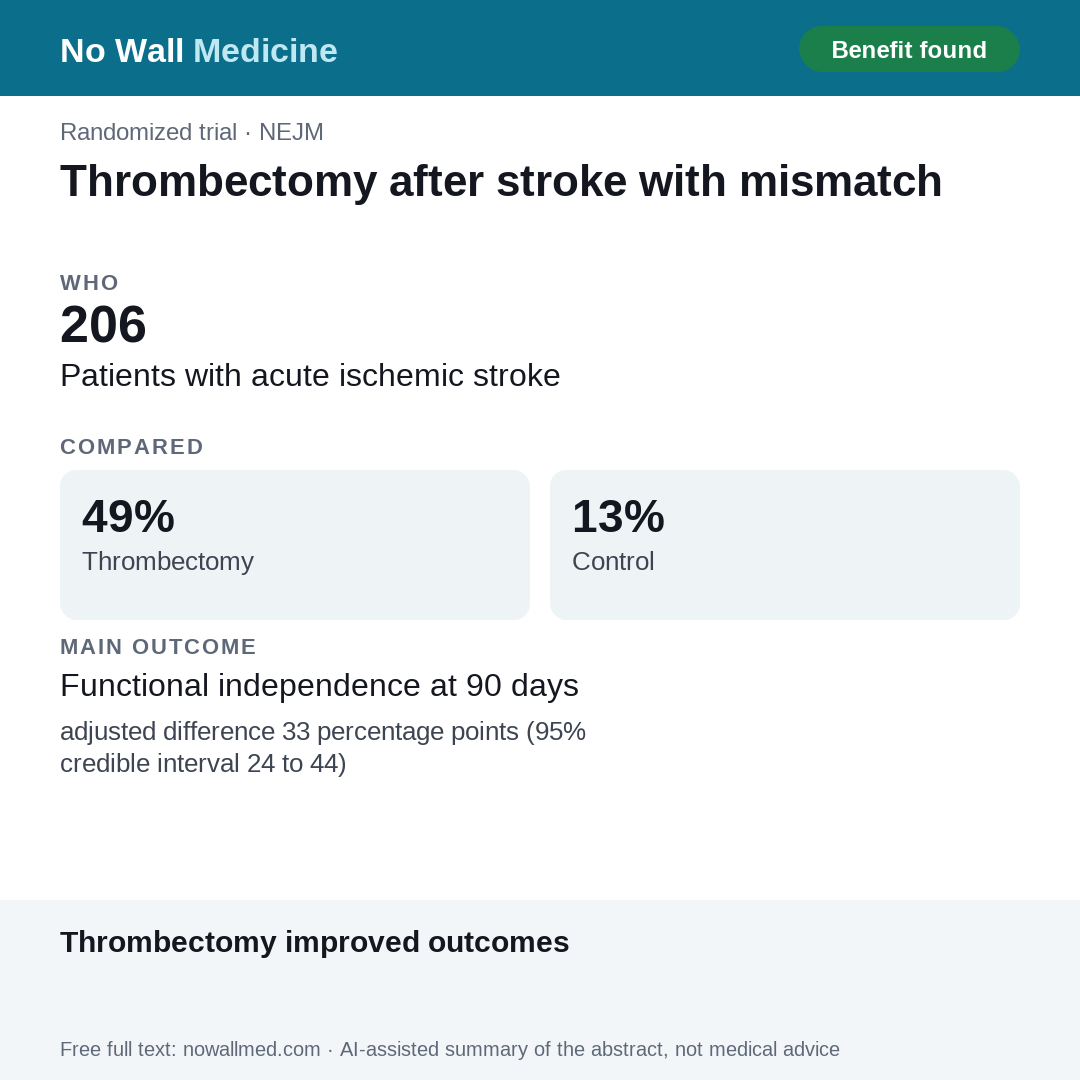
Thrombectomy after stroke with mismatch
Who
206
Patients with acute ischemic stroke
Compared
49%Thrombectomy
13%Control
Main outcome
Functional independence at 90 days
Result: adjusted difference 33 percentage points (95% credible interval 24 to 44)
Bottom line: Thrombectomy improved outcomes
Funded by: Stryker Neurovascular
NEJM · 2017-11-11Download image
Trial at a glance
Bottom line: Thrombectomy plus standard care improved 90-day disability outcomes
Clinical question
Thrombectomy effect in ischemic stroke 6 to 24 hours after onset
Design
Randomized trial
Who was studied
206 patients with ischemic stroke
Key inclusion criteria
- occlusion of intracranial internal carotid artery or proximal middle cerebral artery
- mismatch between clinical deficit and infarct volume
- last known to be well 6 to 24 hours earlier
Interventions
- thrombectomy group: thrombectomy plus standard care
- control group: standard care alone
Primary outcome
utility-weighted modified Rankin scale at 90 days. 5.5 in thrombectomy group, 3.4 in control group, adjusted difference 2.0 points
Secondary outcomes
- rate of functional independence at 90 days: 49% in thrombectomy group, 13% in control group, adjusted difference 33 percentage points
Harms
symptomatic intracranial hemorrhage 6% in thrombectomy group, 3% in control group
Funding
Stryker Neurovascular
Written with AI from the abstract; every number was checked against it. Details such as eligibility criteria may be missing because the abstract does not give them. Read the paper before relying on it.
Key points
- Researchers studied 206 patients with stroke and mismatch between deficit and infarct volume.
- Thrombectomy group had better disability outcomes at 90 days, with 2.0 point difference on modified Rankin scale.
- No significant difference in symptomatic intracranial hemorrhage or 90-day mortality between groups.
Headline and key points written with AI from the paper’s abstract, with every number checked against it. Read the paper before relying on them.
Topics
Spotted a mistake? Suggest a correction
More in Cardiology
Clonal hematopoiesis mutations linked to higher atrial fibrillation risk in cancer populations
Association of Clonal Hematopoiesis Mutations With Incident Atrial Fibrillation: A Systematic Review and Meta-Analysis
Deep learning model detects aortic stenosis from finger-cuff pressure waveforms accurately
Aortic Valve Stenosis Screening Using Deep Learning on Noninvasive Arterial Pressure Waveforms
Spontaneous coronary artery dissection affects younger women more often than expected
Spontaneous coronary artery dissection: implications for women's health, clinical care, and future research
Early lipid-lowering strategies may reduce atherosclerotic cardiovascular disease risk
Lipid-Lowering Strategies in the Era of Early Atherosclerosis Detection: 2026 ACC Scientific Statement: A Report of the American College of Cardiology