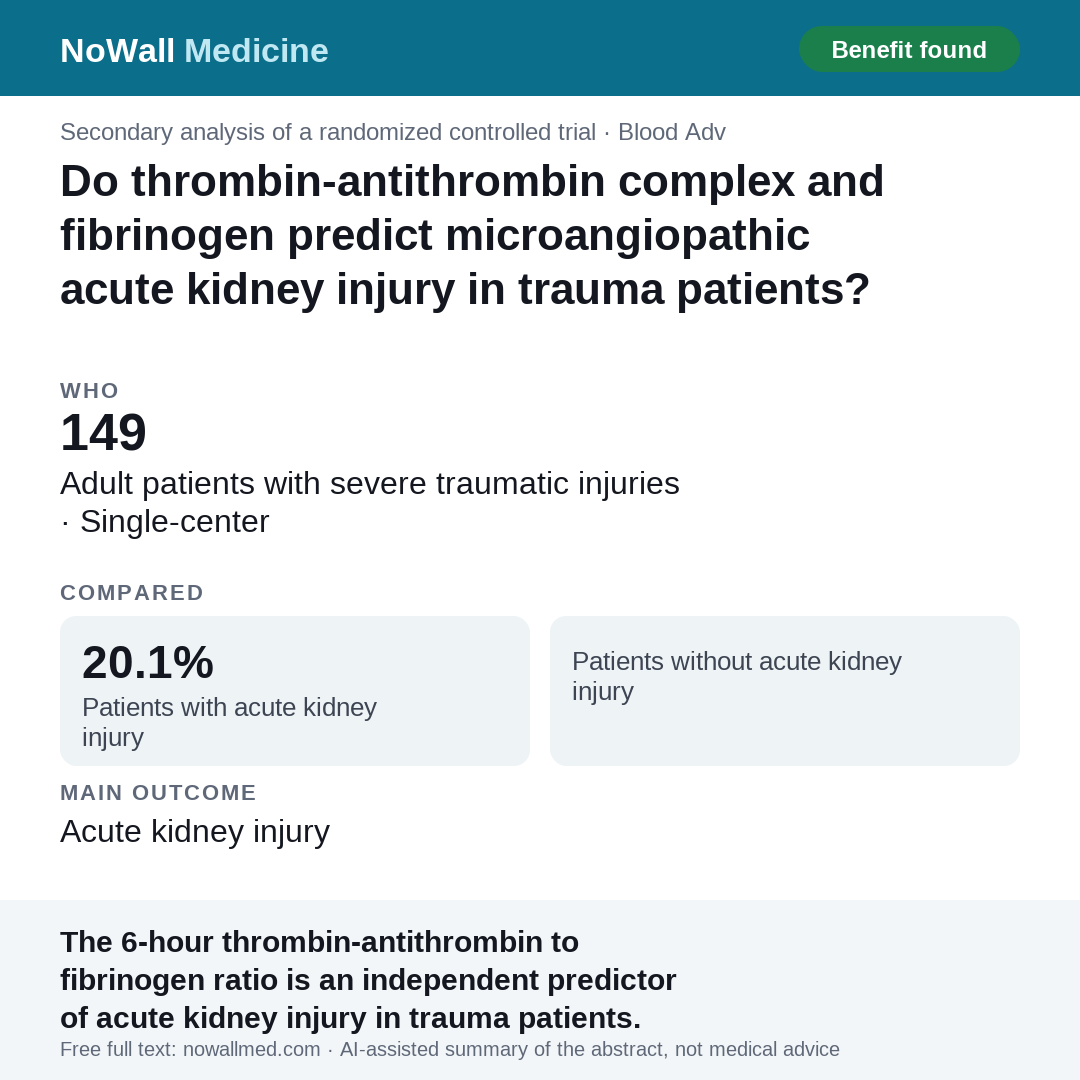
Acute kidney injury (AKI) develops in 20% to 40% of patients with injuries and contributes to poor outcomes. In sepsis and critical illness, dysregulated coagulation and fibrinolysis are linked to microangiopathic kidney dysfunction, but similar relationships in trauma remain poorly characterized. We performed a secondary analysis of a single-center randomized controlled trial of adult patients with severe traumatic injuries. Plasma thrombin-antithrombin (TAT), plasmin-α2-antiplasmin (PAP), and fibrinogen levels were measured within 2 hours of injury and 6 hours later. AKI was defined by the Risk, Injury, Failure, Loss, and End-stage kidney disease criteria. Adjusted logistic regression models evaluated biomarker associations with AKI and receiver operating characteristic analyses identified discriminatory thresholds. Among 149 patients, 30 (20.1%) developed AKI. Patients with AKI had higher TAT and PAP concentrations and lower fibrinogen levels at both time points. The 6-hour TAT-to-fibrinogen ratio was independently associated with AKI (adjusted odds ratio, 7.17; 95% confidence interval, 2.34-21.9; P = .001; area under the curve = 0.88). Supplemental analyses demonstrated consistent associations for TAT and fibrinogen levels individually, whereas PAP level was not independently predictive. A 6-hour TAT level of 173 mg/dL showed a low likelihood of AKI (NPV, 88.2%). Elevated TAT and reduced fibrinogen levels measured 6 hours after injury were independently associated with AKI. This suggests that early coagulation imbalance may reflect evolving microvascular kidney dysfunction in patients with injuries and warrants the evaluation of the TAT-to-fibrinogen ratio as an early marker of trauma-related AKI. This trial was registered at www.clinicaltrials.gov as NCT02535949.
Abstract reproduced under the article’s CC BY NC ND licence.
Reduced intensity hematopoietic cell transplant using best available donor and post-transplant cyclophosphamide is safe and curative for transfusion-dependent thalassemia