Thromboelastography in Microsurgical Reconstruction: A Systematic Review
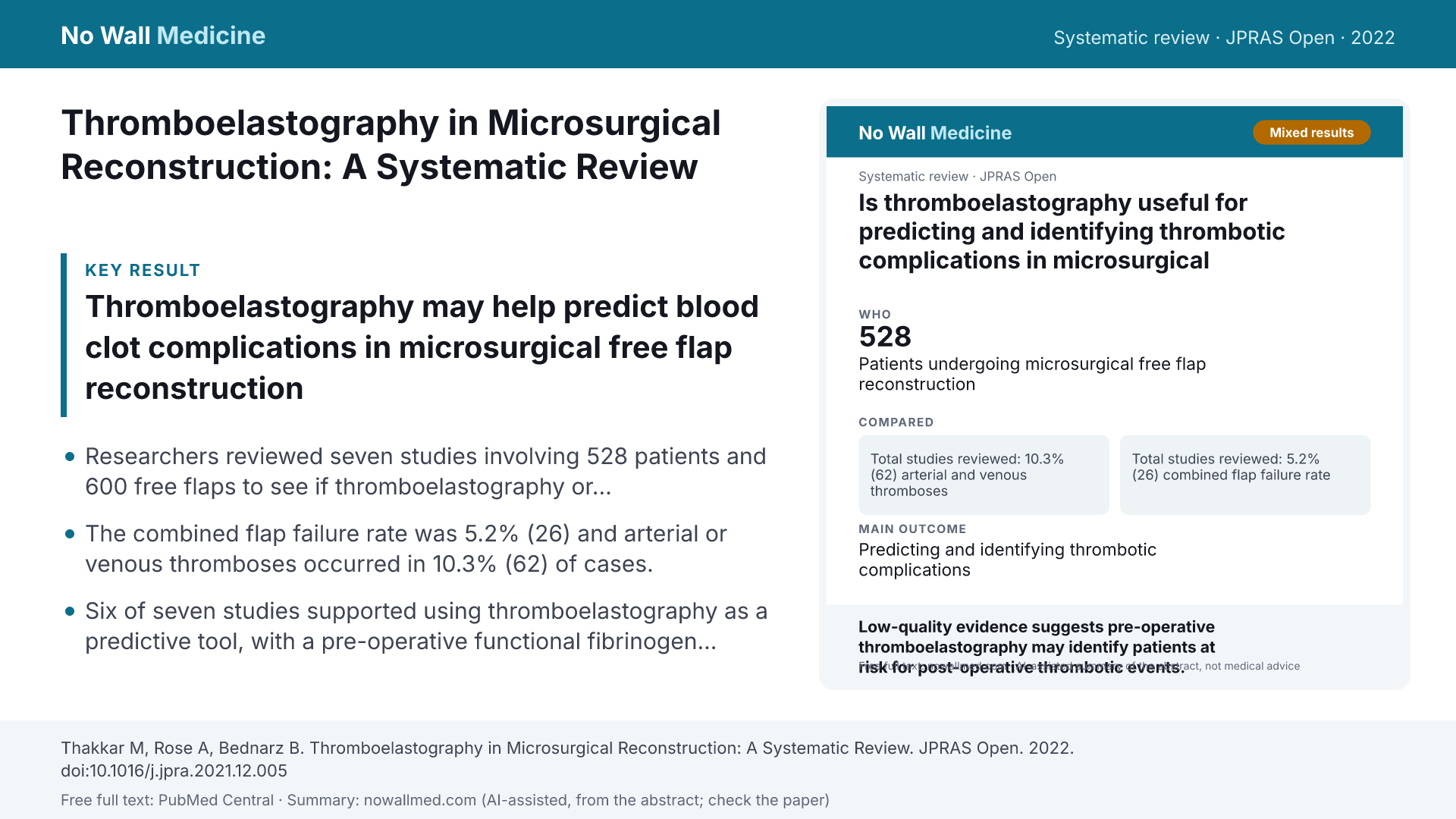
Key result: Thromboelastography may help predict blood clot complications in microsurgical free flap reconstruction
Systematic reviewMixed results
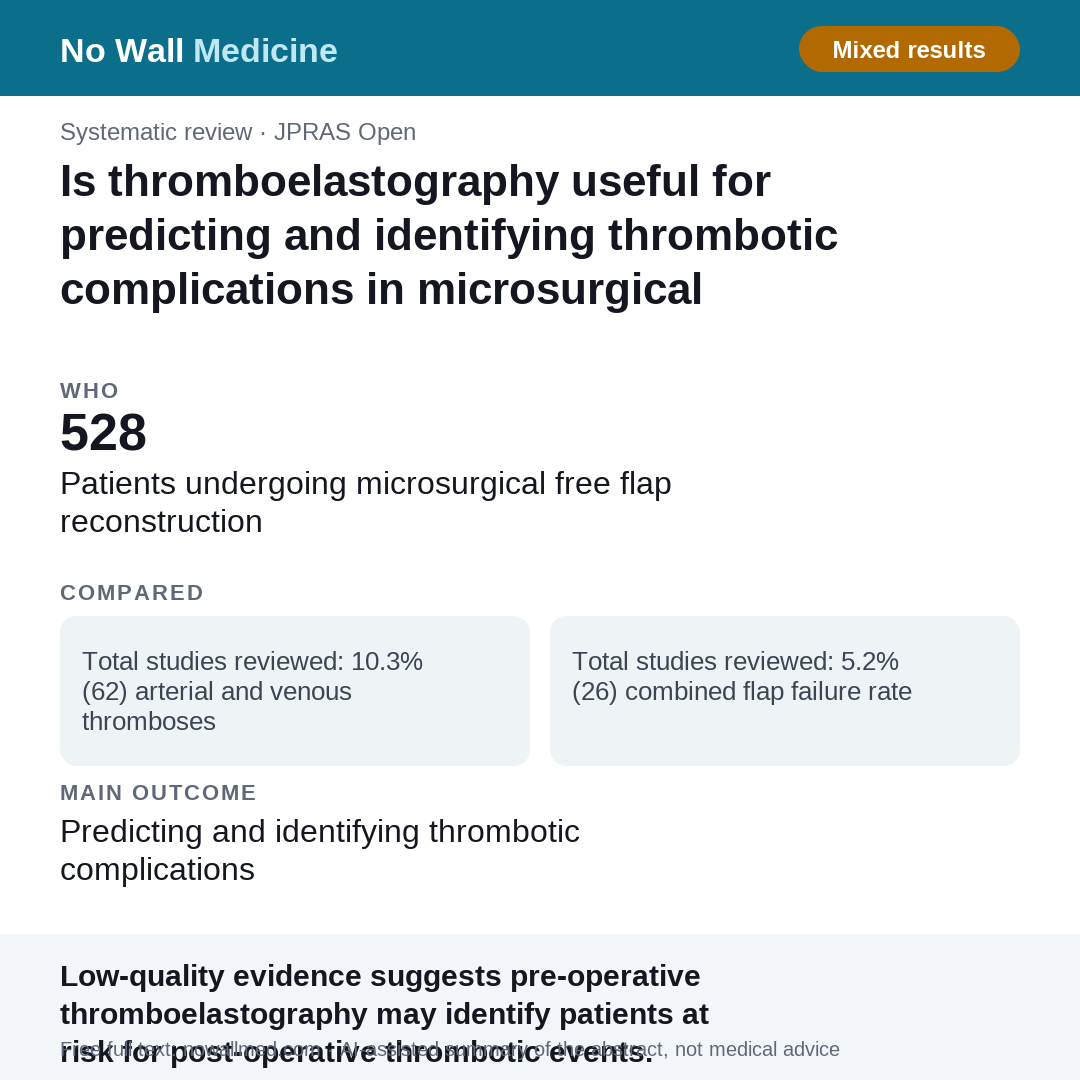
Is thromboelastography useful for predicting and identifying thrombotic complications in microsurgical reconstruction?
Who
528
Patients undergoing microsurgical free flap reconstruction
Compared
Total studies reviewed: 10.3% (62) arterial and venous thromboses
Total studies reviewed: 5.2% (26) combined flap failure rate
Main outcome
Predicting and identifying thrombotic complications
Bottom line: Low-quality evidence suggests pre-operative thromboelastography may identify patients at risk for post-operative thrombotic events.
Limitation: Low-quality evidence requires higher quality, standardised prospective or randomised control trials.
JPRAS Open · 2022-01-11Download image
Key points
- Researchers reviewed seven studies involving 528 patients and 600 free flaps to see if thromboelastography or rotational thromboelastometry could predict blood clots.
- The combined flap failure rate was 5.2% (26) and arterial or venous thromboses occurred in 10.3% (62) of cases.
- Six of seven studies supported using thromboelastography as a predictive tool, with a pre-operative functional fibrinogen to platelet ratio of ≥42 linked to identifying at-risk patients.
Limitation the authors note: The available evidence is low-quality level IV and requires further validation through higher quality, standardised prospective or randomised control trials.
Discussion prompts
- Would these patients look like yours? Who was left out?
- Is the main outcome one that matters to patients?
- Is the difference large enough to change what you do?
Cite: Thakkar M, Rose A, Bednarz B. Thromboelastography in Microsurgical Reconstruction: A Systematic Review. JPRAS Open. 2022. doi:10.1016/j.jpra.2021.12.005
Free full text: PubMed Central · Summary and visual abstract: nowallmed.com/a/thromboelastography-in-microsurgical-reconstruction-a-systematic-5jid7d/ (AI-assisted from the abstract; check the paper before relying on it).