Thrombolytic therapy shows similar effectiveness in full-term and preterm neonates with varying bleeding risks
Thrombolysis in neonates: navigating the balance between efficacy and risk-a systematic review
Systematic reviewMixed results
What are the efficacy and safety of thrombolysis in preterm and term neonates?
Who
265
Preterm and term neonates with thrombosis
Compared
Full-term neonates: restoration of flow 87.2%
Preterm neonates: restoration of flow 85.2%
Main outcome
Thrombus resolution, bleeding events, and mortality
Bottom line: Thrombolysis appears effective for flow restoration but carries substantial bleeding risks, especially in preterm neonates.
Limitation: Evidence is limited and heterogeneous.
J Thromb Haemost · 2026-05-20Download image
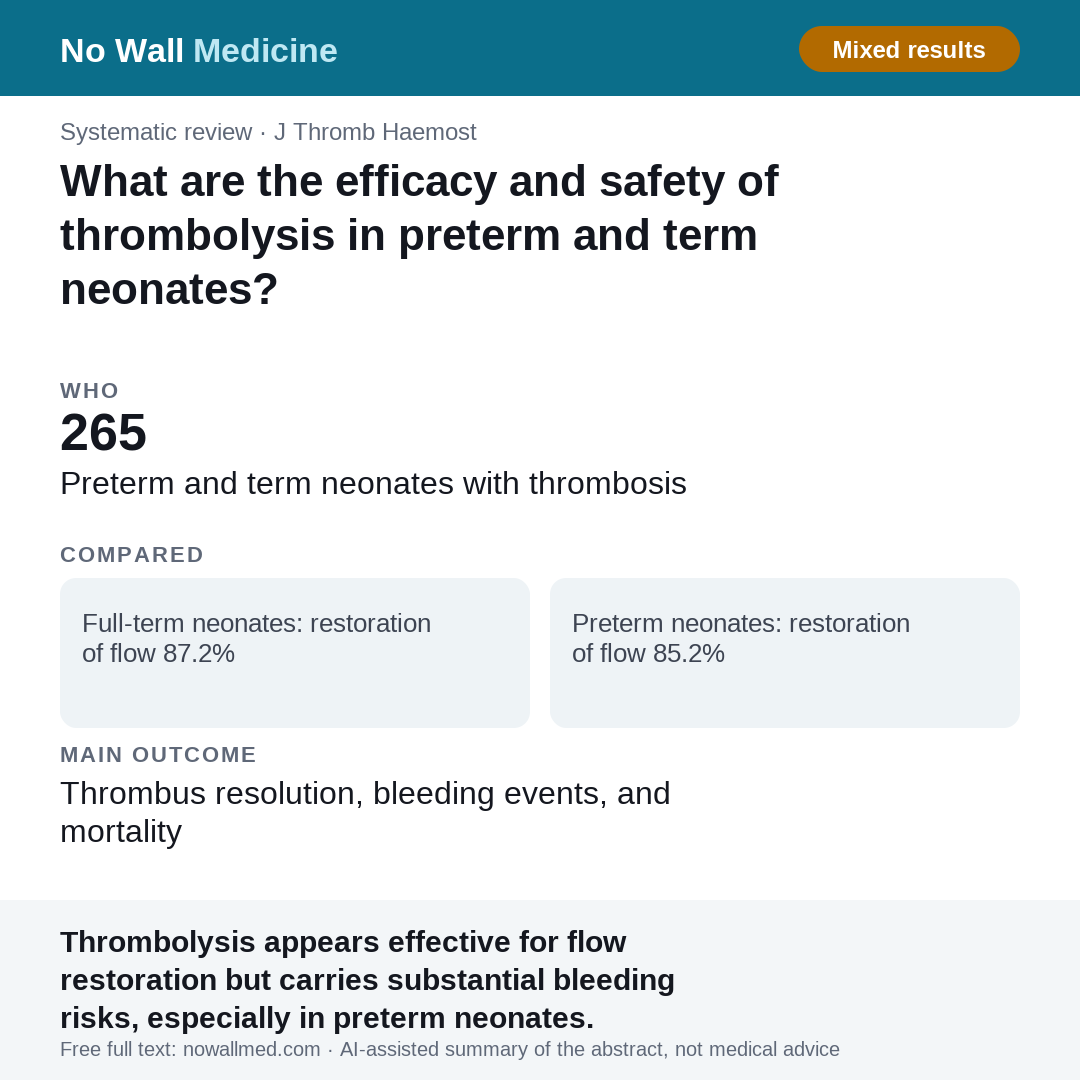
Clinical question: What are the efficacy and safety of thrombolysis in preterm and term neonates?
Why it matters: Clinicians face a challenge in balancing the need for clot-dissolving therapy against the risk of bleeding in a population with immature blood-clotting systems.
Key points
- Researchers reviewed 44 studies involving 265 patients to analyze the dosing, safety, and efficacy of clot-dissolving drugs in preterm and term newborns.
- Flow was restored in 87.2% of full-term neonates and 85.2% of preterm neonates, while the overall mortality related to the treatment was 2.3%.
- Major bleeding occurred in 10.5% of full-term neonates and 14.8% of preterm neonates, while minor bleeding affected 29.1% of full-term and 16.4% of preterm infants.
Limitation the authors note: The evidence available is limited and highly heterogeneous.
Headline and key points written with AI from the paper’s abstract, with every number checked against it. Read the paper before relying on them.
Topics
Cite this article
Klaassen ILM, van Ommen HC. Thrombolysis in neonates: navigating the balance between efficacy and risk-a systematic review. J Thromb Haemost. 2026. doi:10.1016/j.jtha.2026.05.011
Spotted a mistake? Suggest a correction