Five year follow-up shows no difference between thyroid surgery with or without radioactive iodine
Thyroidectomy without radioiodine in patients with low-risk thyroid cancer: 5 years of follow-up of the prospective randomised ESTIMABL2 trial
Multicentre randomised phase 3 trialBenefit found
Is thyroidectomy without radioiodine non-inferior to radioiodine in low-risk thyroid cancer?
Who
698
Patients with low-risk differentiated thyroid cancer · Multicentre
Compared
93.2%no-radioiodine group
94.8%radioiodine group
Main outcome
proportion of patients without an event
Result: -1.6% (90% CI -4.5 to 1.4)
Bottom line: Thyroidectomy without radioiodine is non-inferior to postoperative radioiodine administration in low-risk differentiated thyroid cancer at 5 years.
Funded by: Programme de Recherche Hospitalier Clinique
Lancet Diabetes Endocrinol · 2024-11-22Download image
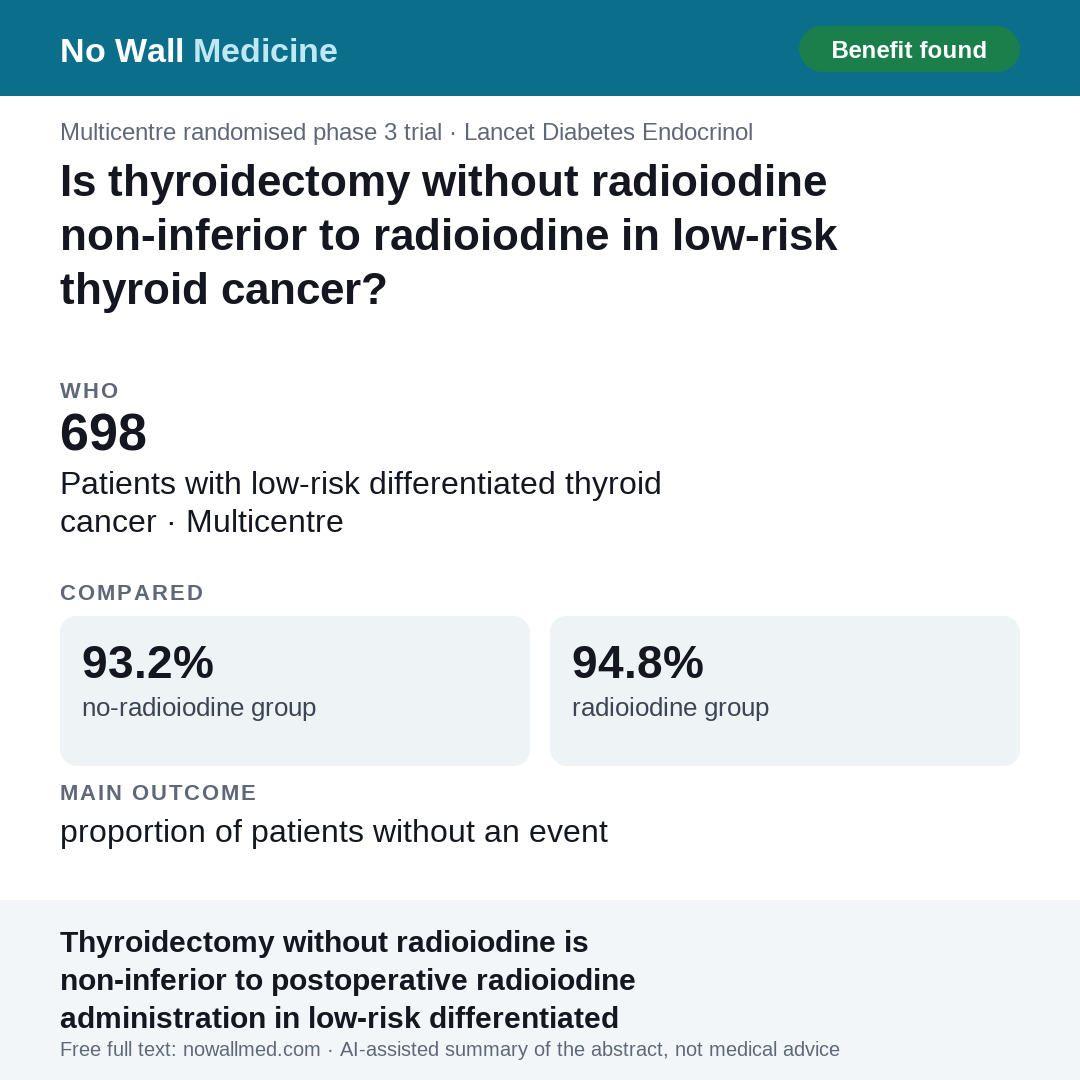
Clinical question: Is thyroidectomy without radioiodine non-inferior to radioiodine in low-risk thyroid cancer?
Why it matters: It was unknown if a follow-up strategy without radioactive iodine administration is as effective as postoperative radioactive iodine for patients with low-risk differentiated thyroid cancer.
Key points
- Researchers studied 698 patients with low-risk differentiated thyroid cancer who were randomly assigned to receive either no radioactive iodine or radioactive iodine after surgery.
- At 5 years, the proportion of patients without an event was 93.2% in the no-radioiodine group and 94.8% in the radioiodine group.
- Events included structural or functional abnormalities and biological abnormalities such as elevated thyroglobulin levels.
Headline and key points written with AI from the paper’s abstract, with every number checked against it. Read the paper before relying on them.
Abstract
Background
ESTIMABL2, a multicentre randomised phase 3 trial in patients with low-risk differentiated thyroid cancer (ie, pT1am or pT1b, N0 [no evidence of regional nodal involvement] or Nx [involvement of regional lymph nodes that cannot be assessed in the absence of neck dissection]), showed the non-inferiority of a follow-up strategy without radioactive iodine (131I) administration compared with a postoperative 131I administration at 3 years post-randomisation. Here, we report a pre-specified analysis after 5 years of follow-up. Methods
Patients treated with total thyroidectomy with or without prophylactic neck lymph node dissection, without postoperative suspicious findings on neck ultrasonography, were randomly assigned to the no-radioiodine group or to the radioiodine group (1·1 GBq-30 mCi after recombinant human thyrotropin-stimulating hormone). Follow-up consisted of annual thyroglobulin and thyroglobulin antibody determinations during levothyroxine treatment and neck ultrasonography in odd-numbered years. An event was defined as abnormal foci of 131I uptake on the post-treatment whole-body-scan requiring subsequent treatment, abnormal neck ultrasonography, elevated thyroglobulin levels, increasing titres or appearance of thyroglobulin antibody (using the same laboratory assay), or a combination of these definitions. Non-inferiority of the proportion of patients without an event in one group compared with the other at 5 years after randomisation was shown if this proportion and its CI did not differ by more than -5%. This study was registered on ClinicalTrials.gov (NCT01837745) and is completed. Findings
Of the 776 patients (n=642 [82·7%] female and n=134 [17·3%] male, median age 52·9 years [IQR 42·6-63·1]) enrolled, 698 were evaluable at 5 years. The proportions of patients without events were 93·2% in the no-radioiodine group and 94·8% in the radioiodine group, for a difference of -1·6% (90% CI -4·5 to 1·4). Events consisted of structural or functional abnormalities (n=11) and biological abnormalities (n=31). Interpretation
The non-inferiority of a follow-up strategy compared with postoperative 131I administration in low risk differentiated thyroid cancer was confirmed at 5 years. There is no loss of opportunity in following these patients without postoperative ablation. Funding
Programme de Recherche Hospitalier Clinique.
Abstract reproduced under the article’s CC BY licence.
Topics
Cite this article
Leboulleux S, Bournaud C, Chougnet CN, Lamartina L, Zerdoud S, Do Cao C. Thyroidectomy without radioiodine in patients with low-risk thyroid cancer: 5 years of follow-up of the prospective randomised ESTIMABL2 trial. Lancet Diabetes Endocrinol. 2024. doi:10.1016/S2213-8587(24)00276-6
Spotted a mistake? Suggest a correction
Top studies every Monday
The week’s key trials and guidelines in your specialties, by email. Free.
Get the weekly digest