Depressive symptoms decreased over time in control groups of digital psychological intervention trials
Time-Dependent Changes in Depressive Symptoms Among Control Participants in Digital-Based Psychological Intervention Studies: Meta-analysis of Randomized Controlled Trials
Meta-analysis of 107 randomized controlled trialsBenefit found
How do depressive symptoms change over time in control groups of digital intervention studies?
Who
11803
11,803 adults with depressive symptoms
Compared
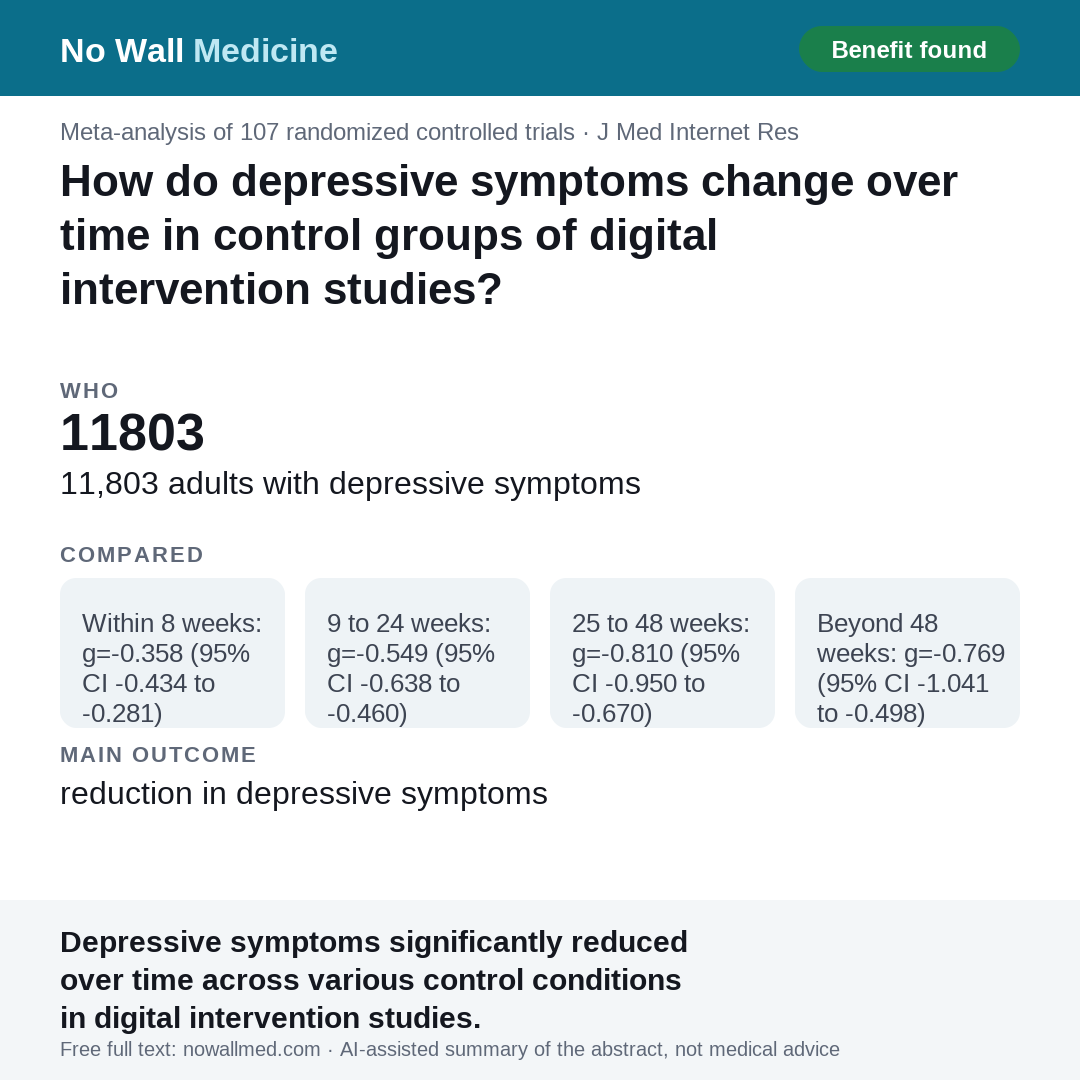
Within 8 weeks: g=-0.358 (95% CI -0.434 to -0.281)
9 to 24 weeks: g=-0.549 (95% CI -0.638 to -0.460)
25 to 48 weeks: g=-0.810 (95% CI -0.950 to -0.670)
Beyond 48 weeks: g=-0.769 (95% CI -1.041 to -0.498)
Main outcome
reduction in depressive symptoms
Bottom line: Depressive symptoms significantly reduced over time across various control conditions in digital intervention studies.
J Med Internet Res · 2023-04-12Download image
Clinical question: How do depressive symptoms change over time in control groups of digital intervention studies?
Why it matters: The effects of different control comparators in digital-based psychological intervention studies have been largely overlooked and may vary in their effects on depression management.
Key points
- Researchers analyzed 107 randomized controlled trials involving 11,803 adults with depressive symptoms to measure changes in control groups.
- Control groups showed small to moderate symptom reduction within 8 weeks (g=-0.358), peaking between 25 and 48 weeks (g=-0.810).
- Care as usual produced a large effect (g=-0.950) in the medium term, while waitlist controls showed significant short-term reduction (g=-0.291).
Headline and key points written with AI from the paper’s abstract, with every number checked against it. Read the paper before relying on them.
Topics
Cite this article
Tong AC, Ho FS, Chu OH, Mak WW. Time-Dependent Changes in Depressive Symptoms Among Control Participants in Digital-Based Psychological Intervention Studies: Meta-analysis of Randomized Controlled Trials. J Med Internet Res. 2023. doi:10.2196/39029
Spotted a mistake? Suggest a correction
Top studies every Monday
The week’s key trials and guidelines in your specialties, plus any topics you follow. By email, free.
Get the weekly digest