Time-restricted eating produced similar weight loss to calorie restriction in adults with obesity
Time-Restricted Eating Without Calorie Counting for Weight Loss in a Racially Diverse Population : A Randomized Controlled Trial
Randomized controlled trialNo clear difference
Time-restricted eating for weight loss
Who
90
Adults with obesity · University of Illinois Chicago
Compared
-4.61 kgTime-restricted eating
-5.42 kgCalorie restriction
Control
Main outcome
Weight loss
Bottom line: Time-restricted eating aids weight loss
Limitation: Not blinded, underpowered
Funded by: National Institutes of Health
Ann Intern Med · 2023-06-27Download image
Why it matters: Long-term randomized trials evaluating the efficacy of time-restricted eating without calorie counting for weight control and cardiometabolic risk reduction are limited.
Key points
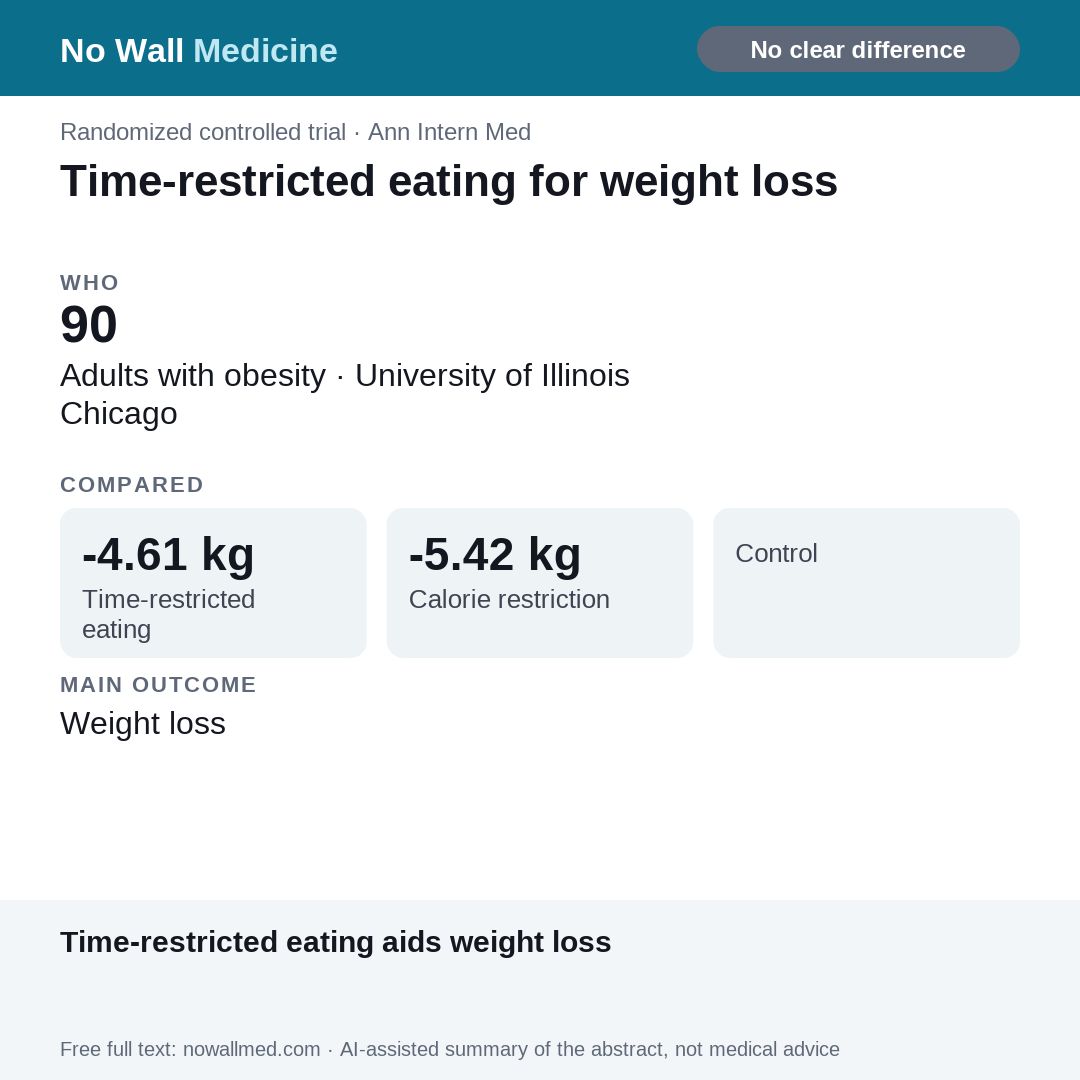
- The study followed 90 adults with obesity assigned to 8-hour time-restricted eating, 25% calorie restriction, or a control group for 12 months.
- Compared to the control group, weight loss at month 12 was -4.61 kg (-4.87%) for time-restricted eating and -5.42 kg (-5.30%) for calorie restriction.
- There was no statistically significant difference in weight loss between the time-restricted eating group and the calorie restriction group of 0.81 kg (0.43%).
Limitation the authors note: The study was not blinded, was not powered to detect relatively large differences in weight loss, and lacked adjustment for multiple comparisons.
Headline and key points written with AI from the paper’s abstract, with every number checked against it. Read the paper before relying on them.
Topics
Cite this article
Lin S, Cienfuegos S, Ezpeleta M, Gabel K, Pavlou V, Mulas A. Time-Restricted Eating Without Calorie Counting for Weight Loss in a Racially Diverse Population : A Randomized Controlled Trial. Ann Intern Med. 2023. doi:10.7326/M23-0052
Spotted a mistake? Suggest a correction