Stepwise reduction of backup ventilation did not increase time spent in oxygen target range
Time spent within the SpO2 target range during nasal CPAP therapy with different backup modes in extremely preterm infants: a randomised cross-over trial
Single-centre randomised cross-over trialNo clear difference
Do different backup modes during nasal continuous positive airway pressure keep infants within oxygen saturation target range?
Who
24
Extremely preterm infants · Level 3 neonatal intensive care unit
Compared
61.1%immediate cessation of backup NIPPV
64.7%stepwise reduction of backup NIPPV
Main outcome
time spent within the oxygen saturation target range
Bottom line: Stepwise reduction of backup intermittent positive pressure ventilation does not provide clinical benefit over immediate cessation.
BMJ Open Respir Res · 2026-06-04Download image
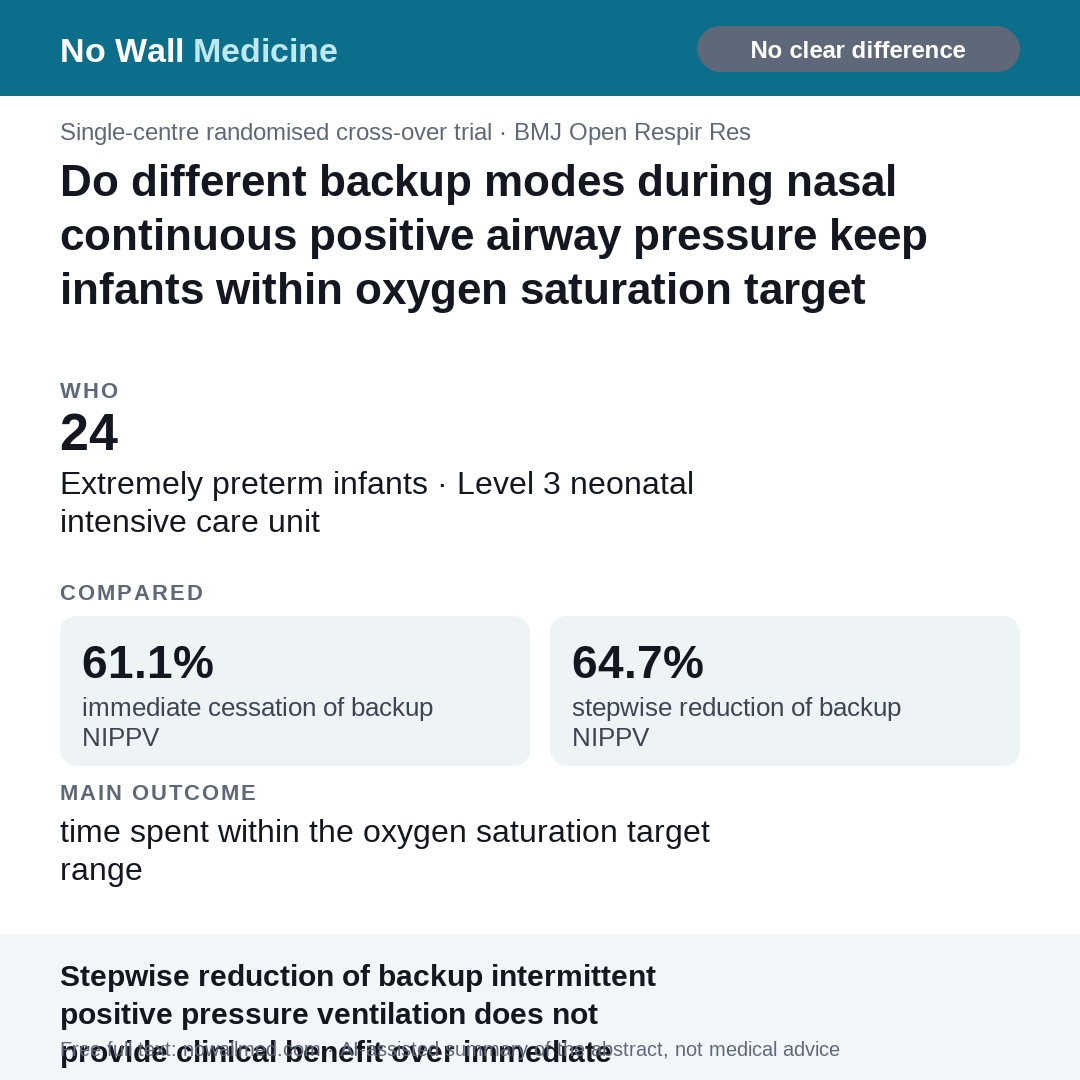
Clinical question: Do different backup modes during nasal continuous positive airway pressure keep infants within oxygen saturation target range?
Why it matters: It is unclear if sophisticated ventilation modes provide clinical benefits over standard modes for maintaining oxygen levels in extremely preterm infants.
Key points
- Researchers studied 24 extremely preterm infants to compare immediate cessation of backup nasal intermittent positive pressure ventilation versus a stepwise reduction of support.
- The mean percentage of time spent within the 88%-95% oxygen saturation target range did not differ between the two groups (61.1% vs 64.7%, p=0.15).
- There were no differences between the groups regarding time spent below or above the target range or the number of prolonged or severe episodes.
Headline and key points written with AI from the paper’s abstract, with every number checked against it. Read the paper before relying on them.
Abstract
Objectives
To study the efficacy of different modes of backup nasal intermittent positive pressure ventilation (NIPPV) during nasal continuous positive airway pressure (nCPAP) therapy to keep extremely preterm (EPT) infants within the oxygen saturation (SpO2) target range. Design
Single-centre randomised cross-over trial. Setting
Level 3 neonatal intensive care unit. Participants
24 EPT infants (median gestational age of 24+1 and median postnatal age of 43 days). Interventions
EPT infants on nCPAP therapy with backup NIPPV during apnoea >4 s were assigned in random sequence to immediate cessation of backup NIPPV or to stepwise reduction of backup NIPPV support on restart of spontaneous respiration. Main outcome measures
Primary outcome was time spent within the SpO2 target range (88%-95%). Secondary outcomes included frequency and duration of hypoxaemic and hyperoxaemic episodes, impact on cerebral tissue oxygenation, parameters of gas exchange and vital signs. Results
The mean percentage of time spent within the SpO2 target range did not differ between immediate cessation of backup NIPPV on restart of spontaneous respiration compared with the stepwise reduction of backup NIPPV (61.1% vs 64.7%, p=0.15). There were no differences in the time spent below or above the SpO2 target range, the number of prolonged (>30 s) and severe (Conclusion
Our findings underpin that new sophisticated ventilation modes like stepwise reduction of backup NIPPV do not necessarily provide a clinical benefit compared with the standard mode. For this, technological advances require robust evaluation within well-designed clinical trials demonstrating the safety and efficacy before being used in everyday clinical practice. Trial registration
German Clinical Trials Register; registration number: DRKS00031956 (https://drks.de/search/en/trial/DRKS00031956), date of registration: 26 May 2023.
Abstract reproduced under the article’s CC BY NC licence.
Topics
Spotted a mistake? Suggest a correction