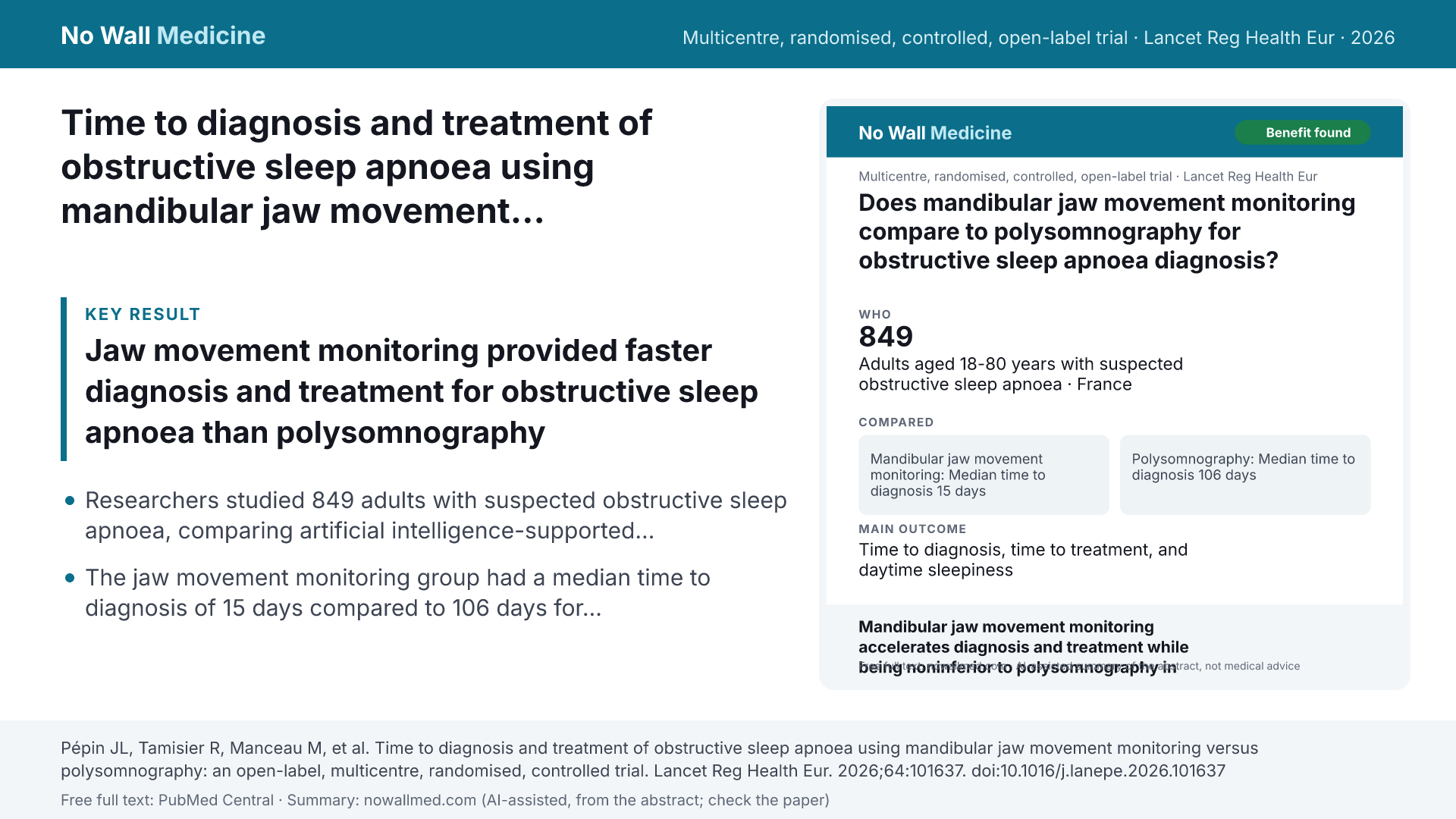
Jaw movement monitoring provided faster diagnosis and treatment for obstructive sleep apnoea than polysomnography
Time to diagnosis and treatment of obstructive sleep apnoea using mandibular jaw movement monitoring versus polysomnography: an open-label, multicentre, randomised, controlled trial
Multicentre, randomised, controlled, open-label trialBenefit found
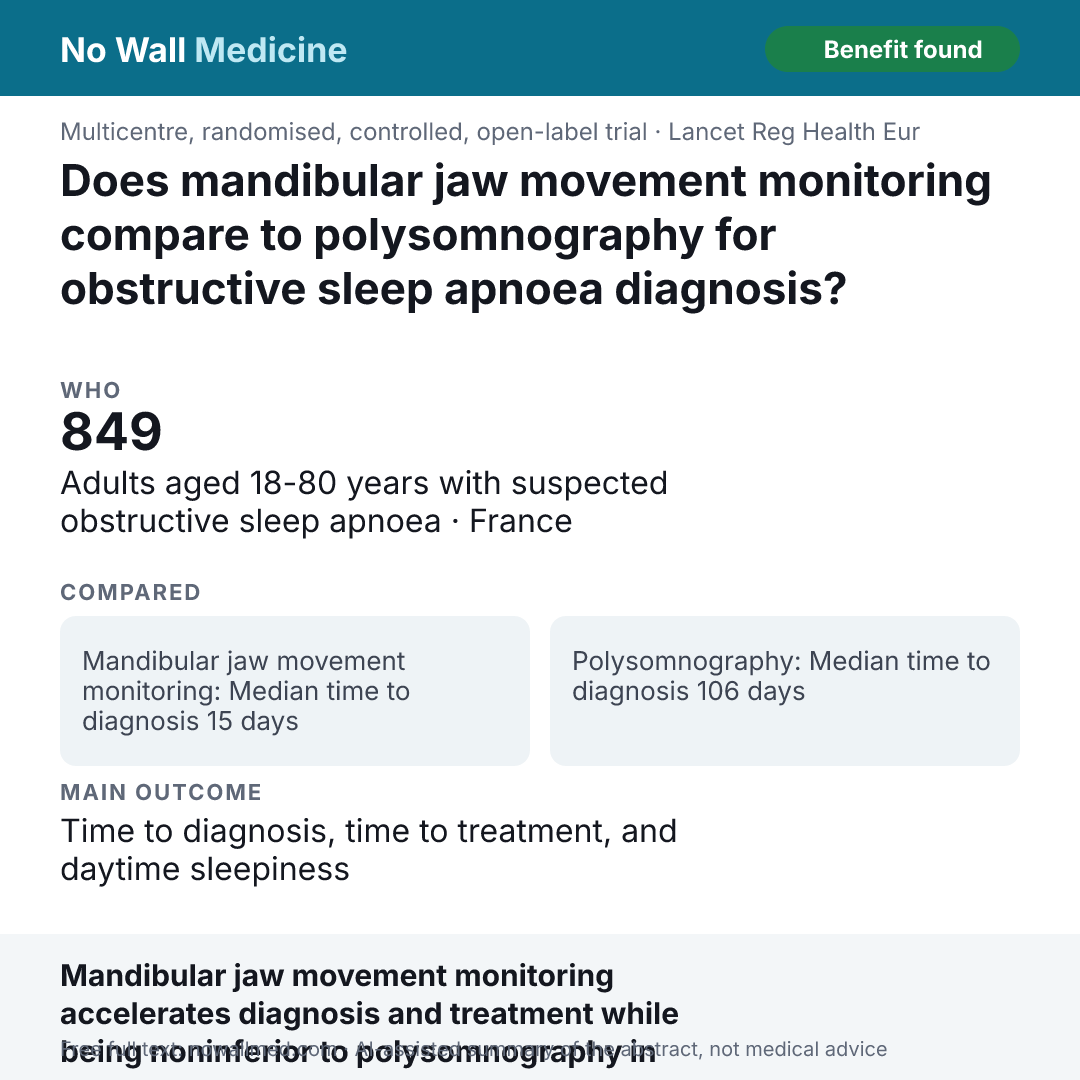
Does mandibular jaw movement monitoring compare to polysomnography for obstructive sleep apnoea diagnosis?
Who
849
Adults aged 18-80 years with suspected obstructive sleep apnoea · France
Compared
Mandibular jaw movement monitoring: Median time to diagnosis 15 days
Polysomnography: Median time to diagnosis 106 days
Main outcome
Time to diagnosis, time to treatment, and daytime sleepiness
Result: difference in ESS at 3 months -2.26 vs -2.29 (95% CI -0.85, 0.79)
Bottom line: Mandibular jaw movement monitoring accelerates diagnosis and treatment while being noninferior to polysomnography in reducing daytime sleepiness.
Funded by: Sunrise and French Ministry of Health
Lancet Reg Health Eur · 2026-03-17 · Save PNG
Clinical question: Does mandibular jaw movement monitoring compare to polysomnography for obstructive sleep apnoea diagnosis?
Why it matters: Obstructive sleep apnoea is frequently underdiagnosed, creating a need for scalable diagnostic alternatives to standard sleep studies.
Key points
- Researchers studied 849 adults with suspected obstructive sleep apnoea, comparing artificial intelligence-supported jaw movement monitoring to polysomnography, which is a standard sleep study.
- The jaw movement monitoring group had a median time to diagnosis of 15 days compared to 106 days for the polysomnography group.
- Median time to starting treatment was 50 days with jaw movement monitoring versus 124 days with polysomnography.
Headline and key points written with AI from the paper’s abstract, with every number checked against it. Read the paper before relying on them.
Was this summary helpful?
Headline, design, result, key points, caveat and citation as plain text.
Cite this article
Pépin JL, Tamisier R, Manceau M, et al. Time to diagnosis and treatment of obstructive sleep apnoea using mandibular jaw movement monitoring versus polysomnography: an open-label, multicentre, randomised, controlled trial. Lancet Reg Health Eur. 2026;64:101637. doi:10.1016/j.lanepe.2026.101637
Spotted a mistake? Suggest a correction