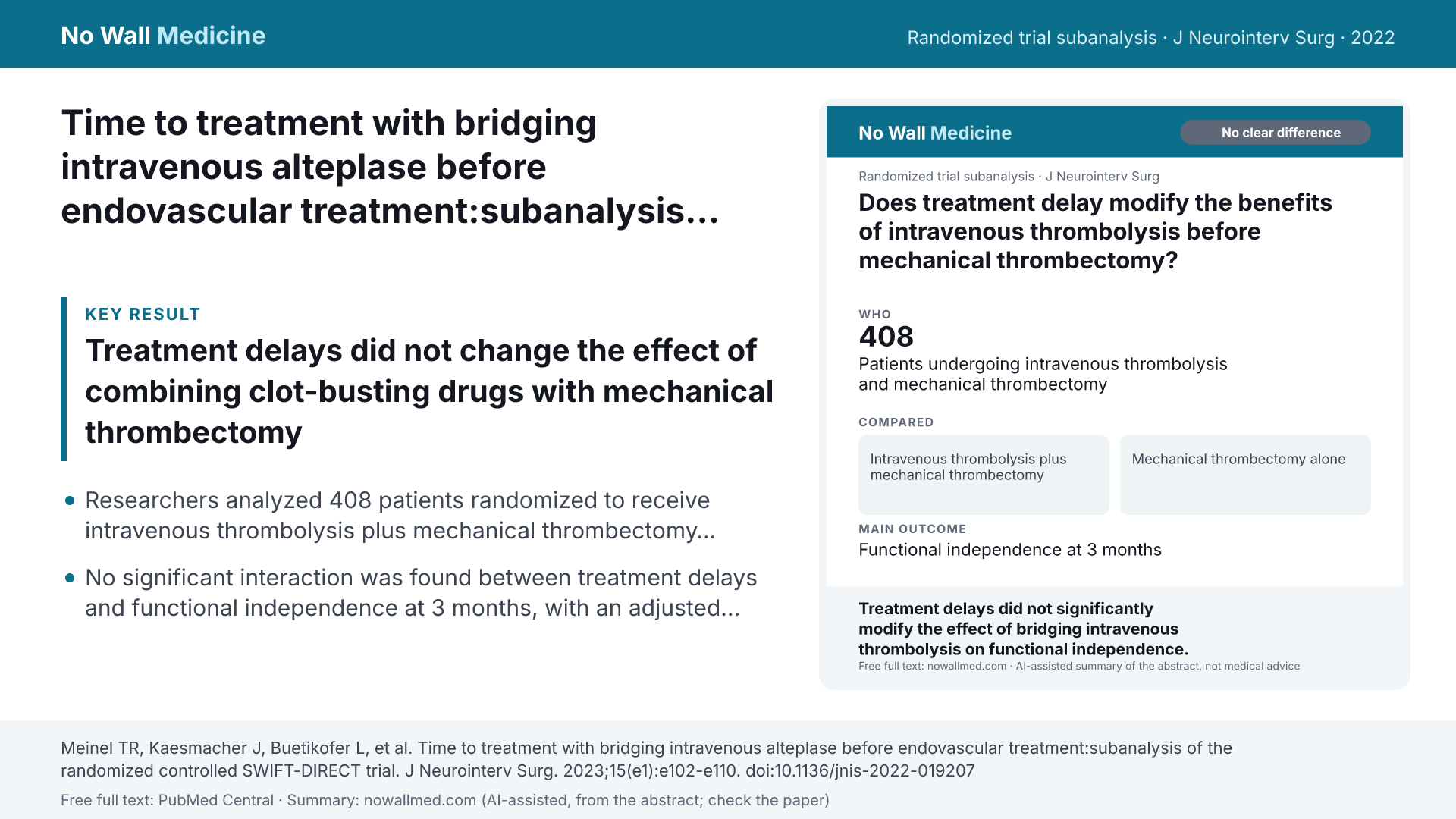
Treatment delays did not change the effect of combining clot-busting drugs with mechanical thrombectomy
Time to treatment with bridging intravenous alteplase before endovascular treatment:subanalysis of the randomized controlled SWIFT-DIRECT trial
Randomized trial subanalysisNo clear difference
Does treatment delay modify the benefits of intravenous thrombolysis before mechanical thrombectomy?
Who
408
Patients undergoing intravenous thrombolysis and mechanical thrombectomy
Compared
Intravenous thrombolysis plus mechanical thrombectomy
Mechanical thrombectomy alone
Main outcome
Functional independence at 3 months
Result: adjusted odds ratio 0.76 (95% CI 0.45 to 1.30)
Bottom line: Treatment delays did not significantly modify the effect of bridging intravenous thrombolysis on functional independence.
J Neurointerv Surg · 2022-07-28Download image
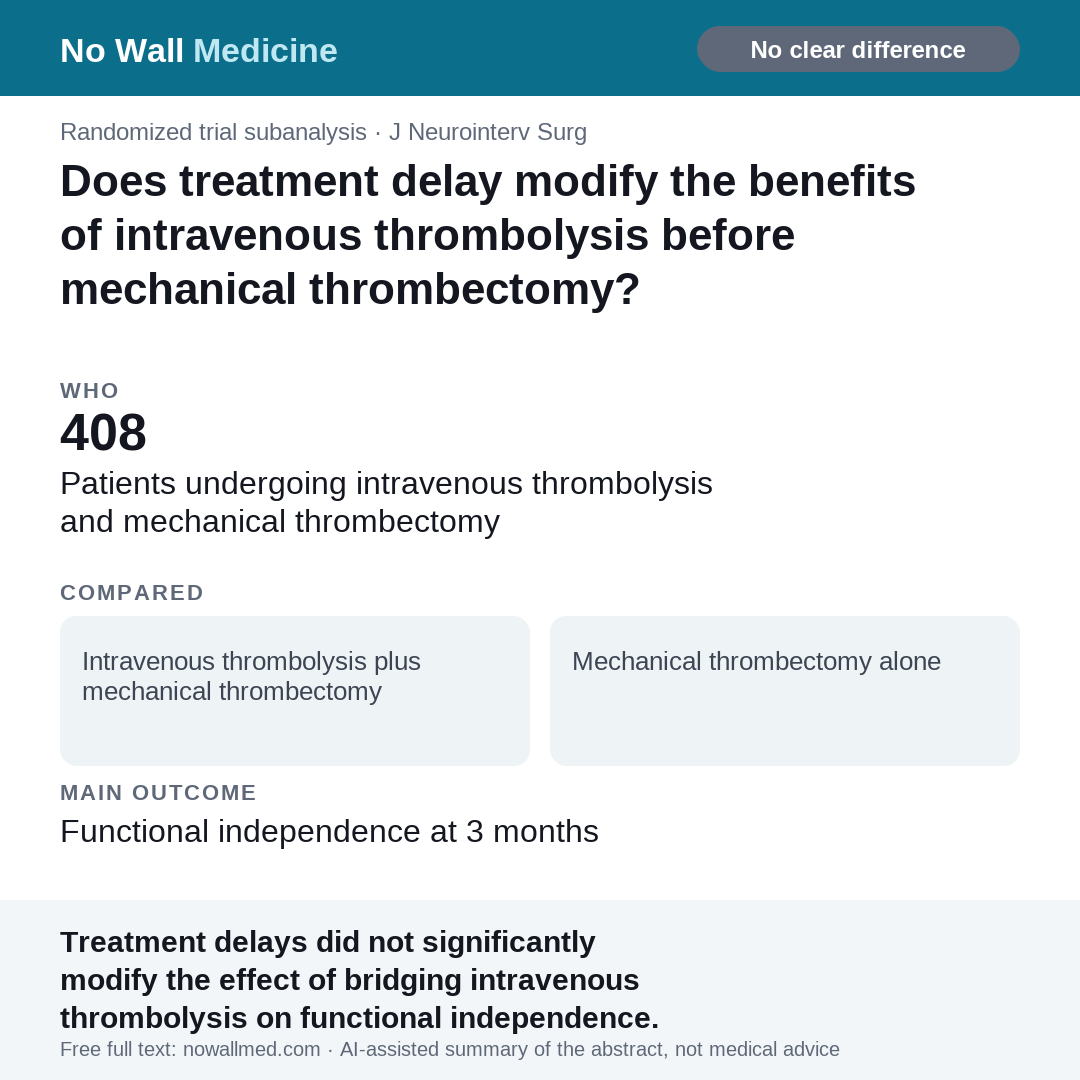
Clinical question: Does treatment delay modify the benefits of intravenous thrombolysis before mechanical thrombectomy?
Key points
- Researchers analyzed 408 patients randomized to receive intravenous thrombolysis plus mechanical thrombectomy or mechanical thrombectomy alone for stroke.
- No significant interaction was found between treatment delays and functional independence at 3 months, with an adjusted odds ratio of 0.76 (95% CI 0.45 to 1.30).
- Secondary analyses suggested a potentially favorable effect of intravenous thrombolysis when in-hospital delays were short.
Limitation the authors note: The authors state that the low power of this subgroup analysis could have missed a clinically important effect.
Headline and key points written with AI from the paper’s abstract, with every number checked against it. Read the paper before relying on them.
Was this summary helpful?
Abstract
Background
We hypothesized that treatment delays might be an effect modifier regarding risks and benefits of intravenous thrombolysis (IVT) before mechanical thrombectomy (MT). Methods
We used the dataset of the SWIFT-DIRECT trial, which randomized 408 patients to IVT+MT or MT alone. Potential interactions between assignment to IVT+MT and expected time from onset-to-needle (OTN) as well as expected time from door-to-needle (DTN) were included in regression models. The primary outcome was functional independence (modified Rankin Scale (mRS) 0-2) at 3 months. Secondary outcomes included mRS shift, mortality, recanalization rates, and (symptomatic) intracranial hemorrhage at 24 hours. Results
We included 408 patients (IVT+MT 207, MT 201, median age 72 years (IQR 64-81), 209 (51.2%) female). The expected median OTN and DTN were 142 min and 54 min in the IVT+MT group and 129 min and 51 min in the MT alone group. Overall, there was no significant interaction between OTN and bridging IVT assignment regarding either the functional (adjusted OR (aOR) 0.76, 95% CI 0.45 to 1.30) and safety outcomes or the recanalization rates. Analysis of in-hospital delays showed no significant interaction between DTN and bridging IVT assignment regarding the dichotomized functional outcome (aOR 0.48, 95% CI 0.14 to 1.62), but the shift and mortality analyses suggested a greater benefit of IVT when in-hospital delays were short. Conclusions
We found no evidence that the effect of bridging IVT on functional independence is modified by overall or in-hospital treatment delays. Considering its low power, this subgroup analysis could have missed a clinically important effect, and exploratory analysis of secondary clinical outcomes indicated a potentially favorable effect of IVT with shorter in-hospital delays. Heterogeneity of the IVT effect size before MT should be further analyzed in individual patient meta-analysis of comparable trials. Trial registration number
URL: https://www. Clinicaltrials
gov ; Unique identifier: NCT03192332.
Abstract reproduced under the article’s CC BY licence.
Subject terms
Cite this article
Meinel TR, Kaesmacher J, Buetikofer L, et al. Time to treatment with bridging intravenous alteplase before endovascular treatment:subanalysis of the randomized controlled SWIFT-DIRECT trial. J Neurointerv Surg. 2022. doi:10.1136/jnis-2022-019207
Spotted a mistake? Suggest a correction