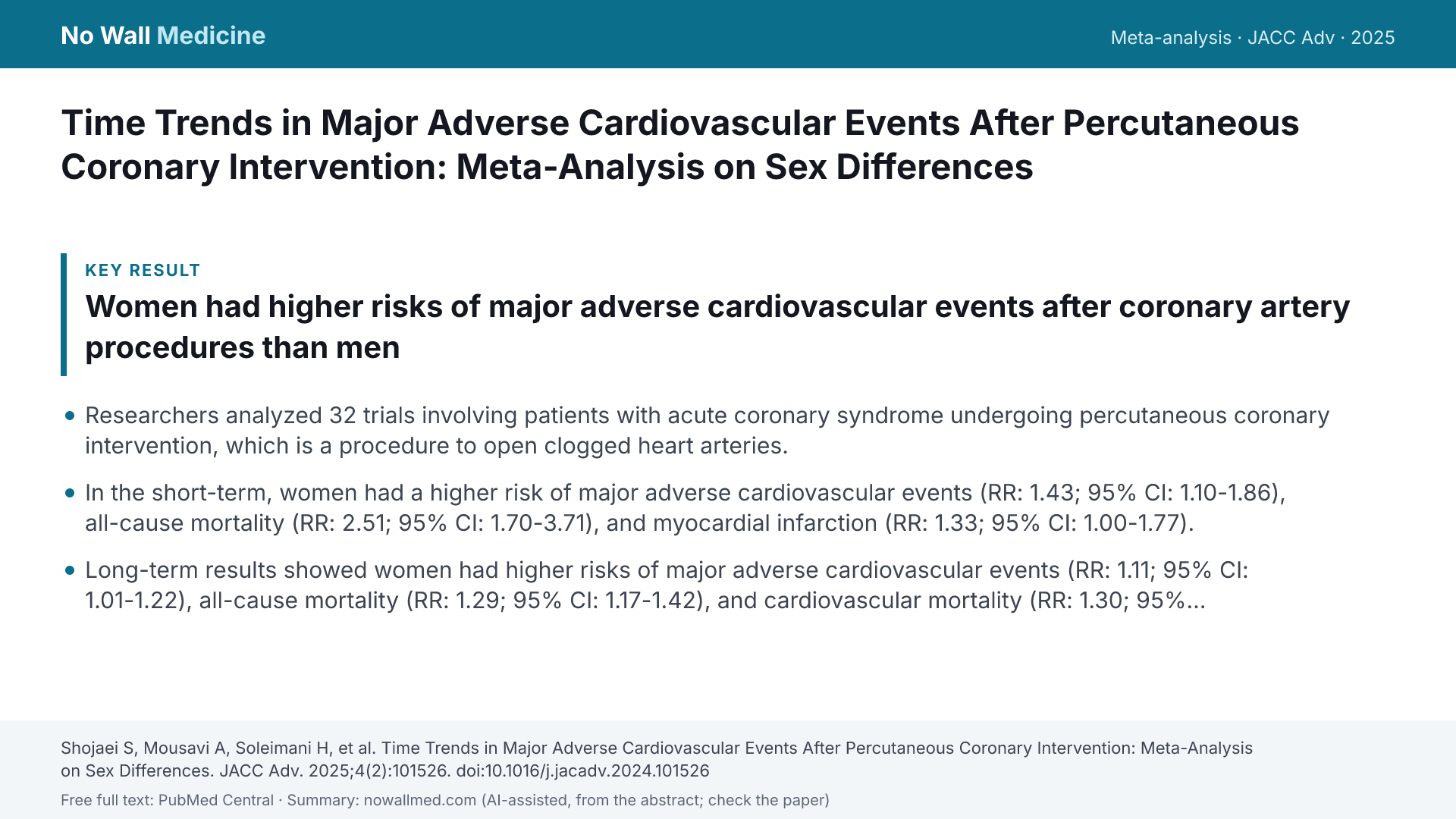
Women had higher risks of major adverse cardiovascular events after coronary artery procedures than men
Time Trends in Major Adverse Cardiovascular Events After Percutaneous Coronary Intervention: Meta-Analysis on Sex Differences
Why it matters: Conflicting results in previous studies created uncertainty regarding whether sex differences exist for cardiovascular outcomes after percutaneous coronary intervention in patients with acute coronary syndrome.
Key points
- Researchers analyzed 32 trials involving patients with acute coronary syndrome undergoing percutaneous coronary intervention, which is a procedure to open clogged heart arteries.
- In the short-term, women had a higher risk of major adverse cardiovascular events (RR: 1.43; 95% CI: 1.10-1.86), all-cause mortality (RR: 2.51; 95% CI: 1.70-3.71), and myocardial infarction (RR: 1.33; 95% CI: 1.00-1.77).
- Long-term results showed women had higher risks of major adverse cardiovascular events (RR: 1.11; 95% CI: 1.01-1.22), all-cause mortality (RR: 1.29; 95% CI: 1.17-1.42), and cardiovascular mortality (RR: 1.30; 95% CI: 1.11-1.52).
Headline and key points written with AI from the paper’s abstract, with every number checked against it. Read the paper before relying on them.
Was this summary helpful?
Headline, design, result, key points, caveat and citation as plain text.
Cite this article
Shojaei S, Mousavi A, Soleimani H, et al. Time Trends in Major Adverse Cardiovascular Events After Percutaneous Coronary Intervention: Meta-Analysis on Sex Differences. JACC Adv. 2025. doi:10.1016/j.jacadv.2024.101526
Spotted a mistake? Suggest a correction