Time-varying association between fetal death and gestational exposure to ambient fine particles: a nationwide epidemiological study of 49 million fetuses in the contiguous US from 1989 to 2004
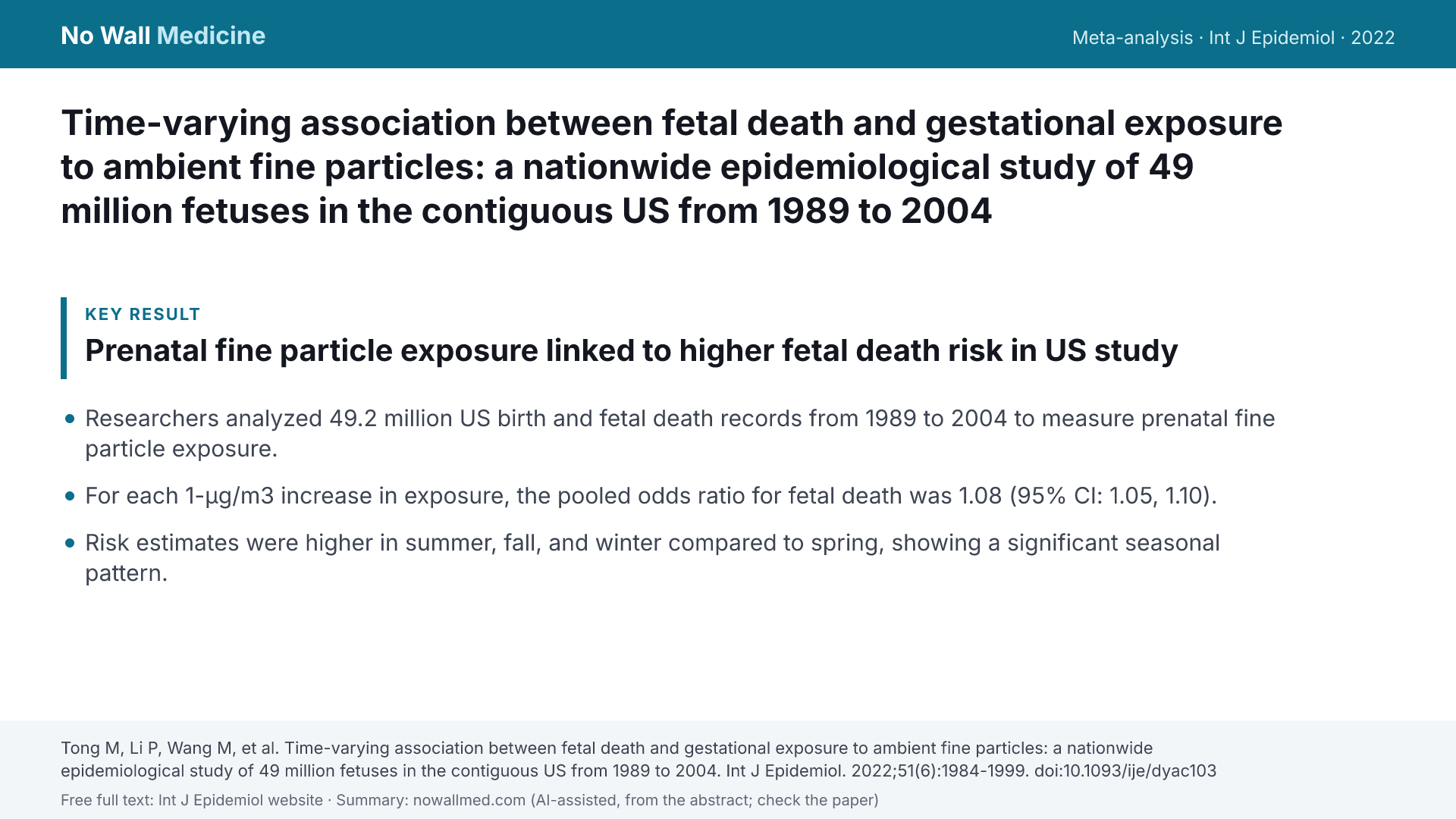
Key result: Prenatal fine particle exposure linked to higher fetal death risk in US study
Key points
- Researchers analyzed 49.2 million US birth and fetal death records from 1989 to 2004 to measure prenatal fine particle exposure.
- For each 1-µg/m3 increase in exposure, the pooled odds ratio for fetal death was 1.08 (95% CI: 1.05, 1.10).
- Risk estimates were higher in summer, fall, and winter compared to spring, showing a significant seasonal pattern.
Why it matters: Earlier studies reported non-significant links between fine particles and fetal death, leaving it unknown if the risk varies over time.
Discussion prompts
- Would these patients look like yours? Who was left out?
- Is the main outcome one that matters to patients?
- Is the difference large enough to change what you do?
Cite: Tong M, Li P, Wang M, et al. Time-varying association between fetal death and gestational exposure to ambient fine particles: a nationwide epidemiological study of 49 million fetuses in the contiguous US from 1989 to 2004. Int J Epidemiol. 2022. doi:10.1093/ije/dyac103
Free full text: Int J Epidemiol website · Summary and visual abstract: nowallmed.com/a/time-varying-association-between-fetal-death-and-gestational-exposure-i4dtt6/ (AI-assisted from the abstract; check the paper before relying on it).