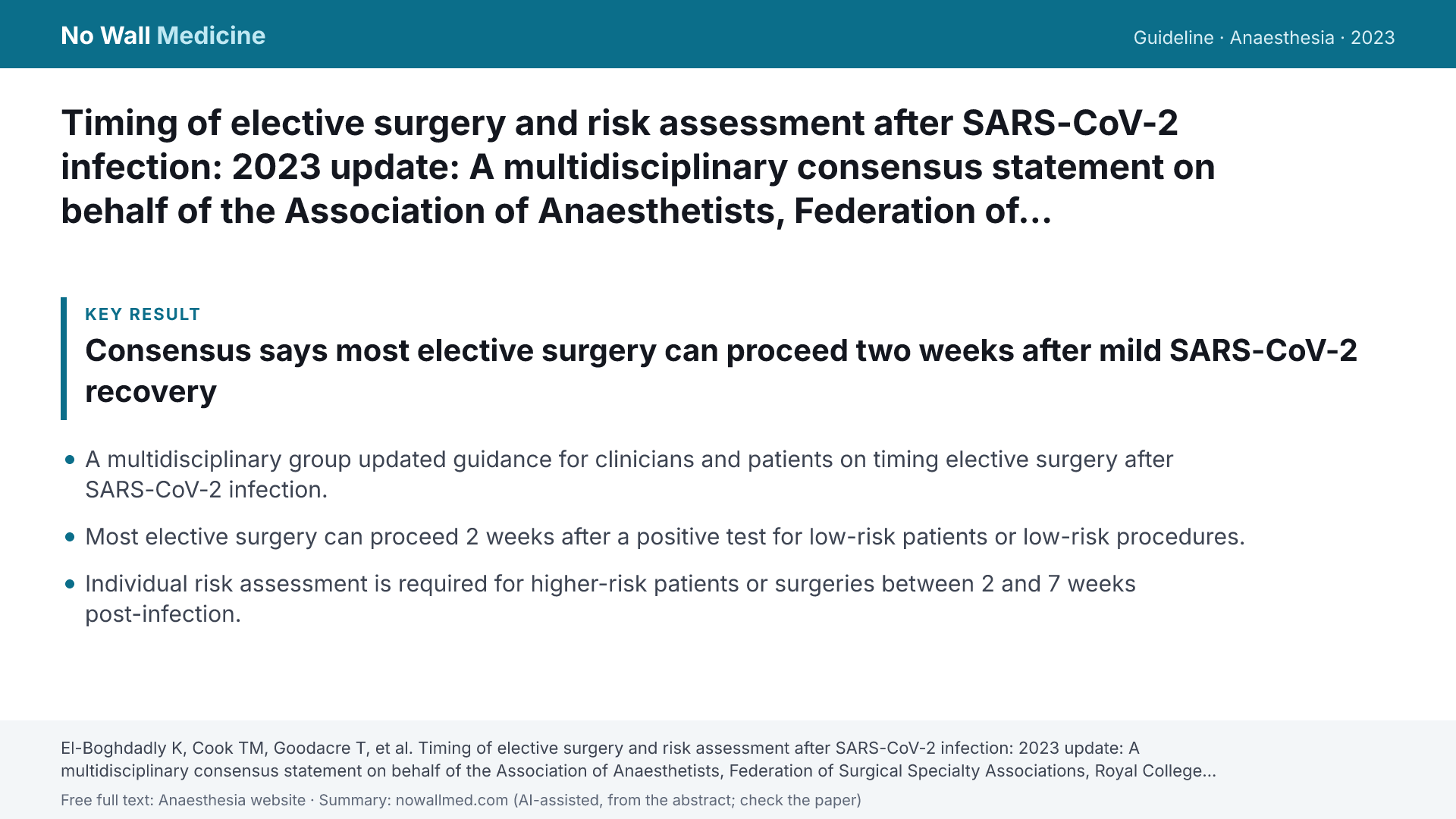
Consensus says most elective surgery can proceed two weeks after mild SARS-CoV-2 recovery
Timing of elective surgery and risk assessment after SARS-CoV-2 infection: 2023 update: A multidisciplinary consensus statement on behalf of the Association of Anaesthetists, Federation of Surgical Specialty Associations, Royal College of Anaesthetists and Royal College of Surgeons of England
No newer version found (checked 2026-11-27). PubMed lists no update or withdrawal of this guideline. Issuing bodies sometimes publish updates elsewhere, so check their website before relying on it.
Why it matters: Previous guidance needed reassessment due to widespread vaccination, less virulent variants, and the need to increase access to safe surgery.
Key points
- A multidisciplinary group updated guidance for clinicians and patients on timing elective surgery after SARS-CoV-2 infection.
- Most elective surgery can proceed 2 weeks after a positive test for low-risk patients or low-risk procedures.
- Individual risk assessment is required for higher-risk patients or surgeries between 2 and 7 weeks post-infection.
Headline and key points written with AI from the paper’s abstract, with every number checked against it. Read the paper before relying on them.
Was this summary helpful?
Subject terms
Headline, design, result, key points, caveat and citation as plain text.
Cite this article
El-Boghdadly K, Cook TM, Goodacre T, et al. Timing of elective surgery and risk assessment after SARS-CoV-2 infection: 2023 update: A multidisciplinary consensus statement on behalf of the Association of Anaesthetists, Federation of Surgical Specialty Associations, Royal College of Anaesthetists and Royal College of Surgeons of England. Anaesthesia. 2023;78(9):1147-1152. doi:10.1111/anae.16061
Spotted a mistake? Suggest a correction