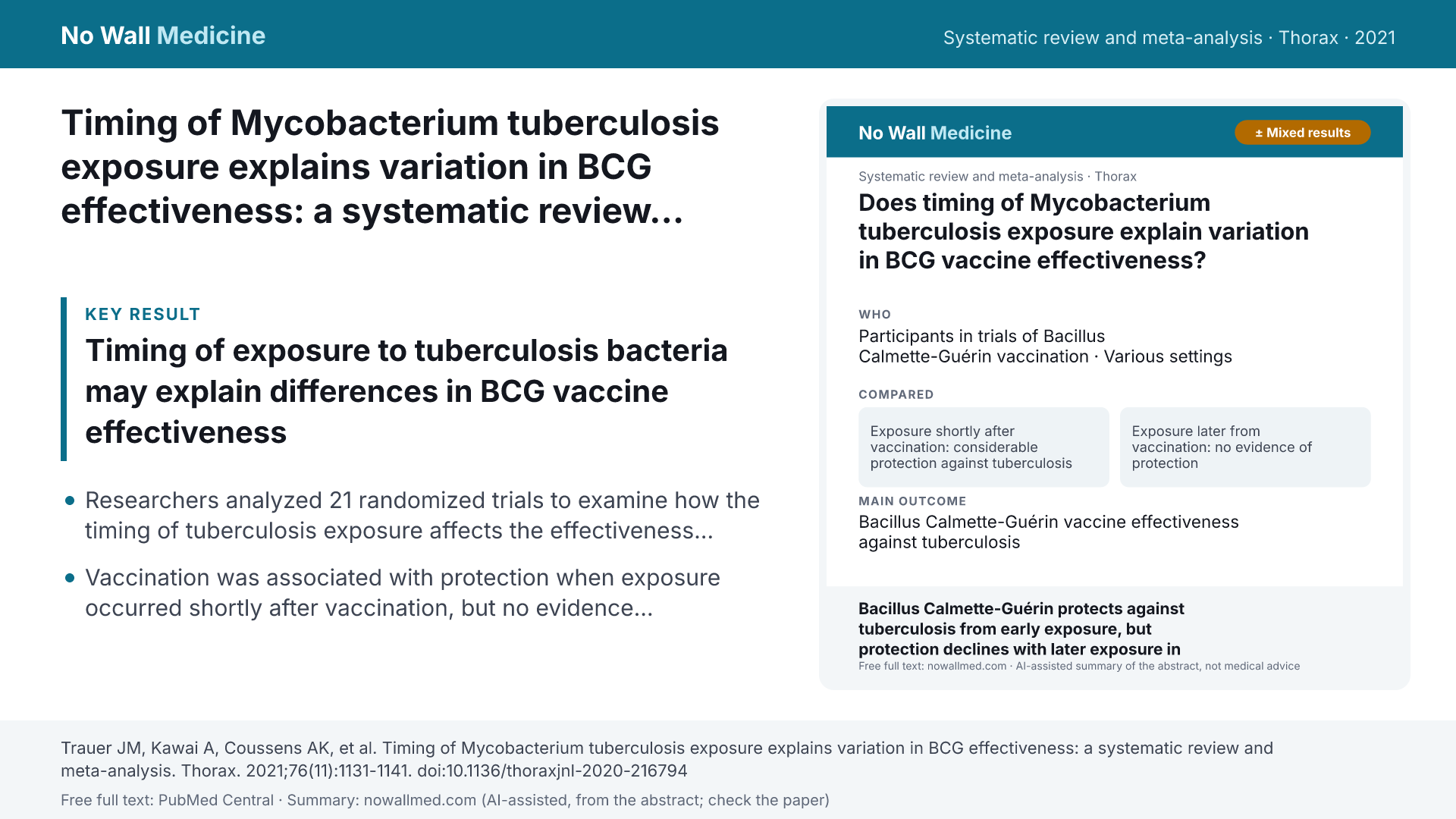
Timing of exposure to tuberculosis bacteria may explain differences in BCG vaccine effectiveness
Timing of Mycobacterium tuberculosis exposure explains variation in BCG effectiveness: a systematic review and meta-analysis
Systematic review and meta-analysisMixed results
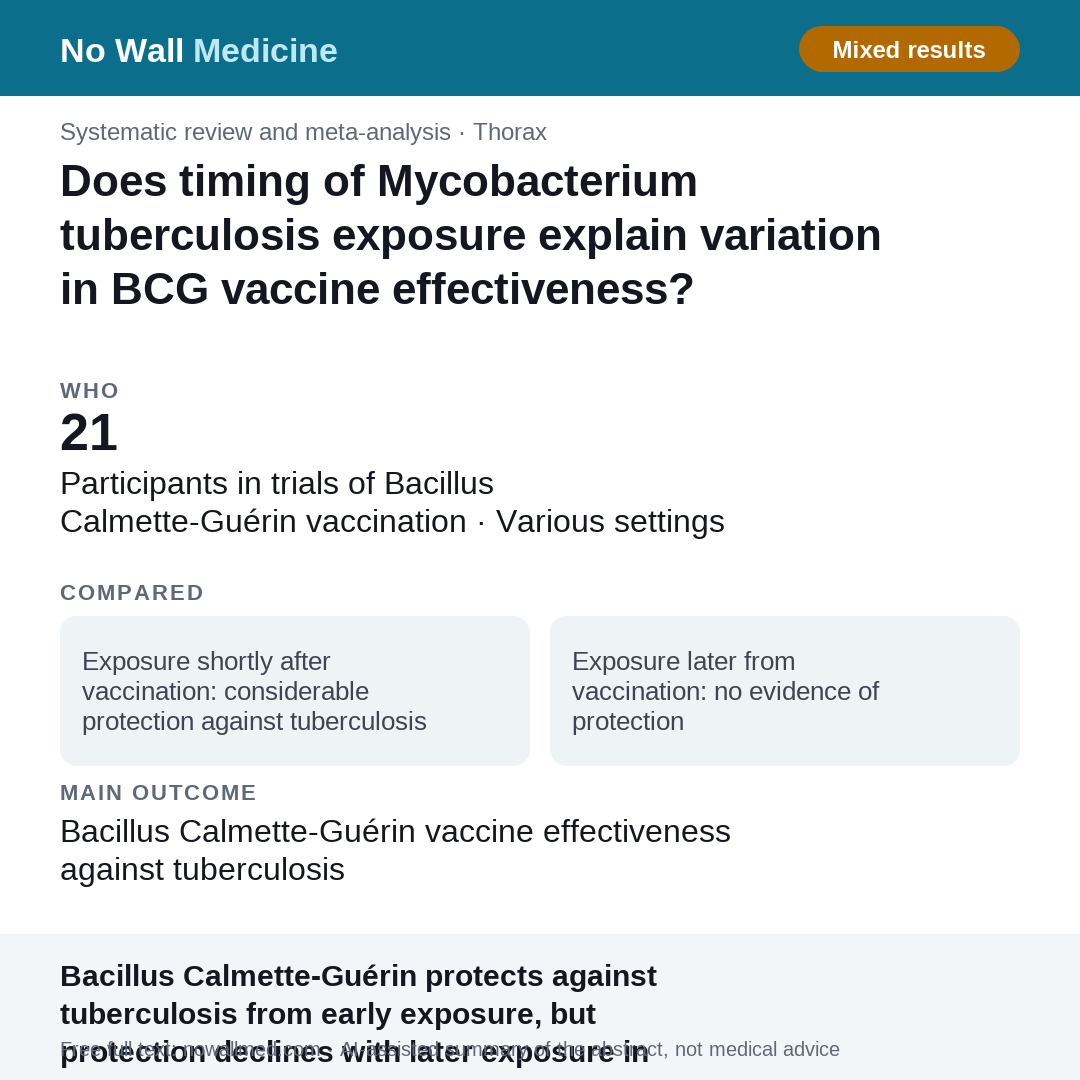
Does timing of Mycobacterium tuberculosis exposure explain variation in BCG vaccine effectiveness?
Who
21
Participants in trials of Bacillus Calmette-Guérin vaccination · Various settings including high-burden and declining burden areas
Compared
Exposure shortly after vaccination: considerable protection against tuberculosis
Exposure later from vaccination: no evidence of protection
Main outcome
Bacillus Calmette-Guérin vaccine effectiveness against tuberculosis
Bottom line: Bacillus Calmette-Guérin protects against tuberculosis from early exposure, but protection declines with later exposure in high-burden settings.
Thorax · 2021-04-23Download image
Clinical question: Does timing of Mycobacterium tuberculosis exposure explain variation in BCG vaccine effectiveness?
Why it matters: The reasons for the varying effectiveness of the BCG vaccine across different studies and locations are not fully explained by current hypotheses.
Key points
- Researchers analyzed 21 randomized trials to examine how the timing of tuberculosis exposure affects the effectiveness of the Bacillus Calmette-Guérin (BCG) vaccine.
- Vaccination was associated with protection when exposure occurred shortly after vaccination, but no evidence of protection was found when exposure occurred later.
- In high-burden settings with longer follow-up, some trials showed no protection and sometimes higher case rates in vaccinated groups than in control groups.
Headline and key points written with AI from the paper’s abstract, with every number checked against it. Read the paper before relying on them.
Was this summary helpful?
Abstract
Rationale
The heterogeneity in efficacy observed in studies of BCG vaccination is not fully explained by currently accepted hypotheses, such as latitudinal gradient in non-tuberculous mycobacteria exposure. Methods
We updated previous systematic reviews of the effectiveness of BCG vaccination to 31 December 2020. We employed an identical search strategy and inclusion/exclusion criteria to these earlier reviews, but reclassified several studies, developed an alternative classification system and considered study demography, diagnostic approach and tuberculosis (TB)-related epidemiological context. Main results
Of 21 included trials, those recruiting neonates and children aged under 5 were consistent in demonstrating considerable protection against TB for several years. Trials in high-burden settings with shorter follow-up also showed considerable protection, as did most trials in settings of declining burden with longer follow-up. However, the few trials performed in high-burden settings with longer follow-up showed no protection, sometimes with higher case rates in the vaccinated than the controls in the later follow-up period. Conclusions
The most plausible explanatory hypothesis for these results is that BCG protects against TB that results from exposure shortly after vaccination. However, we found no evidence of protection when exposure occurs later from vaccination, which would be of greater importance in trials in high-burden settings with longer follow-up. In settings of declining burden, most exposure occurs shortly following vaccination and the sustained protection observed for many years thereafter represents continued protection against this early exposure. By contrast, in settings of continued intense transmission, initial protection subsequently declines with repeated exposure to Mycobacterium tuberculosis or other pathogens.
Abstract reproduced under the article’s CC BY NC licence.
Subject terms
Cite this article
Trauer JM, Kawai A, Coussens AK, Datta M, Williams BM, McBryde ES. Timing of Mycobacterium tuberculosis exposure explains variation in BCG effectiveness: a systematic review and meta-analysis. Thorax. 2021. doi:10.1136/thoraxjnl-2020-216794
Spotted a mistake? Suggest a correction