Surgery at 6 months of age was associated with less velopharyngeal insufficiency than surgery at 12 months
Timing of Primary Surgery for Cleft Palate
Randomized trialBenefit found
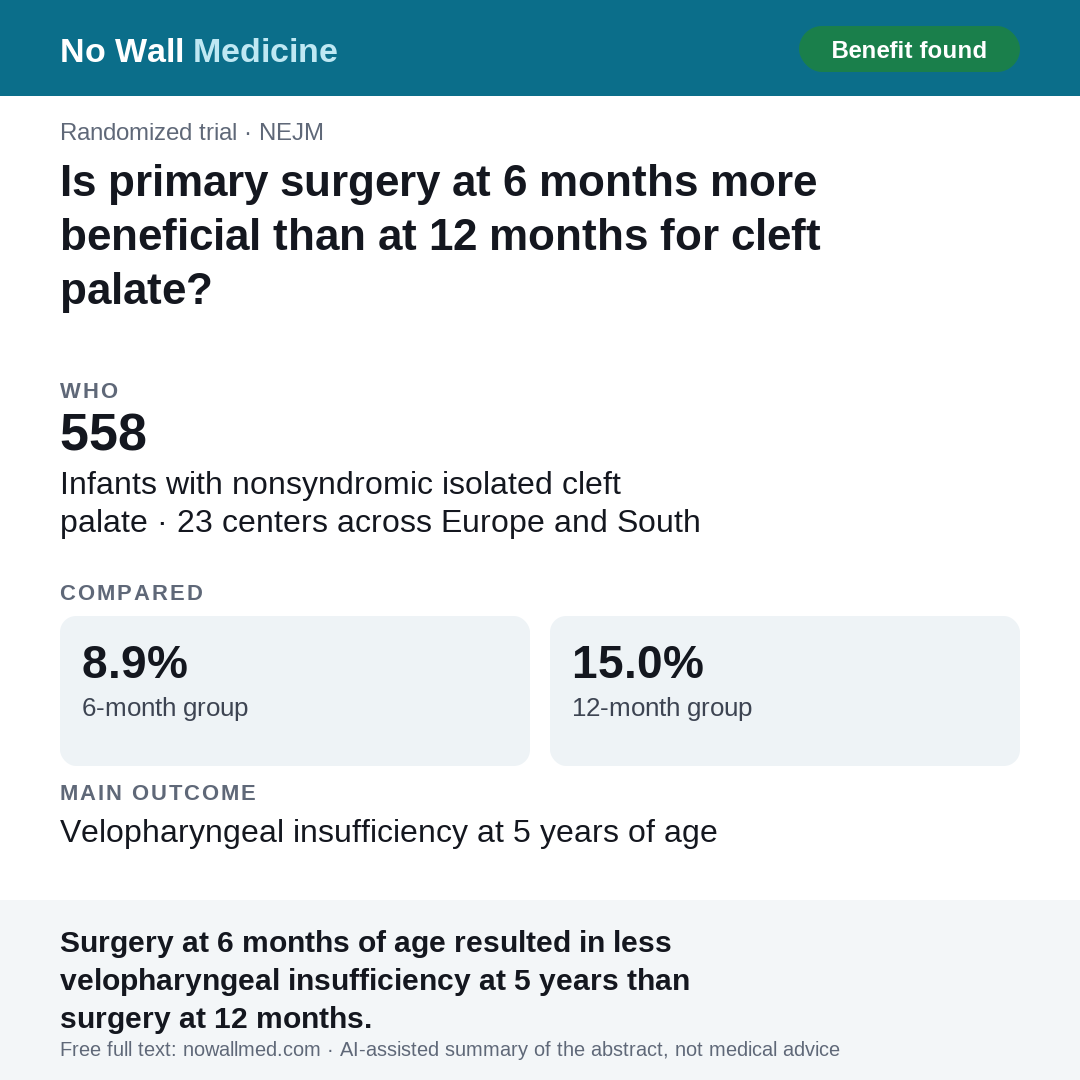
Is primary surgery at 6 months more beneficial than at 12 months for cleft palate?
Who
558
Infants with nonsyndromic isolated cleft palate · 23 centers across Europe and South America
Compared
8.9%6-month group (21/235)
15.0%12-month group (34/226)
Main outcome
Velopharyngeal insufficiency at 5 years of age
Result: risk ratio 0.59 (95% CI 0.36 to 0.99)
Bottom line: Surgery at 6 months of age resulted in less velopharyngeal insufficiency at 5 years than surgery at 12 months.
Funded by: National Institute of Dental and Craniofacial Research
NEJM · 2023-08-30Download image
Clinical question: Is primary surgery at 6 months more beneficial than at 12 months for cleft palate?
Why it matters: It is unknown if performing primary surgery for isolated cleft palate at 6 months of age is more beneficial than waiting until 12 months for speech, hearing, and development.
Key points
- Researchers randomly assigned 558 infants with isolated cleft palate to receive primary surgery at either 6 months or 12 months of age.
- At 5 years of age, 8.9% of infants in the 6-month group had insufficient velopharyngeal function compared to 15.0% in the 12-month group.
- Postoperative complications were infrequent and similar between the two groups, with four serious adverse events reported that resolved by follow-up.
Headline and key points written with AI from the paper’s abstract, with every number checked against it. Read the paper before relying on them.
Topics
Cite this article
Gamble C, Persson C, Willadsen E, Albery L, Soegaard Andersen H, Zattoni Antoneli M. Timing of Primary Surgery for Cleft Palate. NEJM. 2023. doi:10.1056/NEJMoa2215162
Spotted a mistake? Suggest a correction