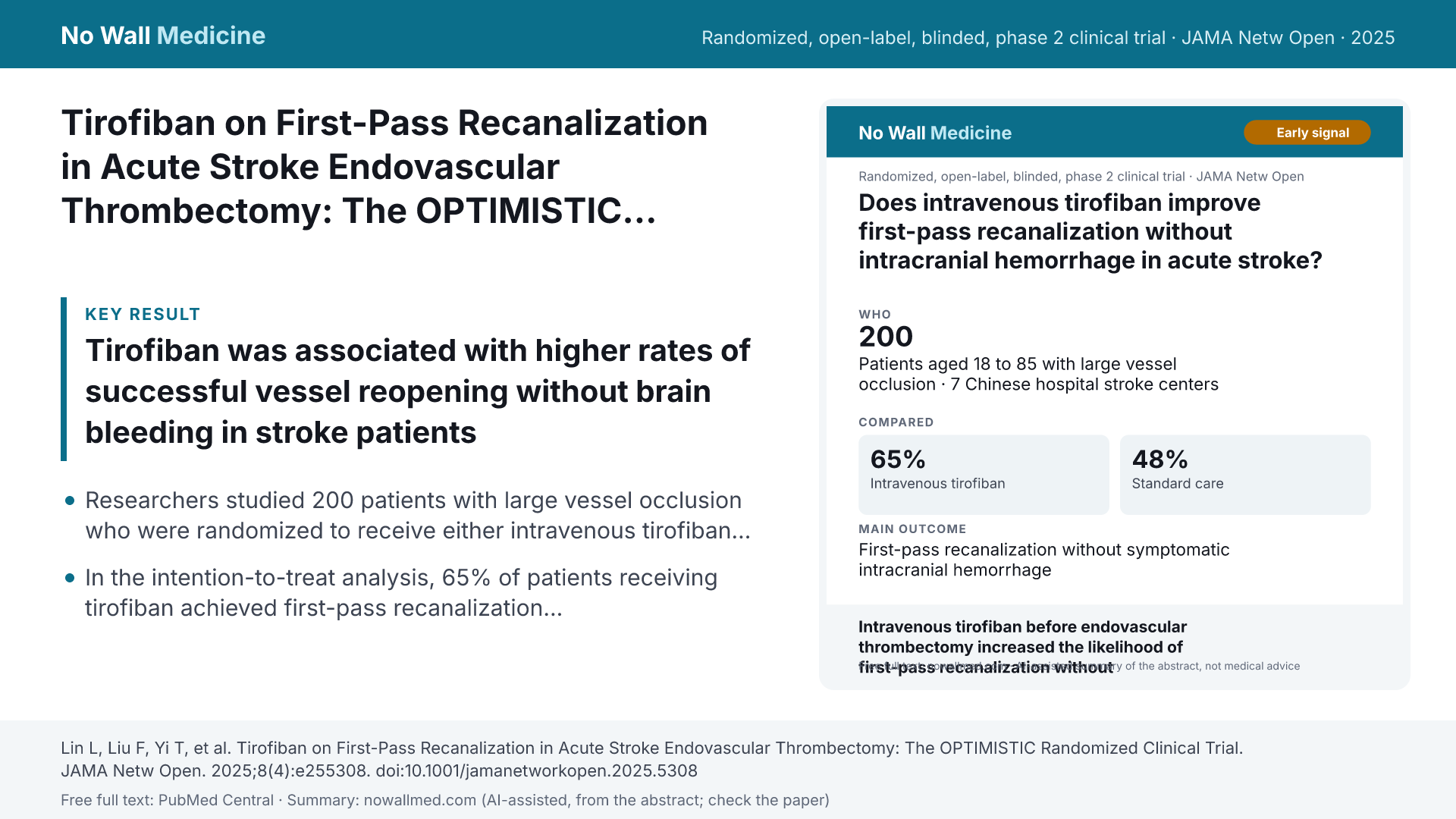
Tirofiban was associated with higher rates of successful vessel reopening without brain bleeding in stroke patients
Tirofiban on First-Pass Recanalization in Acute Stroke Endovascular Thrombectomy: The OPTIMISTIC Randomized Clinical Trial
Randomized, open-label, blinded, phase 2 clinical trialEarly signal
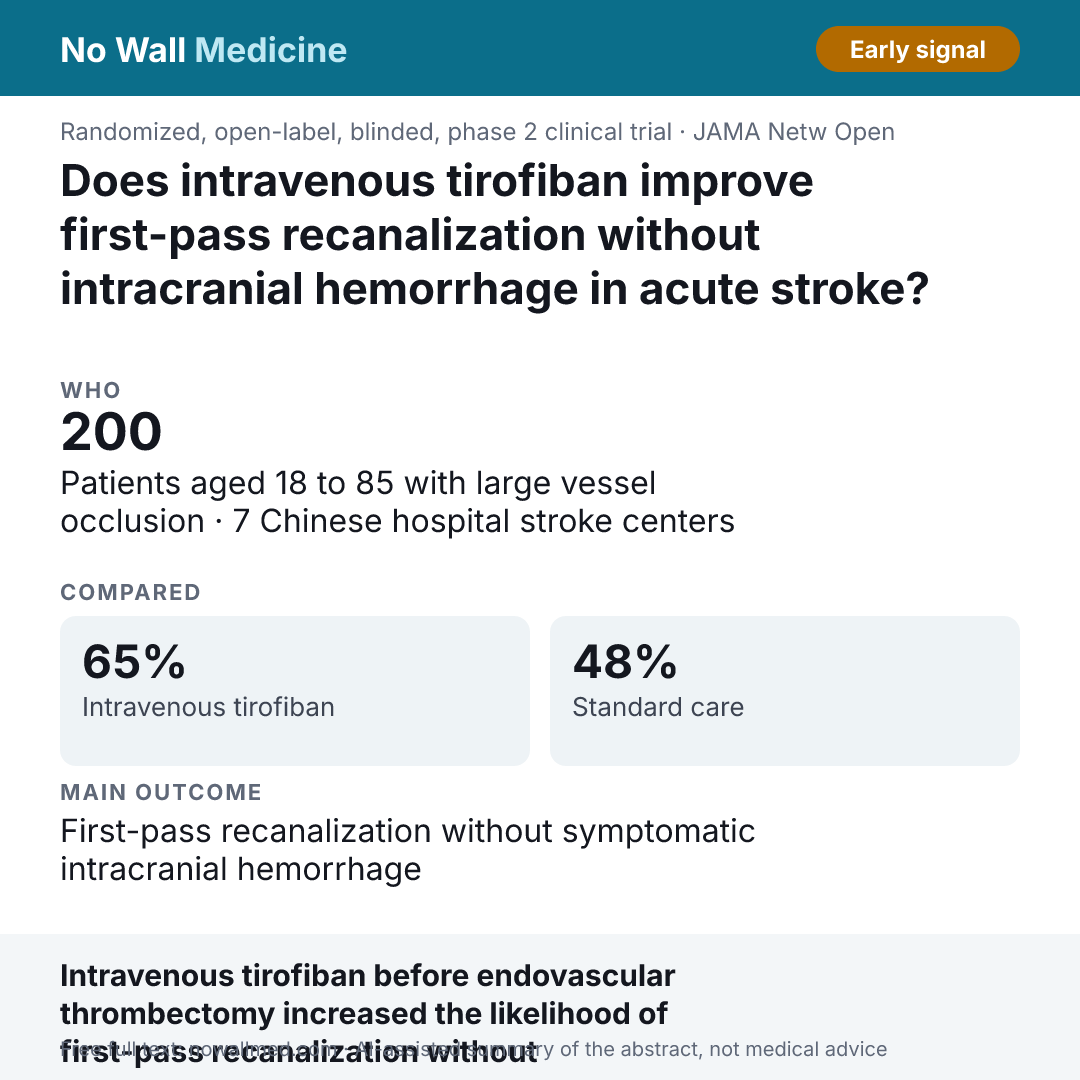
Does intravenous tirofiban improve first-pass recanalization without intracranial hemorrhage in acute stroke?
Who
200
Patients aged 18 to 85 with large vessel occlusion · 7 Chinese hospital stroke centers
Compared
65%Intravenous tirofiban (64/99)
48%Standard care (46/95)
Main outcome
First-pass recanalization without symptomatic intracranial hemorrhage
Result: adjusted risk ratio 1.34 (95% CI 1.04-1.73)
Bottom line: Intravenous tirofiban before endovascular thrombectomy increased the likelihood of first-pass recanalization without symptomatic intracranial hemorrhage.
JAMA Netw Open · 2025-04-01 · Save PNG
Clinical question: Does intravenous tirofiban improve first-pass recanalization without intracranial hemorrhage in acute stroke?
Why it matters: The role of tirofiban, a medication that prevents platelets from clumping together, is uncertain when used alongside endovascular thrombectomy for acute ischemic stroke.
Key points
- Researchers studied 200 patients with large vessel occlusion who were randomized to receive either intravenous tirofiban or standard care before mechanical clot removal.
- In the intention-to-treat analysis, 65% of patients receiving tirofiban achieved first-pass recanalization without symptomatic intracranial hemorrhage compared to 48% in the control group.
- The incidence of symptomatic intracranial hemorrhage, which is bleeding inside the skull, was 0% in the tirofiban group versus 6% in the standard care group.
Headline and key points written with AI from the paper’s abstract, with every number checked against it. Read the paper before relying on them.
Was this summary helpful?
Subject terms
Headline, design, result, key points, caveat and citation as plain text.
Cite this article
Lin L, Liu F, Yi T, et al. Tirofiban on First-Pass Recanalization in Acute Stroke Endovascular Thrombectomy: The OPTIMISTIC Randomized Clinical Trial. JAMA Netw Open. 2025;8(4):e255308. doi:10.1001/jamanetworkopen.2025.5308
Spotted a mistake? Suggest a correction